
Sri Aurobindo Ghosh (1872 – 1950) | PSIR Optional for UPSC
Sri Aurobindo Ghosh (1872 – 1950) | PSIR Optional for UPSC

Questions Asked
- Comment in 150 words: “Nationalism is not a mere political programme but a way of life like religion.” (Aurobindo Ghose) (14/10)
- Comment: Spiritual nationalism of Aurobindo Ghosh. (91/20)
- Discuss Shri Aurobindo’s views on Culture Nationalism. (16/20)
- According to Sri Aurobindo, Swaraj is a necessary condition for India to accomplish its destined goal. Comment. (150 words) (17/10)
- Comment in 150 words: Sri Aurobindo’s “idea of freedom” (13/10)
Introduction
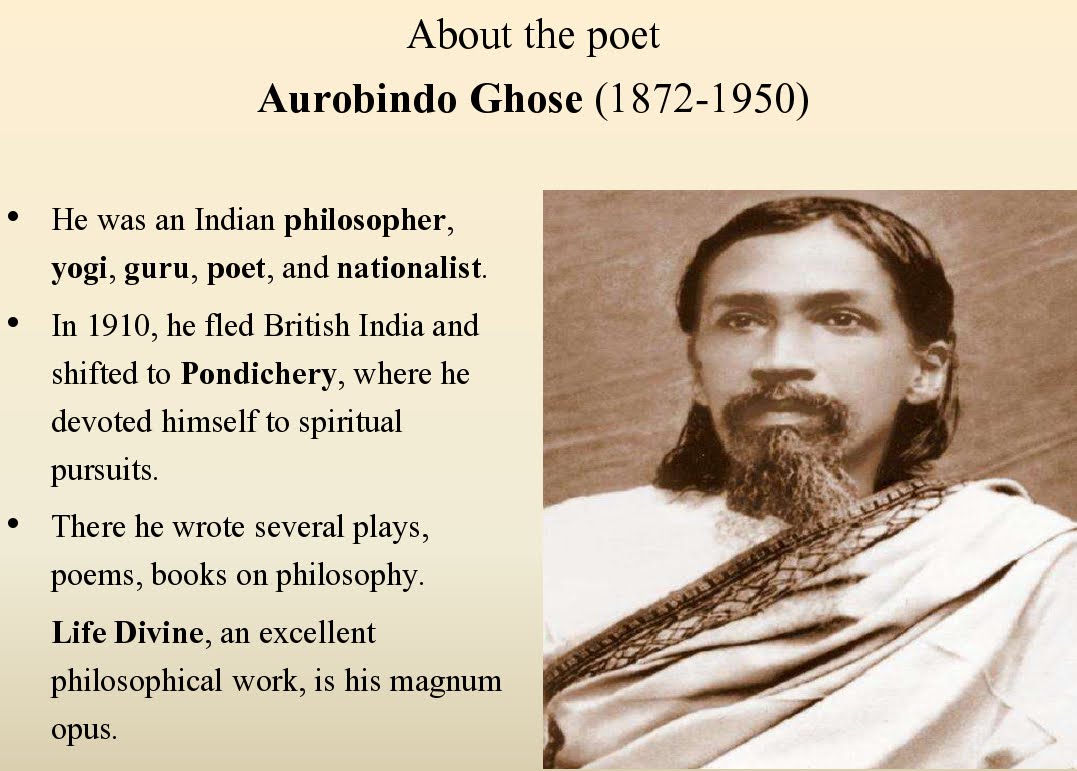
- He was a philosopher, yogi, maharishi, poet, and Indian nationalist.
- He studied for the Indian Civil Service at King's College, Cambridge.
- In 1892, he held various administrative posts in Baroda (Vadodara) and Calcutta (Kolkata).
- He began the study of Yoga and Indian languages, including classical Sanskrit.
- American philosopher Ken Wilber has called Sri Aurobindo "India's greatest modern philosopher sage".
Contribution in freedom struggle
- He joined the Indian movement for independence. Till 1910, he was one of its influential leaders.
- He was involved with the Indian National Congress and with the revolutionary movement in Bengal with Anushilan Samiti.
- Aurobindo established contact with Lokmanya Tilak and Sister Nivedita.
- In 1907 Surat split between the moderates and extremists, he went along with extremists like Bal Gangadhar Tilak.
- He influenced Subhash Chandra Bose to take an initiative of dedicating to Indian National Movement full-time. Bose writes, "The illustrious example of Arabindo Ghosh looms large before my vision".
- He was arrested after of a number of bombings (Alipore Conspiracy).
Spiritual leader
- He fled British India and found refuge in the French colony of Pondicherry and left politics for spiritual work.
- After 1910, he became a spiritual leader, and introduced his visions on human progress and spiritual evolution.
- At Pondicherry, he developed a spiritual practice Integral Yoga.
- He worked for “the evolution of human life into a divine life in divine body”.
- In 1926, with the help of Mirra Alfassa ("The Mother"), Sri Aurobindo Ashram was founded.
Literary works
- The Life Divine: It deals with the philosophical aspect of Integral Yoga.
- Synthesis of Yoga: It deals with the principles and methods of Integral Yoga.
- Savitri – A Legend and a Symbol: an epic poem.
- Bande Mataram: An English newspaper (in 1905).
- Bases of Yoga
- Bhagavad Gita and Its Message
- The Future Evolution of Man
- Rebirth and Karma
- Hour of God
- He contributed to many articles to Indu Prakash.
- He was influenced with the Western philosophy: In his writings, he seek for humanism, rationalism etc.
Sri Aurobindo on Nationalism
Introduction
- Referring to his early writings in the form of various short essays in Bande Mataram: Political writings and speeches, Sri Aurobindo has identified Nationalism as a “divinely appointed Shakti of the eternal” and the Nationalist creed as the “gospel of faith and hope” for striving towards freedom.
- Aurobindo developed the idea of spiritual nationalism which eventually took the shape of an eternal religion based on the common consciousness of individuals.
Views on Nationalism
- Nationalist movement in India according to Aurobindo was a part of that world-wide movement of early twentieth century where nations were seen feeling for their source.
- The reason for this phenomenon is that it was these nations which needed more to feel the difference between themselves and others so that they could assert and justify their individuality as against the powerful countries which tended to absorb or efface it.
- In Sri Aurobindo’s vision, the modern and free Indian nation was not meant to be a colonial copy with an outer machinery of elaborate bureaucratic structures left over by the British and now-merely-to-be-filled by the Indians – though he recognised the necessity for an effective external organisation.
- He envisioned the rebirth of a nation which will be grounded in India’s unique temperament shaped by her spiritual genius and conscious of her true mission.
- This will be a nation of people united in spirit and richly diverse in forms, eternal yet newly evolving, indigenous yet inclusive and integrative of all that continues to come from the world outside.
- Nationalism for Sri Aurobindo had a spiritual aim: to recover Indian thought, Indian character, Indian perceptions, Indian energy, Indian greatness, and to solve the problems that perplex the world in an Indian spirit and from the Indian standpoint.
Aurobindo Ghosh has also based Indian nationalism on the idea of sanatana dharma. He also held that nationalism should become the religion of the youth. We need same level of commitment towards the nation which we have for the religion.
Conclusion
- To conclude we can say that for Sri Aurobindo, India is not just a piece of land, not merely a collection of people.
- It is a conscious Spiritual Being, a Divine Power, a Shakti, Devi, Goddess.
- India is Mother India, a living form of the Divine Mother.
- India must be free from foreign control, for only then could she develop and manifest the greatness of her soul.
- ‘Love India', Sri Aurobindo urged his countrymen, 'serve her, sacrifice all for her, so that she may be free.'
Spiritual Nationalism
- The early writings of Sri Aurobindo, especially Bande Mataram provide the spiritual identity of the nation.
- Spirituals identity of Nation In his opinion was more of a concern and an emphasis on going back to the essential notion of the self.
- The self here, is a broader idea connecting the individual with the collective, not only in a metaphorical sense but also in a metonymic manner, where the quest for an individual’s “inner foundation” could be equivalent in discovering the notion of a quintessential national identity.
- According to Aurobindo, the 'nation' is a mighty 'shakti' composed of all the shaktis of all the millions of units that make up the nation. It is thus a living entity.
- Nationalism in his opinion is not merely a political movement. It is neither a political programme nor an intellectual past time.
- In his opinion, nationalism is akin to religion.
- It is a faith and a creed which one has to live.
- It is a religion which has come from God. Hence, it cannot be crushed.
- He prophesied the people to become the instrument of God who will inevitably spread nationalism to every nook and corner of India.
- Sri Aurobindo posits faith in the divinity of the motherland.
- His message of spiritual nationalism was that the nation is a spiritual power; just like the goddess and nationalism is a spiritual imperative.
- It has an inner imperative, because it is only possible through fulfill of one's own ‘Dharma’ (duty) and also to sacrifice him.
- Aurobindo, upholds Hinduism in its own right as the greatest of all religions.
Culture Nationalism
- According to J.G. Herder Nations can be on the basis of pre-existing cultures, and almost always ideologically expressed in terms of some myths.
- Sri Aurobindo while expounding his philosophy of Indian Nationalism which is at the same time the philosophy of patriotism transcends the customary connotation ordinarily associated with the term nationalism.
- In general parlance the term restricts its ultimate meaning to the love of the land of the country.
- Sri Aurobindo's vision, however, surpasses and outshines the hitherto conventional outlook towards nationalism.
- He postulates a far more integral and holistic philosophy of nationalism, a new brand altogether, which not only professes love for one's country, Janmabhumi, but also confirms its faith in love for the people of the land.
- Further, he expounds the love for the culture of the land which imparts the essential clement of uniqueness and thereby generates within every individual the feeling of unison borne as a result of being culturally unique.
- The basic principle underlying Sri Aurobindo's idea of nationalism is that it is imperative for real unity to manifest as inner oneness and thus help in discovery of the nation soul first and only thereafter proceed towards consolidating itself as a political unity.
- Sri Aurobindo stresses the need for a national religion based on new moral ideals that would lead to the establishment of a new national character.
- Since neither language nor racial difference is a suitable device for the creation of national solidarity, he argues that in the context of India the spread of Hinduism alone will be an effective cultural foundation of Indian nationhood.
- According to Sri Aurobindo a nation-unit is basically a manifestation of the psychological unity or of the nation soul which has the quality of abandoning of egoism both individually and collectively and also venturing to think beyond communal lineation.
- He further observes that while perfecting his own individuality "One should respect and aid and be aided by the same free development in others.
Swaraj
Introduction
- Sri Aurobindo prescribes for a Nationalist to show deep concern in four areas: first Swadeshi, second Boycott, third Swaraj and the last one is National Education.
- He considers Swaraj for a nation as the breath of life.
- It implies that swaraj is the first and foremost condition for existence of a sovereign Nation without which goals of Nations and their citizens cannot be fulfilled.
Concept
- Sri Aurobindo explains that the idea of total Swaraj does not limit itself to mere political freedom; rather it embraces social and spiritual emancipation.
- He declares assertively that God has set apart India as the “eternal fountain of holy spirit, so He will never allow that holy fountain to run dry.”
- India's liberation from foreign domination was the final goal for Aurobindo.
- Sri Aurobindo’s idea of Swaraj was a Dharma-based system. He was mindful and appreciative of the Western concepts of freedom, democracy, and equality that has swept through much of the world.
- He was, however, skeptical of their ‘hues of the West’.
- 'Swaraj', i.e., self-rule by Indians was not merely of economic and political nature. It was necessary for India to perform its spiritual mission dedicated to the upliftment of humanity.
- He advocated independence for India for the following reasons: Liberty being the first indispensable condition of rational development-intellectual, moral, individual and political-is in itself a necessity of national life. Hence it was worth striving for its own sake.
Conclusion
To conclude we can say that Sri Aurobindo was not only redefining the individual’s commitment to integral consciousness of the self but was also incorporating the ideas of swaraj as the foundation of inner sovereignty of a nation that is to be newly imagined and established in communion with the world.
Sri Aurobindo on Freedom
- For Aurobindo Freedom is supreme value. Freedom cannot be compromised.
- Freedom is essential for both – individual as well as nation.
- In the words of Aurobindo, ‘craving for freedom is lodged so deep in human heart that even thousands of arguments are powerless to disapprove it.’
- Aurobindo analyzed existing concepts of freedom.
- According to him, liberal/anarchic view of freedom is mechanical, it ignores the importance of society.
- Liberty should not be seen as a device to satisfy only one’s own impulses without taking into consideration the impulses of others.
- According to him, freedom is ‘obeying the law of our existence’.
- We are humans, we should not live like animals. We should live in harmony with others including environment.
- The real freedom is inner freedom.
- The real power is spiritual power.
- It is power to grow, it is power to move towards perfection. It is power to move towards the perfection of our nature.
- Freedom is not just the fulfillment of mental or physical needs, freedom is flowering of divine within us.
- For attainment of freedom, he developed the idea of a broad-based organization that could channelize the entire power of the country to free it from foreign rule.
- Thus, his insistence on enthusing the masses with the spirit of independence was one of the first efforts to give a mass character to the freedom movement. His objective was to mobilize the masses against the foreign rule.
Thinkers views on Aurobindo
- Rabindranath Tagore: Tagore greatly admired Sri Aurobindo and saw him as a visionary and spiritual leader. He appreciated Aurobindo's emphasis on spirituality and the integration of spiritual consciousness with social and political life. Tagore painted him as the "Messiah of Indian Culture and Civilisation".
- CR Das called Aurobindo the 'poet of patriotism, the prophet of nationalism and the lover of humanity."
- Mahatma Gandhi: While Gandhi acknowledged Aurobindo's intellectual and spiritual depth, he disagreed with Aurobindo's advocacy of political violence during the Indian independence movement. Nevertheless, Gandhi recognized Aurobindo's contribution to Indian thought and spirituality.
- Andrew Cohen: Cohen, an American spiritual teacher, has drawn inspiration from Sri Aurobindo's ideas on evolutionary spirituality. He sees Aurobindo's teachings as a valuable resource for individuals seeking personal and collective transformation.
Criticisms
- Some critics argue that Sri Aurobindo's philosophy can be challenging to comprehend and apply due to its complex and abstract nature. Others criticize certain aspects of his political views and his support for violent means during the Indian independence movement.
Contemporary Implications
- In the progress towards the ideals of internationalism, individual is today witnessing an identity crisis as now the individual is not regarded anymore as the fundamental unit of humanity but only minute part whose existence is subordinated to the common aims and interests of the organised society.
- This would result in piece-meal growth of internationalism as it would lead to uniformity and not a true union which has respect for individuality and diversity.
- Aurobindo's philosophy of nationalism logically begins from the basic unit- the individual.
- This notion holds universal applicability transcending the barrier of time and age and the resultant differences in political, social and economic conditions of that particular period.
- In the first instance if the idea of inner oneness, as given by Aurobindo, is nurtured in its right spirit it would provide the right impetus in the right direction for the harmonious and holistic progression towards the goal of world union.
- At the same time it would also help in realising the necessity of maintaining the much stressed individuality while progressing towards an ever growing collectivity.
- If his thought of perfecting individuality is applied in its true essence to the contemporary period, it will not only further the case of globalisation but can also help in effacing, to a large extent, the global menace that terrorism has come to assume.
Critical Evaluation
- In the context of his theory of 'spiritual nationalism', it is argued that though it is called spiritual nationalism, in reality it was religious therefore reactionary in character.
- It was an attempt to mobilize the masses on an emotional basis and detracting their attention from real issues like poverty, economic exploitation, inequality which are inimical to the progress of the individual as well as the community.
- It is argued that to regard nationalism as an instrument of spiritual perfection is too idealistic and visionary for the common person.
- To associate religion with politics, though in the name of spirituality, is a dangerous proposition in a multireligious, multicultural plural society like India.
- Aurobindo's defenders would, however, claim that his concept of nationalism and human unity were based on his understanding of the Hindu Sanatana Dharma, which to him meant an open and universal philosophy of life.