

Questions Asked
- Examine Gandhi’s critique of ‘Modernisation’. (16/15)
- Comment: Validity of the statement that most prominent among Gandhian principles are non-violence, adherence to truth and dignity of labour. (01/20)
- Comment: Gandhi’s concept of Truth and Non-violence. Why was he opposed to modern civilisation? (03/20)
- Comment: The true source of right is duty. If we all discharge our duties, rights will not be far to seek.” (M. K. Gandhi) (02/20)
- Comment in 150 words: Gandhi’s Views on state (15/10)
- Explain Gandhi’s ideas regarding State and highlight their relationship with modern democracy and principles of anarchism. (06/60)
- Comment: “Real rights are a result of performance of duty”. (Mahatma Gandhi) (08/20)
- Examine the Gandhian idea of village community as an ideal unit of self-governances. (12/20)
- Comment: M.K. Gandhi's concept of Swaraj (19/10)
Introduction
- Gandhi cannot be regarded as a political philosopher in the conventional sense of the term.
- Gandhi is rightly regarded as father of Indian nationalism.
- It was under Gandhi that the national movement became mass movement.
- Gandhi denied the existence of Gandhism. However Gandhism cannot be denied because there are many persons who consider themselves as Gandhian.
- Gandhism is not merely a political creed, it is a message.
- His philosophy wants to bring about a transformation in human life by the supremacy of self-suffering love.
- He stressed peace, modesty, gentleness and a sense of devout respect for the religious views of others.
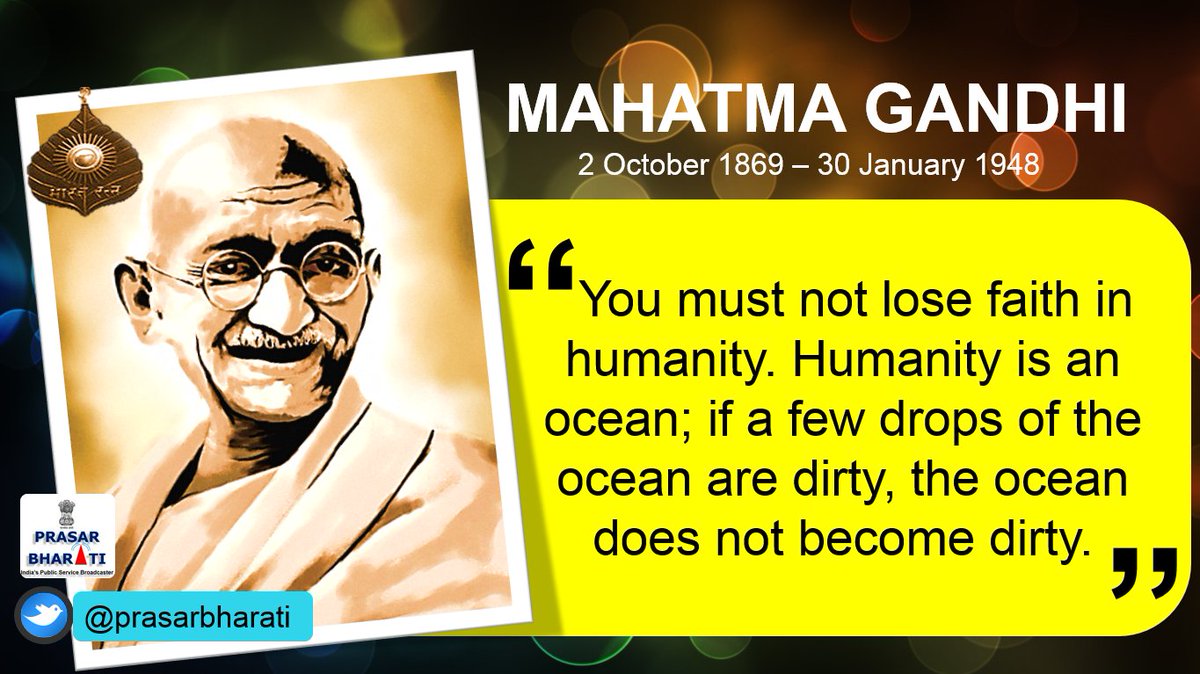
Views About Gandhi
- According to survey of Times magazine, Gandhi is the second most loved personality after Jesus Christ.
- According to professor Humayun Kabir, Gandhi was not a philosopher but a strategist. More than a philosopher, he was psychologist. He understood the mass psychology. Hence Gandhi emerged as the most successful mass leader.
- Gandhi was a political actionist and a practical philosopher; he was not a theorist. (Bondurant, 1967,
Gandhi’s Modern Indian Political Thought
Major Pillars of Modern Indian political thought according to Gandhism are:
- Decentralisation: Gandhiji had envisioned for independent India a policy that would be based on the principle of democratic self-government or self-rule. Democracy can function smoothly and according to the concept of swaraj only if it is decentralised. According to him, ‘centralisation as a system is inconsistent with non- violent structure of society.’ He wanted the centre of power to move from cities to villages.
- Trusteeship: The main thrust is on treating resources as a public trust with a man being the trustee, so that the riches of nature and society are equitably used. The theory was intended to combine the advantages of both capitalism and communism, and to socialise property without nationalizing it.
- Non-Violent State: Gandhian concept of ideal state or society was a non-violent and stateless society. He repudiated state on ethical, historical and economic grounds. Gandhian conception of ideal state was a non-violent democratic state where social life would remain self-regulated.
- Universal Brotherhood: He believed in egalitarianism, fraternity, and communal unity between diverse ethnic and social groups.
Gandhi’s idea of Modernity
- “Indian civilization is the best and that the European is a nine days' wonder.” – M.K. GANDHI
- In Gandhiji's own words Hind Swaraj 'is a severe condemnation of modern civilization'.
- Gandhiji's negative opinion about modern civilization extended to all its aspects.
- Modern technology, machine being the fundamental constituting unit of it; and Western social institutions, particularly those pertaining to law and medicine, came in for the most severe criticism.
- He denounces Western materialism and modern technology like the railways, the telegraph, the telephone and heavy industries.
- He categorically rejects all the major components of the modern industrial civilisation.
- Gandhi considers the advent of technology and industrialisation as the basic cause of human misery in modern society.
- This view crystallises during the process of industrialisation in South Africa.
- He hails the immense increase in productivity and consequent rise in standards of living in the West but he denies that industrialisation, in its current form, advanced human civilisation and its well-being and happiness.
Idea of Modernity for Gandhi
- Gandhi realized that the factory civilization, which is the hall mark of modern civilization, in fact, reduces the value of the human being.
- Gandhi, thus, had a fundamental objection to industrialization as it widens the gap between the rich and the poor and industrialization breeds hatred and alienation.
- Gandhi was also opposed to industrialization as it would contribute to the growth of cities and destruction of harmonious life in the rural surroundings.
- In the cities slums and shanties are invariable. In cities and towns, the inequalities are much more glaring and the exploitation would go unabated.
- Gandhi’s Conception of civilization is not rights based; duty based.
- “Civilization is that mode of conduct which points out to man the path of duty.”
- Where there is no poverty that is happiness; where there is no discrimination that is happiness; where people have contentment that is happiness. In other words,
- Gandhi was concerned with the improvement of quality of life rather than quantitative development.
- Gandhi came to the conclusion that Western Civilization was based on brute force.
- Gandhi opined that even for the West, modernization is evil, and in the case of India and the Orient, it is worse.
- Gandhi saw colonialism as the fruit of modern civilization.
- For Gandhi Morality is far superior to any constitution or positive law.
Real purpose of Gandhi’s critique of modern civilization
- We can consider it as a part of Gandhi’s ‘war of position’, an attempt to build counter hegemony. Gandhi’s critique questions the legitimacy of ‘civilising mission’ and ‘white man’s burden’.
- Gandhi has discussed the critique of modern civilisation in his book Hind Swaraj.
- In Hind Swaraj he has given ‘blue print for the future path of development to be adopted by India’.
Gandhian Principles
- “My life is my message” – Mahatma Gandhi
- Mahatma Gandhi always believed that “An ounce of practice is worth more than tons of preaching”.
- He propounded eleven principles or eleven vows which are known as ‘ekadash vratas ' namely :
- Sataya or Truth, Ahimsa or nonviolence, Brahmacharya or celibacy, Asteya or non stealing, Aparigraha or nonpossession, Sharirshrama or bread labour, Aswada or control of palate, Sarvatra Bhayavarjana or fearlessness, Sarva Dharma sambhav or equality of religions, Swadeshi or use of locally made goods, and Sparshbhavna or untouchability.
- All these eleven vows of Gandhi are evergreen and will find their relevance in every timeframe.
- Aparigraha shows the mirror to consumers in the era of capitalism and market driven crazy consumerism.
- Aswada finds its place in generating healthy food habits among individuals, sarvatra bhayavarjana worked as a miraculous mantra to impart will power in Corona pandemic times.
- Sharirshrama reminds individuals of dignity of labour and importance of physical activities in daily lives.
- Brahmacharya, asteya, sarvadharma sambhav, sparshbhavna are moral directives to each and every citizen of the nation.
- The current stand of ' vocal for local ' and ‘make in India’ are actually derived from the idea of swadeshi.
- Understanding the dignity of labour makes it possible for fair treatment of every individual irrespective of his nature of work, even sometimes the government makes efforts that one should learn dignity of labour.
- Global peace, sustainable development, public order, fraternity and healthy trans-border relationships can only be possible when there lies nonviolence.
- In fact, international treaties, agreements and memorandum of understanding signed between nations are solely based on adherence to truth.
Rights and Duties
- Gandhiji was a champion for advocating the importance of performing our duties as citizens in overall national development.
- Gandhiji firmly believed in the philosophy that the true source of rights is duties, and if we all discharge our duties, then rights will not be far to seek.
- Gandhi neither sacrifices individual for the sake of society nor sacrifices society for the sake of individual. Like Aurobindo, Gandhi looks for balance.
- The balance between rights and duties, the balance between individual and society.
- Gandhi is inspired by the philosophy of Nishkama Karma found in Geeta.
- Geeta suggest to perform your duty and when we perform our duty, we automatically get our rights.
- Rights and duties are neither antithetical nor independent of each other. When we fulfill our obligations, we automatically get the rights.
- Thus Gandhi’s theory of rights comes near to Laski’s theory of rights and duties.
- Gandhi suggested that if instead of insisting on rights everyone does his duty, there will immediately be the rule of order established among mankind.
- Rights that do not flow directly from duty well performed are not worth having.
Gandhi’s idea of State
Introduction
- The state, for Gandhi, represents violence in its concentrated form but is necessary since human beings are social by nature and as such morally incapable of acting in a socially responsible manner.
- He desires a state that would employ as little violence and coercion as possible and wanted individual actions to be regulated by voluntary efforts as far as possible.
- He advocates limited state sovereignty for there is an obligation higher than mere politics.
- His position is strengthened by his faith in individual personality evident from his remark: “If the individual ceases to count, what is left of society”.
Idea of state for Gandhi
- He desires the establishment of a society in which the state exists outside the daily life of the common man.
- The ideal society would be a decentralised one giving ample scope for self-development.
- Gandhiji believes that the state would not accept individual differences and diversity of opinions and attitudes.
- It would become ‘Hostile to strong and independent – minded citizens groups and community lest they should become centers of independent initiative and dissent.
- Political power, for Gandhi, is “the capacity to regulate material life through national representatives.
- If national life becomes so perfect as to become self-regulated, no representation becomes necessary.
- There is then a state of enlightened anarchy. In such a state everyone is his own ruler. He rules himself in such a manner that he is never a hindrance to his neighbor.
- In the ideal state, therefore, there is no political power because there is no state”.
- Gandhi provides a framework for a participatory, functional and development state with maximum inclusion and minimum exclusion.
- He does not defend the all-powerful leviathan and like Thoreau, desired a government that governs the least; not in the sense of having a night watchman state but a fully functional one with rough parity and active citizenry.
Principles of Anarchism
Although he regarded the state as rooted in violence, he differed from anarchists.
- Unlike anarchists, Gandhi put emphasis on moral force and on the realisation of one’s own self and his technique of establishing a stateless society free from violence. Hence there was no place for violence in Gandhi’s ideal state.
- Further, Gandhi also did not want to abolish the state completely as did the anarchists.
- He admitted that his ideal state or society would have representative institutions and government.
- His ideal society would be a stateless society consisting of self-sufficing, self-regulating and self-governing village communities joined together in a voluntary federation, the maintenance of federation involved the necessity of government.
- Thus, his ideal state is predominantly a non-violent state, and not a non- violent and stateless society as it is generally thought.
- He was only opposed to the oppressive authority and to the theory of absolute sovereignty of the state, but not to the ideal state itself.
- According to Gandhiji, democracy lies not in the number of persons who vote, but in the sense to what extent masses imbibe the spirit of non-violence, and social service.
- In an ideal democratic state, the powers are to be decentralised and equality is to prevail in every sphere of life.
- Every individual is to be given fullest freedom to devote himself to social service according to his capacity.
- The structure of the state that is to emerge as a result of non-violent revolution is to be a compromise between the ideal non-violent society and the facts of human nature.
- He believed that democratic government was a distant dream so long as non-violence was not recognised as a living force, an inviolable creed, not a mere policy.
- He remarked thus: ‘A nation that runs it affairs smoothly and effectively without much state interference is truly democratic. When such conditions are absent, the form of government is democratic in name.’
Conclusion
- To conclude we can say that Gandhiji considered the state as an organisation of violence and force. Being an apostle of non-violence, he was repelled by the coercive character of the state.
- He postulated that in the ideal state there will be the sovereignty of the moral authority of the people, and the state as a structure of violence would be extinct.
- But he was not for the immediate ending of the state power.
- The increasing perfection of the state should be the immediate goal although the ultimate aim is philosophical and moral anarchism.
Gandhi’s idea of self-governance
Introduction
- Good governance demands respect for human rights, rule of law, strengthening of democracy, promoting transparency and capacity in public administration.
- Panchayat Raj is a system and process of good governance.
- Villages have always been the basic units of administration in India since ancient times.
Basic components of self governance
Gandhi made it very clear that concentration of either economic or political power would violate all the essential principles of participatory democracy.
- To check centralization, Gandhi suggested the institution of village republics both as institutions of parallel polities and as units of economic autonomy.
- Village is the lowest unit of a decentralized system.
- Politically a village has to be small enough to permit everyone to participate directly in the decision-making process. It is the basic institution of participatory democracy.
- In his Presidential Address at the Belgaum Congress, Gandhi said that the Panchayat was not only a right medium for securing cheap justice but also an instrument for avoiding reliance on government for the settlement of mutual justice.
- Gandhian decentralization means the creation of parallel politics in which people's power is institutionalized to counter the centralizing and alienating forces of the modem state.
- According to Mahatma Gandhi, utilization of the local resources is quite fundamental to the development of the Panchayat Raj system.
- Gandhi believed that villages should not only be self-sufficient but also capable of defending themselves, even if need be, against the whole world.
Concept of Swaraj
Introduction
- The word Swaraj is a sacred word, a Vedic word, meaning self-rule and self-restraint.
- Swaraj meant freedom was primarily an individual, not a collective quality.
- It included the conventional civil liberties of the press, speech, association and religion.
- It distinguished between inner and outer forms of freedom, inner freedom as anchoring and sustaining outer freedom.
- Gandhi believed that Self-discipline or rule over self is the first condition of self-rule or Swaraj.
Swaraj according to Gandhi
- By Swaraj, Gandhi meant the government of India by the consent of the people as ascertained by the largest number of the adult population, male or female, native-born or domiciled, who have contributed by manual labour to the service of the State and who have taken the trouble of having their names registered as voters.
- Gandhi believed that Swaraj can be maintained only where there is a majority of loyal and patriotic people to whom the good of the nation is paramount.
- Gandhi uses the term swaraj to mean positive freedom, to participate in the process of politics in every way possible.
- He identifies what he calls the three pillars of Swaraj: (a) Hindu-Muslim unity, (b) abolition of untouchability and (c) upliftment of Indian villages.
- Criticising Tilak, he categorically emphasises that social evils are an impediment for Swaraj and therefore underlines the importance of social reforms.
- Gandhi observed that Real Swaraj will come, not by the acquisition of authority by a few, but by the acquisition of the capacity by all to resist authority when it is abused.
- In other words, Swaraj is to be attained by educating the masses to a sense of their capacity to regulate and control authority.