

Questions Asked
- Comment: “Material well-being alone is supreme. For, spiritual good and sensual pleasures depends upon material well-being.” (Kautilya) (93/20)
- Discuss Kautilya’s views on the elements of the State. (19/15)
- Comment: “In the happiness of his subjects lies the king’s happiness; in their welfare his welfare.” (Kautilya) (07/20)
- What do you understand by the notion of Statecraft? Discuss the theory of statecraft as given by Kautilya. (17/15)
- Compare and contrast Kautilya and Machiavelli on statecraft. (09/20)
- Compare and contrast the views of Kautilya and Machiavelli on Statecraft. (15/15)
- Analyse, as per Kautilya, the Saptanga theory of the state. (13/15)
- Critically examine the ‘Sapta Prakriti’, of state as envisaged by Kautilya. (07/60)
- Comment: “Of those (officers) the ways of embezzlement are forty.” (05/20)
- Comment: “Rulership can be successfully carried out (only) with the help of associates: one wheel alone does not turn." (Kautilya) (94/20)
- Comment: Mandal theory. (03/20)
Introduction
- Kautilya was the great Prime Minister of Chandragupta Maurya.
- Kautilya's Arthasashtra is a magnificent work on the art of government in ancient political thought which was composed between 3rd-2nd Century B.C.
- In his political and administrative ideas, the focus of attention was the king.
- According to his beliefs, for the smooth functioning of administration and for the welfare of the people, the king had to be acquainted in the four Vedas and four sciences of government (Anvikashaki Trai, Varta and Dandniti).
Thinkers views
- T.N.Ramaswamy said, “The Arthasastra is truly an anthology of political wisdom and theory and an art of statecraft, scattered in pre-Kautilyan writings, streamlined and reinterpreted by Kautilya in his attempt to construct a separate and distinct science of statecraft.”
- Arthashastra is defined by Dr. A.L. Basham as a ―treatise on polity, an encompassing enough view but not enough to separate it from other popular guides.
- Dr. D.D. Kosambi refers to Arthashastra as a ―science of material gain.
- Dr. R. Boesche translates Arthashastra as a ―science of political economy.
Kautilya’s view on working of the state and administration
- Kautilya's administrative and judicial structure was hierarchical in nature.
- As for impartiality, he emphasised on the principle of equity and immediacy.
- As for law and order, he believed that law was an imperial command enforced by sanctions.
“Material well-being alone is supreme. For, spiritual good and sensual pleasures depends upon material well-being.” (Kautilya)
- Arhashastra, the ancient treatise on statecraft is firmly predicated on two seemingly divergent strands – artha and dharma, the former alluding to material well-being and the latter to spiritual good.
- Interestingly, and innovatively, Kautilya weaves these two together and presents to us a theory of state which is both rational-prudent and abstract-ideal.
- The primary theme of Arthashastra is ruling well.
- At the level of the state, government plays an important role in ensuring the material well being of the nation and its people.
- Therefore, Arthashastra includes guidance on the productive enterprises, taxation, revenue collection, budget, and is in this manner the ―scene of economics.
- According to Kautilya, a state policy which aims at material progress would necessarily bring about the happiness of the people.
- This interlinkage between economic progress and righteousness is a logical corollary of the text’s materialist stance – “Material well-being alone is supreme. For spiritual good and sensual pleasures depend on material well-being.”
Consequently, for Kautilya, there is no duality between life and livelihood; they are one composite whole.
- The term ‘artha’ denotes land (inhabited by humans) which is the well-spring of all economic activities.
- Arthashastra is the science of protection of this land as a source of material well-being.
- The materialist undercurrent of statecraft entwines both life and livelihood inseparably.
Elements of the state/Saptanga Theory
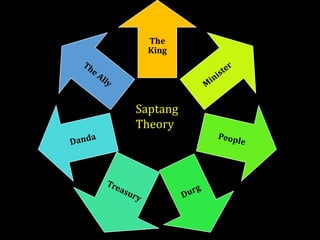
- One of the most significant contributions of Kautilya in the realm of political thought is his Saptanga theory (sapta prakriti) of the state.
- Kautilya held the view that a state is a combination of seven elements i.e.
Swamin (the Lord or the Sovereign)
- The ruler is equivalent to the head in a human body.
- Kautilya did not believe in divine origin of kinsgship. He believed it to be a human institution.
- An ideal king, according to Kautilya is one who has the highest qualities of leadership, intellect, energy and personal attributes.
- The king must be able to gain confidence in others.
- He must be easily accessible, truthful and a pioneer.
- He should have a sharp intellect, be brave, prompt and must possess a strong mind.
- To Kautilya, the swamin could be one person or a number of persons.
- However, to Kautilya the swamin is a veritable sovereign owing allegiance to none.
Some of the main duties assigned to the king by Kautilya are:
- Ensuring people’s welfare
- To maintain dharma or prescribed duties of all human being.
- To protect his subjects from internal and external threats.
- Protection of people from eight types of calamities
- Maintenance of law and order in the state.
- To ensure universal and free education for all the citizens
- To display Atma vrata (self-control) and to do this, the king had to abandon six enemies – kama (lust), krodha (anger), lobha (greed), mana (vanity), mada (haughtiness), and harsha (overjoy).
Amatya (The ministers):
- Amatya represents eyes of the state.
- According to Kautilya the Amatya refers to a minister or any kind of high officials, who are involved in all functioning of the government.
- Kautilya says that the Amatya must be a native of the country and must possess devotion towards the Swamin.
- Apart from the king, there are three top positions in the council of ministers – the mantri or the prime minister (closest political advisor of the king), the commander-in-chief (involved in military planning and conduct of foreign policy) and the crown prince who alternates between political and military assignments.
- These four posts form the supreme body of political deliberations.
- Kautilya did not fix the number of ministers which depends on requirement.
Janapada (The population):
- Janpada represents the legs of the state.
- Janapada to Kautilya implies the land and the population.
- According to him fertility is an essential component of janapada.
- In this element, Kautilya discussed the functioning of the village and towns including their organization.
- Kautilya believed that the rural population has a stronger physical and mental make-up than the urban population.
- That is why; he did not approve of the urban style entertainment like alcohol consumption and gambling for the countryside.
- Under land reclamation policy, Kautilya favours allotment of land to shudra peasants for cultivation
Kosha (the treasury)
- Kosha is considered as the mouth of the state.
- Kautilya opined that a good state is one which is rich in gold and silver, as well as big and variegated that it may be capable of withstanding calamities for long and uninterruptedly.
- Kautilya attached great importance to the growth of treasury as he believed that treasury played an important part in the maintenance of internal and external independence of a state.
Durga (the fort):
- Durga represents the arms of a state.
- Security of treasury and army would depend on fortification of the state.
- Durga or the fort is considered as an extremely important element in a state, as it is related to the defence of the empire.
- Usually, forts were constructed on the borders of the territory.
- Kautilya divided the forts into four categories: surrounded by water (Audak fort), hills (Parvat fort), desert (Dhanvan fort) and forest forts (Van fort).
Bala (the Army)
- It is equivalent to brain in a human body.
- The military force consist of cavalry, infantry and chariot riders.
- He considered Kshatriyas as excellent material for the army as they are good warriors.
- He does not prefer the Vaishyas and Shudras for joining army when the state is confronted with emergency.
- Kautilya divides the armies into six categories i.e.
- Hereditary forces
- Hired troops
- Soldiers of fighting corporations,
- Troops belonging to an ally
- Troops belonging to an enemy
- The soldiers of wild tribes
Mitra (the ally)
- A mitra represents ears of a state.
- According to Kautilya, an ideal ally is one who is a friend of the family for a long time, constant and powerful in support, amenable to control, shares a common interest, can mobilise his army quickly and is not someone who would double cross his friends.
According to Kautilya there are two types of allies
- Sahaja mitra: It consists of those persons whose friendship was derived from the time of father and grandfather and were situated close to the territory of the immediately neighboring enemy.
- Kritrim mitra: Kritrim mitra refers to an acquired ally whose friendship was reported for the protection of wealth and life. Kautilya held that the ally of the first category was superior to the ally of the second category.
Welfare nature of the state
- According to Kautilya, the primary objective of the state is to ensure the welfare of the people.
- Kautilya gives immense power to the king. He also attaches an element of divinity.
- To Kautilya the powers of the king are derived from three sources i.e. prabhushakti (Power of the Army and The Treasury) Manta Shakti (advice of wise men specially the council of minister) and Utsha Shakti (Charisma).
- In Arthashasrtra Kautilya never advocated the “Theory of Divine Origin” of monarch. Kautilya was of the view that as the state is a human institution, so it should be governed by a human being. As such, the king should be the protector of the whole society.
“In the happiness of his subjects lies the king’s happiness; in their welfare his welfare.”
- In this statement (taken from Arthashastra), Kautillya refers that the King is a father figure for his subjects, so the king should treat his subjects in the same way as his children.
- Welfare of subjects is the first and foremost duty of a king.
- Kautilya identified an ideal ruler as one "who is ever active in promoting the welfare of the people and who endears himself by enriching the public and doing well to them".
- The king should render selfless service to his subjects.
- It is the first and foremost duty of the King to protect the life and property of his subjects and to save the people from anti-social elements or as well as natural calamities, such as fire, floods, earthquakes etc.
- To Kautilya only when the subjects are happy, the King can be happy.
- Thus, Kautilya conceptualized the idea of a welfare state for the very first time in Ancient Indian political writings.
Principles of Statecraft
Introduction
- Statecraft theory is in political Science an approach to understanding politics, policy change and political leadership, which focuses on the interests of the political elite.
- It was first developed by British academic Jim Bulpitt to understand the government of Margaret Thatcher.
- In common parlance statecraft means skillful management of state affairs.
- Kautilya was a proponent of a welfare state but definitely encouraged war for preserving the power of the state.
Kautilya’s Views
- He thought that the possession of power and happiness in a state makes a king superior hence a king should always strive to augment his power. This actually coincides with Weber's view that there is no morality in international politics which means that states must be at war all the time.
- Kautilya believed that for the prosperity of a state, the state must be devoid of internal conflict and the King should be in control of the state. To maintain this internal peace, he believed in a just and realistic rule of law.
- His definition of a state was one which had power and wealth and hence he put property rights and protection of wealth as one of the important themes in his jurisprudence. In fact, he advocated that one could get rid of corporal punishment by paying off fines.
- Kautilya believed that nations acted in their political, economic and military self-interest.
- He thought that foreign policy or diplomacy will be practiced as long as the sell-interest of the state is served because every state acts in a way to maximize power and self-interest.
- The protection and promotion of political, military and economic interests of a State rested on six constituent elements, viz. the king, the ministers, the fortress, the countryside, the treasury and the army.
- For the purpose of settlement of disputes, four methods were advocated, namely, 'Sama' (conciliation) , 'Dana' (appeasement), 'Bheda' (dividing), and 'Danda' (use of force) to be employed as the last resort.
- According to Arthashastra, the State should follow a six-fold policy with other States: (1) Sandhi (treaty of peace); (2) Vigrah (war); (3) Asana (neutrality) (4) Yana (marching) - presumably a threat; (5) Samsrya (alliance) and (6) Dwidibhava (making peace with one and end war with another).
- Among more cynical advices Kautilya offered to the king are about
- his stress on diplomatic manoeuvres and espionage activity.
- his ‘doctrine of silent war’ or a war of assassination against an unsuspecting king,
- his approval of secret agents who killed enemy leaders and sowed discord among them,
- his view of women as weapons of war,
- his use of religion and superstition to bolster his troops and demoralize enemy soldiers,
- the spread of disinformation.
Kautilya described three types of political system namely rule making, rule application and rule adjudication and has been recognized for his contributions to bringing diplomacy at the helm of state’s affairs.
Kautilya and Machiavelli

Introduction
- ‘Arthashastra’ is recognized as the masterpiece of Kautilya while ‘The prince’ earned laurels for Machiavelli.
- Comparison is often made between Kautilya and Machiavelli, (the great modern European thinker) as both these two thinkers evolved ways and means to ensure practical administration in the state.
Similarities between Kautilya and Machiavelli
- Both Kautilya and Machiavelli laid stress upon gathering first-hand information about the activities, designs and strengths of the neighboring enemy states.
- Besides another common element between Kautilya and Machiavelli was that they both relied upon earlier records of historical evidence about the actions of enemy states.
- Both believed in the principle of political expediency.
- Both Kautilya and Machiavelli hold almost similar views regarding the conception of the state. Both believe in a strong monarchy as the best form of government.
- Both attach importance to force and its use in keeping order and hence the necessity of a powerful king as head of the state.
- The law of punishment must remain ever vigilant to prevent the people of the four castes and orders from swerving from their respective duties and avocations. He looked upon Royalty as the most vital factor in the body-politics.
- Both emphasize the need for a strong and powerful army in a prosperous state. Both hate the idea of keeping mercenaries or discontented soldiers.
- Kautilya goes into greater details about the classification of armies and soldiers and how to deal with each arm than Machiavelli. The latter advises that a wise prince should not deem that "a real victory which is gained with the arms of others," whether auxiliaries or mercenaries and must turn to his own arms.
Difference between Kautilya and Machiavelli
Background and Context
- Kautilya (Chanakya): Kautilya was an ancient Indian philosopher, statesman, and advisor to Emperor Chandragupta Maurya in the 4th century BCE. He wrote the treatise "Arthashastra," which encompassed political, economic, and military aspects of governance.
- Machiavelli: Machiavelli was an Italian political philosopher and writer during the Renaissance period in the 15th and 16th centuries. He is famous for his work "The Prince," which focuses on political leadership and the acquisition and maintenance of power.
Nature of Leadership and Morality
- Kautilya: Kautilya emphasized the importance of a virtuous and moral leader. He believed that a ruler should uphold dharma (righteousness) and work for the welfare of the people. However, he also recognized the pragmatic aspects of politics and acknowledged the necessity of employing certain unethical means to ensure stability and security.
- Machiavelli: Machiavelli argued that a ruler should prioritize political effectiveness over moral considerations. He famously stated that "the ends justify the means," suggesting that a ruler should be willing to employ deceit, violence, and manipulation to maintain power and achieve political goals.
Purpose of the State and Governance
- Kautilya: Kautilya believed that the state's primary purpose was to ensure the well-being and prosperity of its subjects. He advocated for a strong and centralized state, with a well-organized administration, efficient taxation, and a robust military. Kautilya's Arthashastra encompassed various aspects of governance, including economic policies, diplomacy, and the management of internal and external threats.
- Machiavelli: Machiavelli focused on the acquisition and maintenance of power for the ruler. He believed that a ruler should prioritize stability and security, even if it meant using ruthless tactics. Machiavelli stressed the importance of maintaining a strong army and creating a sense of fear among the populace to deter potential challenges.
Relationship between the Ruler and the People
- Kautilya: Kautilya emphasized the importance of a symbiotic relationship between the ruler and the people. He believed that the ruler's legitimacy stemmed from the consent and support of the governed. Kautilya advocated for a just and compassionate ruler who prioritized the welfare of the people.
- Machiavelli: Machiavelli viewed the relationship between the ruler and the people as one based on pragmatism rather than benevolence. He suggested that a ruler should be willing to act in ways that might be contrary to popular opinion if it served the interests of maintaining power and stability.
Contextual Factors
- Kautilya: Kautilya's political thought was deeply rooted in ancient Indian culture, ethics, and the prevailing social order. He considered factors such as dharma, the varna system, and the role of the king within the broader framework of Indian civilization.
- Machiavelli: Machiavelli's political thought emerged during the Renaissance in Italy, a period of political instability and power struggles among city-states. His work was influenced by the political context of his time, which included constant warfare, the influence of powerful families, and the emergence of nation-states.
Contemporary Relevance and Criticisms
- Kautilya: Kautilya's ideas continue to be studied and applied in various fields, including politics, economics, and management. His emphasis on the welfare of the people and effective governance resonates with contemporary discussions on good governance and leadership ethics.
- Machiavelli: Machiavelli's ideas have generated debate and controversy. Critics argue that his approach neglects moral considerations and promotes a cynical view of politics. However, his work continues to be studied for its insights into the realities of political power and the dynamics of leadership.
Views on corruption by Kautilya
- According to Kautilya, human nature possesses corruption. It is the human psyche.
- He said That as it is impossible not to taste the honey that is found at the trip of the tongue. So it is impossible for a government servant not to eat up at least a bit of the King’s revenue.
- The government servant employed by the government can never locate corruption.
- The level of corruption is steady and maybe there could have been marginal fluctuations.
- He believed that “men are naturally fickle minded” and are comparable to “horses at work who exhibit a constant change in their temper”.
- Kautilya provides a comprehensive list of 40 kinds of embezzlement.
- To gist those, practices and acts that can be termed corrupt such as, causing loss of government, misuse of government property, misappropriation of revenue, falsification of documents, inequality in work, false budgeting, inequality in price, weight, numbering, and quality of the production, obstruction in lawful process, exploiting public, corrupting the officials, taking bribe, failure of expenditure under work, false measurement, allocating expenditure under wrong heads, cheating with weight etc.
Kautilya suggests ways to overcome corruption
- Psychology or mental set up of the corrupt officers should be changed so that it should be eliminated forever.
- To Prevent and control corrupt practices and officers, law should be followed strictly.
- In corruption cases, all the concern senior or junior officers in that particular department should be checked.
- The non-corrupt supporter of corruption should also be treated as corrupt-hiding a crime of corruption is another crime.
- Working procedure of the officers should be supervised regularly. For that purpose a special supervisory officer should be appointed. This supervisor must be continuously in contact with the king so that the king should know about malpractices taking place in the department.
- In collection of revenue and other cesses, if there should be any difference, the concern officer or public servants should be enquired immediately.
- The public servants should be transferred continuously from one department to another so that they should not get a chance to make corruption boldly in any new department.
- There should be ‘Information Organization’. The informer should inform the king about corruption in any department. A person who is working as an Informer should be kept undisclosed.
Theory of Mandala
Introduction
- Interstate relations and foreign policy find a prominent place in Kautilya’s Arthashastra.
- He has tried to explain the dynamics of interstate relations through his mandala theory.
- Kautilya has also explained upayas (peace politics) and shadgunyas (six war tactics).
- He also emphasised that a king should have a detailed system of diplomatic relations with different states.
- Kautilya argued that welfare of a state depends on its active foreign policy and he highlighted that there are links between the domestic factors and foreign policy of a state.
Concept Of Mandala
- Mandala is a Sanskrit word which means circle.
- Mandala projects the world in terms of geometry.
- Kautilya used the shape of mandala to develop a political geometry that accounts for different political realities.
- It was not a new concept given by Kautilya as it was earlier discussed by Manu and there were indirect references to it in Rigveda.
- However, it was Kautilya who gave a comprehensive theory of mandala for security and survival of state.
Basic understanding
- The Mandala concept is one in which there are circles of friends and foes with the central point being the King and his State.
- Mandala theory of foreign policy, is based on the geographical assumption.
- This embraces twelve kings in the vicinity and he considers the kingdoms as neighbors, the states which are the enemy’s neighbors are his enemies’ friends and the next circle of states are his friends.
- He also believes that the states which are his neighbors and are also neighbors of his enemies are neutral and should always be treated with respect.
- He believes that this circle is dynamic and the King should strive to be expanding his central position and reduce the power of the other kings in the vicinity.
- He also proposes to build alliances with states which are two degrees away from the center to create a balance of power.
- In the Kautilyan world he did recognize the importance of middle powers.
- In addition he mentions that war is an outcome of a power struggle and state sovereignty hence he treats diplomacy as a temporary phenomenon.

Peace Politics or Upayas
- There are four upayas to realise an objective or aim and they have existed since the period of epics and the Dharmashastra.
- These include Sama (conciliation), Dana (concession or gift), Bheda (punishment), Danda (dissension).
- These upayas were to be used in times of peace by the king in his foreign relations.
- He said that foreign relations would be determined by self-interest, not by ethical concerns.
War Tactics or Shadgunyas
He elaborates on the six forms of diplomacy which scholars find very interesting.
- Sandhi: This means accommodation, which means that kings seek to accommodate each other and do not resolve to hostile means.
- Vigraha: This means hostility shown to a neighbor or a state. Kautilya strongly believed that the states are always at war and seek power.
- Asana: This means indifference and he choose this policy for states which are neutral in his mandala concept of nations.
- Dvaidhibhava: This means double policy which was very well practiced by Bismarck. Kautilya advocates this foreign policy for states which are superior militarily. Kissinger followed this strategy where he made an alliance with China such that at no time Russia and China could become closer in ties than US and China. Kautilya advocated the same concept within his Mandala framework.
- Samsarya: This policy of protection is followed where a stronger state intervenes and shelters a weak state.
- Yana: This policy is to attack. Kautilya does mention that peace and stability in a state make the state even powerful but never shies away from attacking the weak and unjust king.
Conclusion
- Much of our knowledge about state policy under the Mauryas comes from the Arthashastra written by Kautilya.
- Though it was written at the end of the fourth century B.C, it appears to have been rediscovered only in 1905.
- Kautilya is described by historians as both the emperor’s prime Minister and economist of the Mauryan state.
- Most agree that his work can be read as an adequate description of his time yet also serving as a practical manual of how to govern.
- Kautilya stresses on the importance of religion as an important force to depoliticize the masses when confronted with state power, thus reducing the risk of rebellion.
Current relevance of Kautilya's view
- It is obvious that according to Kautilya, the aim of statecraft in the present situation is to be focused on the population in terms of their well-being.
- Covering various topics on administration, politics and economy, it is a book of law and a treatise on running a country, which is relevant even today.
- He provided valuable basis for economic science.
- It contains very useful economic ideas on foreign trade, taxation, public expenditure, agriculture and industry.
- Good governance and stability are inextricably linked. If rulers are responsive, accountable, removable, recallable, there is stability. If not, there is instability.
- This is even more relevant in the present democratic setup.
- Heavy taxation should be avoided. If tax rates are high, public will not be willing to pay the tax and find out the ways of tax evasion.
- Low rate of taxation will yield more revenue to the state. He was fully aware that terms of trade were not just depending on economics but also on various parameters.
- Social welfare is the centre point of kautilya’s economic ideas.
- The State was required to help the poor and helpless and to be proactive in contributing to the welfare of its citizens.
- The emphasis that Kautilya gave to human capital formation is relevant in current times because development is not possible without human capital accumulation.
- Apart from these ideas there are a number of things in Arthsashtra which is very relevant such as conservation of natural resources.