

PYQs
- Comment: ‘The mode of production in material life determines the general character of the social, political and spiritual problems of life.’ (Karl Marx). (91/20)
- “The root of politics, according to Marx, does not lie in the state; it lies in the social conditions underlying this institution, that is, in the material conditions of life as reflected through the mode of production.” Comment. (05/60)
- “The history of all hitherto existing society is the history of class struggle.” (Karl Marx). Comment. (03/60)
- Examine Ambedkar’s critique of Marxism. (13/15)
- “Revolution in Permanence” (22/10)
Introduction
- Karl Marx (1818-1883) was a German philosopher, critic of political economy, economist, historian, sociologist, political theorist, journalist and socialist revolutionary.
- Marxism is a body of doctrine developed by Karl Marx in the mid-19th century. It also includes the ideas of Friedrich Engels and their supporters, who call themselves Marxists.
- Marxism was first publicly formulated in 1848 in the pamphlet The Communist Manifesto by Karl Marx and Friedrich Engels.
- Marx work examines the historical effects of capitalism on labor, productivity, and economic development.
- He argues that a worker revolution is needed to replace capitalism with a communist system.
Background and Evolution
- Marxism developed as a critique of capitalism after the industrial revolution. As per Marxism, capitalism was inherently flawed and will ultimately fail.
- Marxism originates from the works of 19th-century German philosophers Karl Marx and Friedrich Engels.
- As Marxism has developed over time into various branches and schools of thought, no single, definitive Marxist theory exists. – Wolff and Resnick (1987).
- Its forms include Soviet Marxism, Marxism-Leninism, and Anti-Stalinist Marxism.
- Its extreme form is communism.
- Chinese variant of Marxism-Leninism given by Mao Zedong.
Thinkers’ Perspective
- Various Marxian concepts have been incorporated and adapted into a diverse array of social theories leading to widely varying conclusions - Phillip O'Hara, (2003) Encyclopedia of Political Economy.
- Marxism has had a profound impact on global academia, having influenced many fields, including anthropology - William Roseberry.
- As per Vladimir Lenin, "the principal content of Marxism" was "Marx's economic doctrine."
- Marxism is a left-wing to far-left method of socioeconomic analysis. It uses a materialist interpretation of historical development (historical materialism) to understand class relations and social conflict. Also, it uses a dialectical perspective to view social transformation. – Luke March, (2009) in his "From Marxism to the Mainstream".
- “As Marxism has developed over time into various branches and schools of thought, no single, definitive Marxist theory exists”. – Wolff and Resnick (1987).
Also, refer Criticism section for thinker’s perspective
Central Themes of Marxism
- The key characteristics of Marxism in philosophy are its materialism and its commitment to political practice as the end goal of all thought.
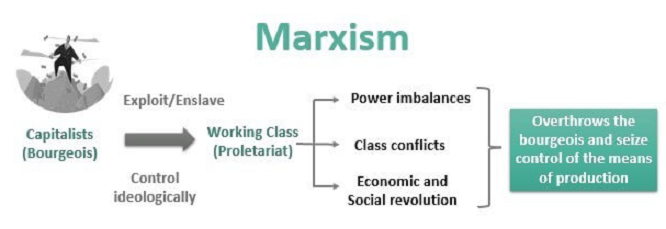
- The theory is also about the struggles of the proletariat and their reprimand of the bourgeoisie.
- The main themes of Marxism are: critique of political economy, base and superstructure, dialectical materialism and historical materialism, class struggle, revolution, alienation and communism.
1. Base and Superstructure
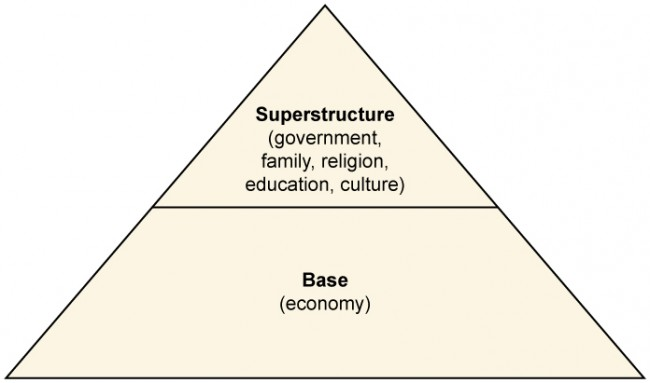
- It discusses the impact of the economic system on the social relations.
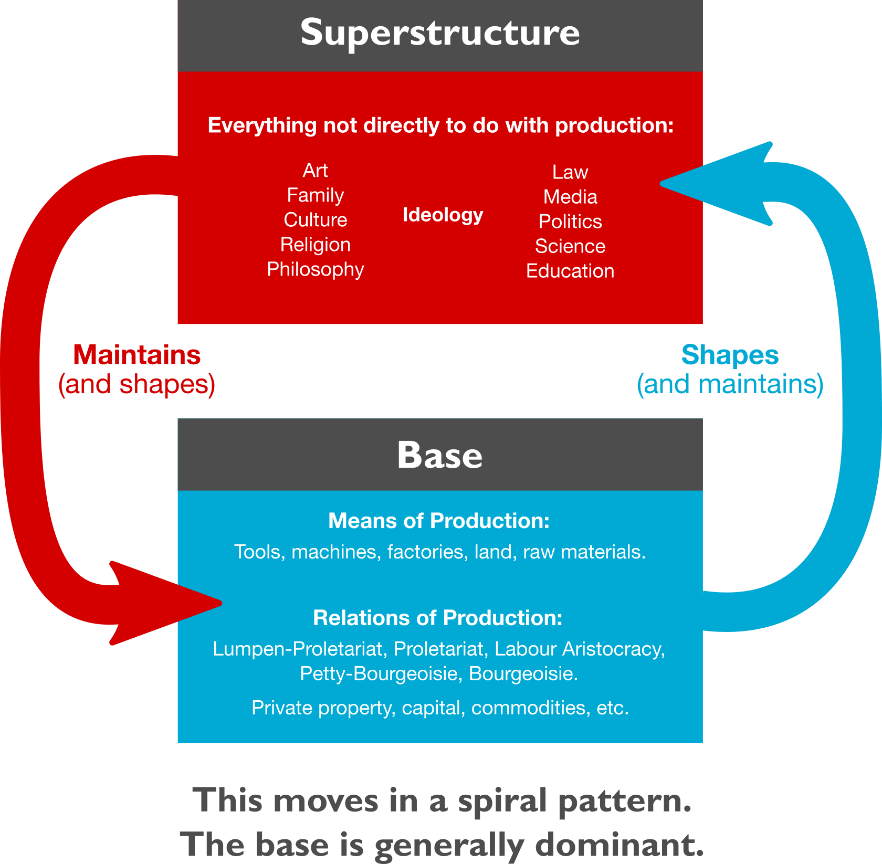
- The form of economic organization (The Base or Sub-structure) influences all other social phenomena (The Superstructure) such as political institutions, legal systems, cultural systems etc.
Hegel vs Marx
- Marx replaced the concept of “the idea” of Hegel by “the base or economic forces”. As per Hegel, the idea matters, and all the other things are only its reflection. Idea lies in the base or the sub-structure of the society, which determines everything in the superstructure.
- According to Marx, the material or the economic forces are in the substructure and the idea is a part of the superstructure. Ideas are the reflection of material forces.
- As per Marx, the economic forces determine the idea and not vice versa. Thus, Marx has reversed the position of idea and matter.
- This is the reason that he claims that “in Hegel it was upside down and I have corrected it”.
2. Dialectical Materialism
- Materialism means that it is “the physical matter” which is the basis for any change.
- Dialectical materialism is the scientific methodology for the interpretation of history.
- The concept of dialectical materialism emerges from statements by Marx in his work Das Kapital.
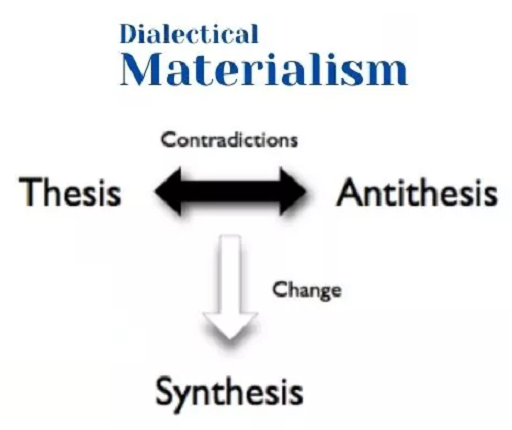
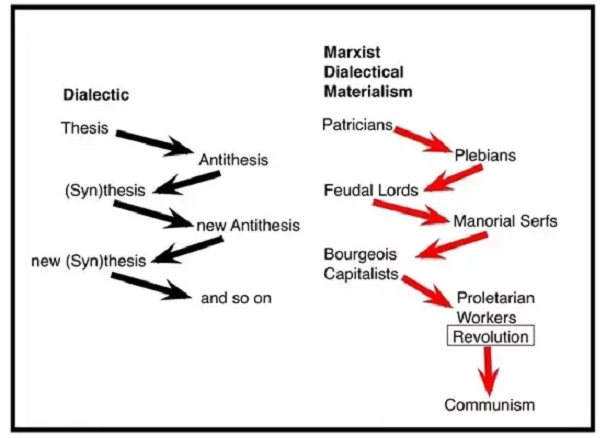
- The dialectical method is a discourse between two contradicting points of views, but wishing to establish the truth through reasoning and argumentation.
- The dialectical process will come to an end after arriving at the perfect truth. For Marx, it is the achievement of communism.
3. Historical Materialism
- Historical materialism is the term used to describe Karl Marx's theory of history.
- Historical materialism is an extension of the principles of dialectical materialism to the study of society and its history.
- Dialectical materialism is a theory that states historical and political events are a result of the conflict of social forces.
- Historical materialism is its application which locates historical change in the rise of class societies and the way people work together to make their livelihoods.
Stages of world history
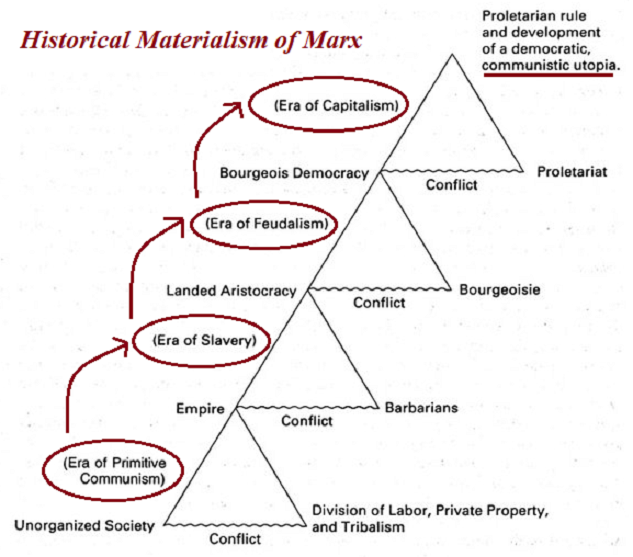
- Marx suggests that all society passes through unilinear evolution. Every society progresses stage by stage and every society has marched ahead.
- He has suggested about the history of society, i.e., World history has been divided into four stages: primitive communism, the slavery system, feudalism and capitalism.
- Primitive Communism: It is the age of hunter-gatherers. The resources and property hunted or gathered are shared with all members of a group in accordance with individual needs.
- Slave system: The development of new forces of material production (technological development) give rise to surplus production. It leads to private property. Now society gets divided into masters and slaves.
- Feudalism: Feudal lords own the means of production, and the peasants carry out the production work.
- Capitalism: The bourgeois class owns the means of production. The proletariat, the industrial worker, class carries out the production.
- Revolution: The further exploitation of workers by the proletariat push the workers for the proletariat revolution.
- Establishment of communism: New forces of production take root and give rise to new relations of production.
Evaluation of Historical Materialism
- Historical materialism is based upon a philosophy of human history. It is best understood as a sociological theory of human progress.
- As a theory, it provides a scientific and systematic research programme for empirical investigations.
- At the same time, it also contains a revolutionary programme of intervention into society.
- It is this unique combination of scientific and revolutionary characters which is the hallmark of Marx’s original formulation.
4. Theory of Surplus
- The theory of surplus explains the exploitation in the capitalist society which ultimately leads to revolution.
- Surplus is the difference between the value created by the worker and the value paid to the worker as wages.
- For example, a worker has created a value of Rs. 25,000 and has been paid wages of Rs. 15,000. Then Rs. 10,000 will remain as surplus.
- The worker always creates more value than he is actually paid. This surplus value created by the worker is the profit of the bourgeois.
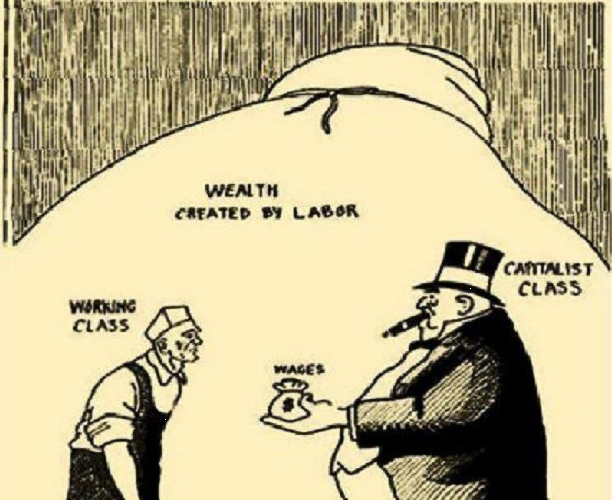
- The wages of the workers continue to fall with the growth of capitalism and reach the stage of subsistence level.
- Subsistence wage is the minimum possible wage for the survival of the labour force.
- Thus, cutthroat competition in capitalism leads to the deterioration of the share of the proletariat. This intensifies class struggle and eventually leads to revolution.
5. Class Struggle
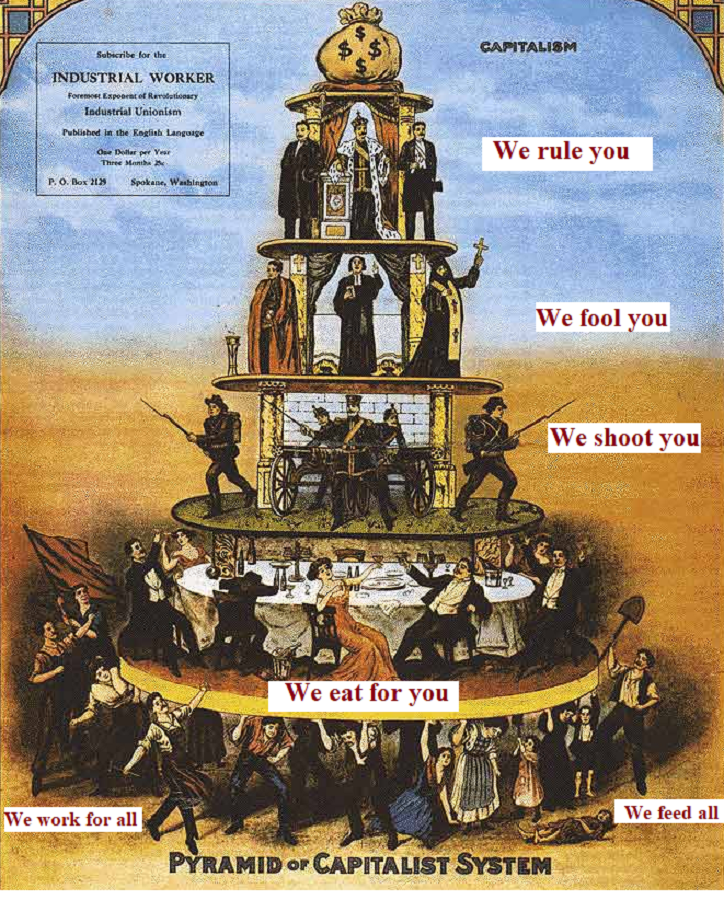
- According to Marx, the history of all existing society has been the history of class struggle.
- All historical society is characterized by the dominant and dependent classes.
- As the property-owning class owns the means of production, it exploits the propertyless class, which results in class struggle.
- The history of all hitherto existing society is the history of class struggles. E.g. Free people and slave, lord and serf, worker and owner, or in a word, oppressor and oppressed. As the oppressed class openly fights or create an open revolution, it either leads to a revolutionary reconstitution of society or to the common ruin of the oppressor classes.” – Karl Marx and Friedrich Engels in Communist Manifesto.
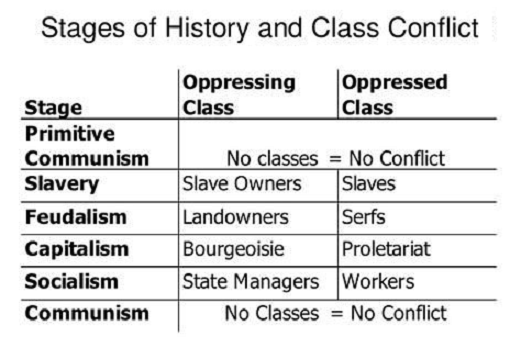
- The class struggle starts as soon as the stage of primitive communism ends. It exists in the slavery system, feudalism, and capitalism. Ultimately it paves the way for revolution and seeks for establishment of communism.
- Karl Marx and Friedrich Engels have continually referred to the "materialistic inversion" of the Hegelian dialectics.
Criticism
- Critics argue that the statement ‘the history of all hitherto existing society is the history of class struggles’ may not be true in those societies, where there is gradual gradations of rank rather than sharply defined classes.
6. Revolution
- “The history of all hitherto existing society is the history of class struggles. E.g. Free people and slave, lord and serf, worker and owner, or in a word, oppressor and oppressed. As the oppressed class openly fights or create an open revolution, it either leads to a revolutionary reconstitution of society or to the common ruin of the oppressor classes.” – Karl Marx and Friedrich Engels in Communist Manifesto
- Class struggle is a long-drawn affair, but revolution is short, swift and violent.
- Revolution occurs due to incompatibility between the means or forces of production and the relations of production.
- Revolution makes the superstructure compatible with the base or the means of production.
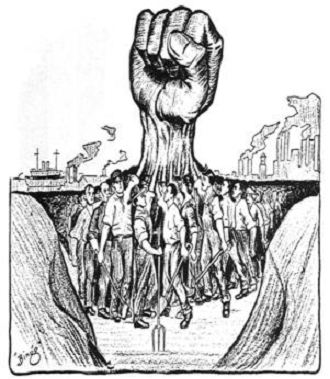
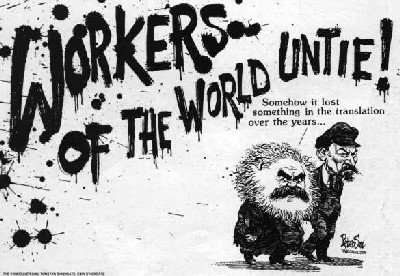
- In the words of Marx, ‘revolution is the indispensable mid-wife of social change’. E.g. Feudal revolution brought an end to the slavery system; the bourgeois revolution ended feudalism and the proletariat revolution will bring an end to capitalism.
- According to Marx, the proletarian revolution will be the last revolution because it will eliminate the contradictions.
- Revolution cannot be advanced or postponed. It will occur when the forces of production have matured and do not match the relations of production.
7. Idea of Alienation
- Marx takes the idea of alienation from Hegel and Ludwig Feuerbach.
- According to Marx, alienation is “the process whereby the worker is made to feel foreign or alien to the products of his own labor”.
- The work created by the worker is estranged (distanced) from him, and belongs to the owner of the property.
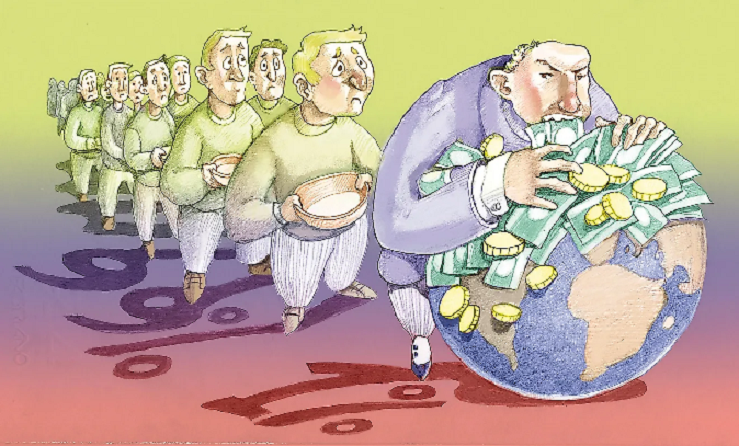
- The alienation from the self is a consequence of being a mechanistic part of a social class, the condition of which estranges a person from their humanity.
- The workers are also alienated from their own humanity. The reason is because the worker can express labour (his fundamental social aspect of personal individuality) only through a private system of industrial production in which each worker is an instrument: i.e., a thing, not a person. – Marx in the "Notes on James Mill" (1844).
- Karl Marx's theory of alienation describes the estrangement (Entfremdung) of people from aspects of their human nature (Gattungswesen, 'species-essence') as a consequence of the division of labor.
8. Communism
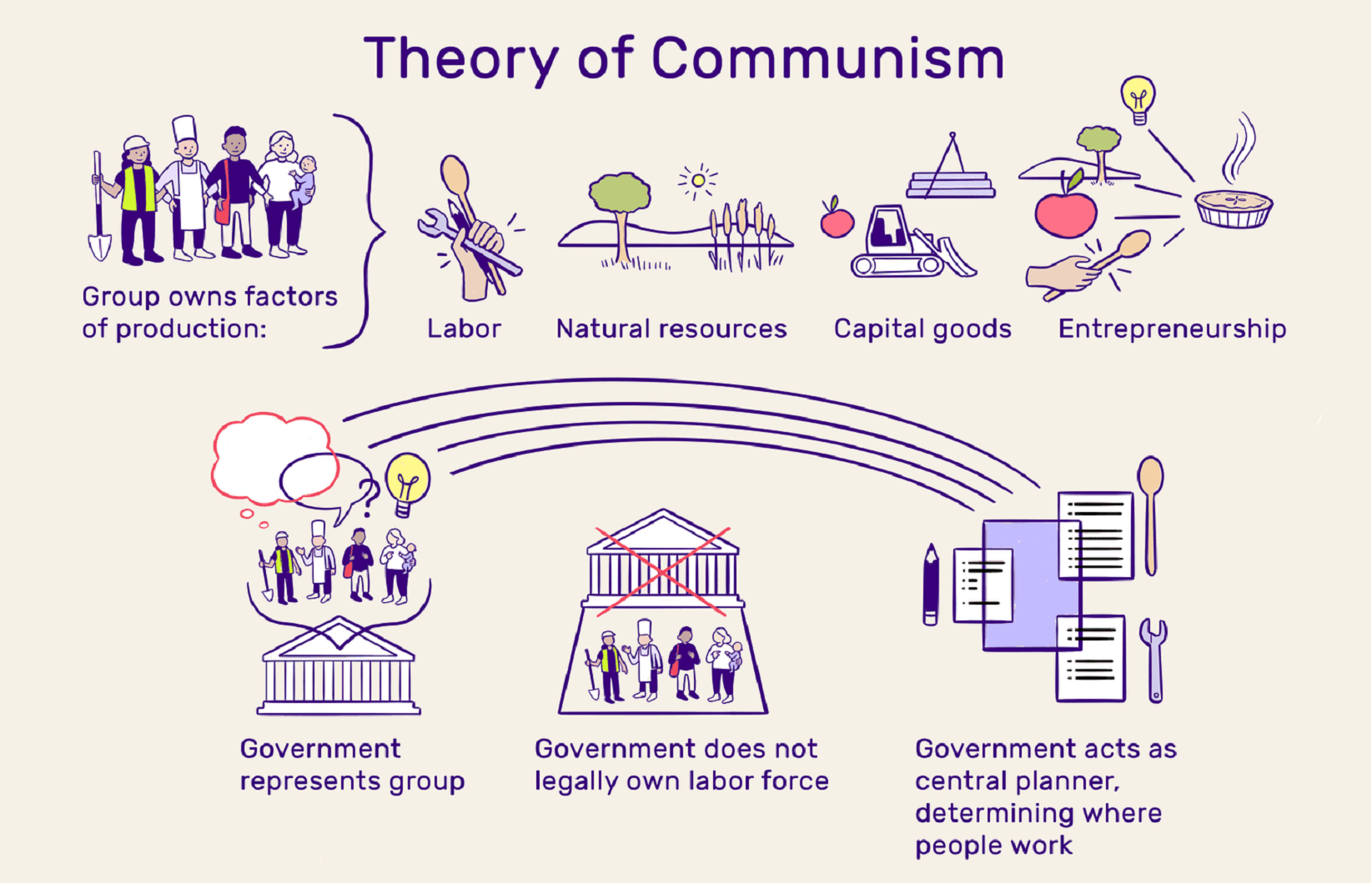
- Communism became the dominant political tendency within the international socialist movement by the 1920s. It is a far-left ideology, and it is also known as the radical left or the extreme left.
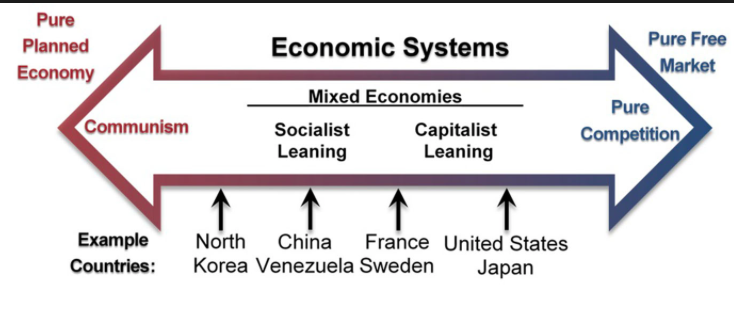
- According to this concept, under the dictatorship of the proletariat, the socialist state will blossom into communism.
- For the Marxists, socialism is the lower stage of communism based on the principle of "from each according to his ability, to each according to his contribution".
- The Marxist conception of socialism is a specific historical phase, which would displace capitalism and precede communism.
- The goal of communism is the establishment of a communist society, i.e. a socioeconomic order centered around common ownership of the means of production and distribution.
- A communist society also involves the absence of private property, social classes, money and the state.
- Communists often seek a voluntary state of self-governance. Its ultimate goal was achieving a classless society, at which point the state would "wither away."
- Since there will be no private property, there will be no exploitation. Hence, there will be no class division or no dominant and dependent class.
- Profit motive will be replaced by social needs.
- Communism is usually distinguished from socialism since the 1840s. Contemporary communism is an offshoot of socialism and is sometimes called revolutionary socialism.
- After the establishment of communism, there will be no further social change and dialectical process will come to an end.
- Cooperation and not cutthroat competition will be the basis of this society society and production will be for consumption and not to earn profit.
Merits of Marxism
- Under a Marxist system, everyone gets their fair share of the national wealth. All the people are given equal opportunities and exploitation is eliminated.
- Marxism emphasizes on human rights. It seeks for equal rights, equality in class structure, equal gender roles, health care and access to education etc.
- It acknowledges all the social forces involved in society including the power interests of different groups.
- It brought forward the weaknesses of capitalism.
- Marxism encourages pressure groups and trade unions to stand up for personal rights. It creates a system of checks and balances in an organisation.
- According to Marx, communities will be working together to achieve success, where all people would come together to provide for each other.
Demerits/ Critique of Marxism
- BR Ambedkar found Marxism undemocratic. As per him, it was unable to confront the non-material roots of social problems. Also, he was against its violence as a means to equality.
- Ambedkar saw that Marxism could not solve problems that originated from societal stigma. As per him, it was focused on economic inequality.
- Leszek Kołakowski states that Marx philosophical dogmas cannot be proved by scientific means.
- Okishio's theorem doubts the Marx's view that the rate of profit would tend to fall. As per this theorem, if capitalists use cost-cutting techniques and real wages do not increase, the rate of profit must rise.
- It has also been criticized for allegedly resulting in lower living standards in socialist countries in relation to capitalist countries. However, this claim is disputed.
- Karl Popper argues Marx’s theory was initially genuinely scientific, but it was degraded into pseudo-scientific dogma.
- Democratic socialists reject the idea that communism can be accomplished only through class conflict and a proletarian revolution.
- Many non-Marxist libertarian socialists reject the need for a transitory state phase.
- Vladimir Dmitriev has alleged that Marx drew conclusions that do not follow his theoretical premises.
- James A. Robinson argued that Marx's economic theory was fundamentally flawed because it attempted to simplify the economy into a few general laws. It ignored the impact of institutions on the economy.
Relevance of Marxism in the Contemporary World
- The core values of Marxism are adopted as per the parts of fundamental and human rights globally.
- In India, the left-wing ideology has significant role in the enlightemnent of the youth. It also creates system of check and balance on the government.
- Globally, there is a rise in the number of pressure groups and trade unions.
- Today technology has enabled the professionals to take significant powers of control. This has resulted in the making of a ‘new bourgeoisie’ that has cultural capital.
- Members of this new bourgeoisie control the creation of knowledge and dominate the fields of science and technology, education and the media.
- E.g. Companies such as Google, Disney and Netflix operate for profit and their economic developments are largely determined by their market position and quest for profits.
- Hence, there is a new class struggle is started between the technologically enabled and technologically challenged class.
- It is evident in the revolution against the big MNCs globally.
Evaluation and Conclusion
- The arrival of Marx and Engels on the intellectual podium signaled a revolution in man’s attempts to acquire knowledge for the understanding of human society. Marxism as a social thought deal with all areas of man’s economic and social life.
- Marxism is a living philosophy. After Marx it has been enriched by Lenin, Trotsky, Stalin, Rosa Luxembourg, Gramsci, Lukacs, Althusser, Mao etc.
- Marxism as an ideology has definitely lost its edge, but it has not become totally redundant. As long as exploitation will continue, people will be oppressed and suppressed, Marxism will remain relevant.
Ambedkar’s critique of Marxism
- Ambedkar’s antipathy towards Marxism was based on philosophical grounds, rather than its application in the Indian Context.
- Ambedkar felt that Marxism was incomplete. He attacked its anti-democratic rhetoric and the violent means of its implementation.
- Ambedkar was not always antithetical to Marxist theory. His embrace of Marxist theory was in recognition of the potential for equality and the common cause between workers and untouchables.
- Ambedkar wrote Annihilation of Caste which is largely influenced by the ideology of Marxism.
- However, he was also cautious when employing Marxism. There were several aspects of Marxism that Ambedkar found problematic. For example, he recognised the undemocratic nature of Marxism, which ultimately seeks for dictatorship of proletariat.
- As per him, Marxism was unable to confront the non-material roots of social problems. He saw that Marxism could not solve problems that originated from societal stigma. As per him, Marxism was focused on economic inequality.
- Ambedkar, argued that Marxism “was and is incapable of handling caste contradictions”. He felt that Marxism was unable to solve the problem of caste in India, as those were basically social rather than economic.
- Unlike the Marxists, Ambedkar pays special attention to religion. “To ignore religion is to ignore a live wire,” he has said.
- Ambedkar attacked the members of the Communist movement in India. He argued that their caste background interferes with their ability to recognize the problem of caste. He stated that the Communists were “a bunch of Brahmin boys.”
- Summing up the relation of Ambedkar with Marxism, Gail Omvedt says “With Marxism, Ambedkar was both attracted and alienated by it.”
Revolution in Permanence
Revolution in Permanence or Permanent revolution is the strategy of a revolutionary class – pursuing its own interests independently, without compromise or alliance with opposing sections of society.
Views of Karl Marx and Friedrich Engels
- Marx first used the term in the phrase "by substituting permanent war for permanent revolution" in The Holy Family (1844).
- If a bourgeois revolution is suppressed, they should not give up hope, but continue to pursue their interests. They should substitute "permanent war with permanent revolution". A war may be suppressed, but a revolution can be continued forever. It was seen in France, when Napoleon prevented the bourgeois revolution. According to Marx, he did this by suppressing the "liberalism of bourgeois society".
- According to classical Marxism, “only a society of advanced capitalism with a large working class” was ripe for communist revolution. However, Russia met none of these conditions.
- Karl Marx conceived of a two-stage revolution. This is often referred to as the theory of stages, the two-stage theory or stagism:
- First the bourgeois revolution to overthrow the existing capitalist system.
- Then the proletarian revolution to establish a dictatorship of proletariat for transition to communism.
- Marx argued that, ‘mere a political change was insufficient’. He contrasted political revolution with permanent revolution.
- For Marx, permanent revolution involves “a revolutionary class (in this case, the bourgeoisie) continuing to push for its interests despite the political dominance of the opposing class”. He visualises the beginnings of new revolutions when counter-revolution becomes powerful.
- The revolution should not stop at the first stage, but it must be continued. It should be continued until human relations are fundamentally transformed, or the relations in production in the economic structure are improved.
- Proletariat should organise autonomously: It is essential to be organized and centralized in clubs. Marx say that "an association of momentary expedience" is permissible if and only if "an enemy has to be fought directly".
Views of Leon Trotsky
- Trotsky opposed the two-stage theory of Marx. As per Trotsky, a well-established monarchy or an advanced capitalist system can not be overthrown by the bourgeois alone.
- The bourgeoisie alone in a capitalist country are incapable of developing such a productive force which would be able to overthrow advanced capitalism.
- In an advanced capitalist stage, which is a reactionary period of world capitalism, the objectives of the bourgeois-democratic revolution could not be achieved by the bourgeoisie itself. There are higher chances of suppression of a bourgeois revolution alone. The second stage of revolution might never come.
- However, it is not easy to suppress both the bourgeois and the proletarian revolution together. Hence, both must come together.
- The proletariat must seize social, economic and political power, which will lead to an alliance with the peasantry.
- Trotsky opposed the “socialism in one country principle”. He stated that, ‘in a reactionary period of world capitalism, socialist revolutions are needed across the world in order to combat the global capitalist hegemony’.
Case study of Russia
- "Permanent Revolution" was Trotsky's explanation of how a communist revolution could occur in an industrially backward Russia.
- Trotsky's theory was proved in the 1917 Russian revolution. Tsarism was overthrown by a bourgeois revolution in February, which in turn, was overthrew by the Bolsheviks in October.
- In the October Revolution, a Bolshevik armed insurrection by workers and soldiers successfully overthrew the Provisional Government of the bourgeois.
- However, the Bolsheviks faced the dilemma of how to sustain power where an advanced industrial economy did not exist. Bolshevik rule almost failed in Russia.
- As a result, Russia erupted into a bloody civil war, which pitted the "Reds" (Bolsheviks) against the enemies of the “White Army”. The White Army consisted of independence movements, monarchists, liberals, and anti-Bolshevik socialist parties.
Evaluation
- Saumyendranath Tagore, the founder of the Revolutionary Communist Party of India and an international communist leader, argued that "the theory of Permanent Revolution has two aspects.
- One aspect is related to the revolution of a particular country, the immediate passing over from the bourgeois democratic phase of the revolution to the socialist revolution.
- The second aspect is related to the international tasks of the revolution.