
What is primordial germ cell? With the help of suitable diagram, discuss the process of oogenesis. (IAS 2021/15 Marks)
What is primordial germ cell? With the help of suitable diagram, discuss the process of oogenesis. (IAS 2021/15 Marks)

Introduction
Primordial germ cells are the precursor cells that give rise to gametes in organisms. In the case of females, primordial germ cells differentiate into oogonia, which then undergo the process of oogenesis to produce mature eggs. Oogenesis is a complex process involving several stages of cell division and differentiation.
Primordial Germ Cells (PGCs)
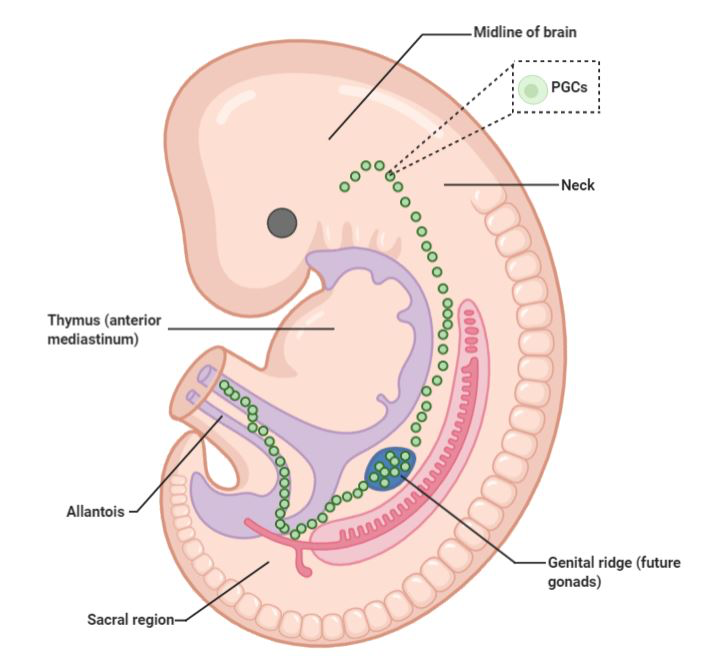
- Primordial germ cells (PGCs) are the earliest identifiable precursors of gametes, which eventually give rise to sperm in males and ova (eggs) in females. They are derived from the epiblast and migrate to the developing gonads during embryogenesis.
- Origin: PGCs originate in the early stages of embryonic development, specifically in the epiblast, before gastrulation occurs.
- Migration: PGCs migrate through the hindgut and dorsal mesentery, eventually colonizing the genital ridges, where they undergo mitotic proliferation.
- Specification: The development of PGCs is influenced by signaling molecules, such as bone morphogenetic proteins (BMPs), and they are specified through a combination of genetic and epigenetic changes.
- Function: The main function of PGCs is to undergo mitosis, then meiosis, and finally differentiate into mature gametes (sperm or oocytes) during the process of gametogenesis.
- Epigenetic Reprogramming: PGCs undergo extensive epigenetic reprogramming, including DNA methylation erasure and re-establishment of sex-specific epigenetic marks, ensuring proper gamete development.
Oogenesis: The Process
- Formation of Oogonia:
- PGCs migrate to the developing gonads and differentiate into oogonia.
- Oogonia are diploid cells that proliferate through mitosis.
- These cells undergo rapid mitotic divisions during fetal development to increase their number.
- Primary Oocyte Formation:
- Oogonia enter meiosis I and become primary oocytes.
- The primary oocytes are arrested in the prophase stage of meiosis I (specifically, in the diplotene stage of prophase I).
- This arrest lasts until puberty, and the oocytes remain dormant within the ovarian follicles.
- Follicular Development:
- At puberty, hormonal changes trigger the maturation of a few primary oocytes during each menstrual cycle.
- The primary oocyte resumes meiosis I, which is completed just before ovulation, producing a secondary oocyte and a polar body (a smaller cell that eventually degenerates).
- The secondary oocyte is haploid and contains most of the cytoplasm from the primary oocyte.
- Secondary Oocyte and Meiosis II:
- The secondary oocyte begins meiosis II but is arrested at the metaphase stage.
- Meiosis II is only completed if the oocyte is fertilized by a sperm.
- If fertilization occurs, the secondary oocyte completes meiosis II, forming a mature ovum and a second polar body.
- Mature Ovum Formation:
- Upon completion of meiosis II, a mature ovum is formed.
- The mature ovum contains half the number of chromosomes (haploid) and is ready for fertilization.
- If fertilization does not occur, the secondary oocyte degenerates.
Conclusion
Oogenesis is a crucial process in the reproductive cycle of females, leading to the production of mature eggs for fertilization. The differentiation of primordial germ cells into oogonia and the subsequent stages of oogenesis involve intricate cellular and molecular mechanisms.