
Give an illustrated account of integument and its derivatives in vertebrates with suitable diagrams. (IAS 2024/20 Marks)
Give an illustrated account of integument and its derivatives in vertebrates with suitable diagrams. (IAS 2024/20 Marks)

Introduction:
The integumentary system in vertebrates is composed of the skin and its derivatives, including hair, feathers, scales, and glands. These structures serve a variety of functions, such as protection, thermoregulation, and sensory perception.
Integument and Its Derivatives in Vertebrates
1. Structure of Integument
- Layers of the Skin:
- Epidermis: Outer layer, derived from ectoderm; consists of stratified squamous epithelium.
- Dermis: Inner layer, derived from mesoderm; composed of connective tissue, blood vessels, and nerves.
- Hypodermis: Subcutaneous layer, not strictly part of the integument; provides insulation and fat storage.
2. Functions of the Integument
- Protection: Acts as a barrier against pathogens, UV radiation, and mechanical injury.
- Regulation: Controls body temperature and water loss.
- Sensory Reception: Contains sensory receptors for touch, temperature, and pain.
- Excretion and Secretion: Involved in sweat production and excretion of waste materials.
- Communication: Color patterns and scent glands are used in species recognition and mating.
Integumentary Derivatives in Vertebrates
These are structures arising from the epidermis or dermis. They vary significantly across vertebrate classes.
a. Fish
- Scales: Dermal origin; provide protection and reduce water resistance.
- Placoid Scales: Found in cartilaginous fishes (e.g., sharks).
- Ganoid, Cycloid, and Ctenoid Scales: Found in bony fishes.
- Mucous Glands: Maintain skin moisture and reduce friction in water.
b. Amphibians
- Mucous and Poison Glands: Keep the skin moist for respiration and defense.
- No Scales: Most amphibians lack scales, except in some species like caecilians.
- Pigmentation: Chromatophores for camouflage and thermoregulation.
c. Reptiles
- Epidermal Scales: Protective keratinized structures (e.g., in snakes, lizards).
- Claws: Keratinized structures for locomotion and defense.
- Scutes: Dermal plates in turtles and crocodiles.
d. Birds
- Feathers: Modified epidermal scales; used for flight, insulation, and display.
- Types: Contour feathers, down feathers, and flight feathers.
- Beak: Keratinized structure adapted for feeding.
- Claws and Scales: Found on the feet and lower legs.
e. Mammals
- Hair or Fur: Keratinized structures for insulation and sensory functions.
- Sweat and Sebaceous Glands: Regulate body temperature and maintain skin.
- Nails, Claws, and Hooves: Protect tips of digits and aid in locomotion.
- Horns and Antlers: Keratinized or bony structures for defense and display.
- Mammary Glands: Modified sweat glands for lactation.
Diagrams:
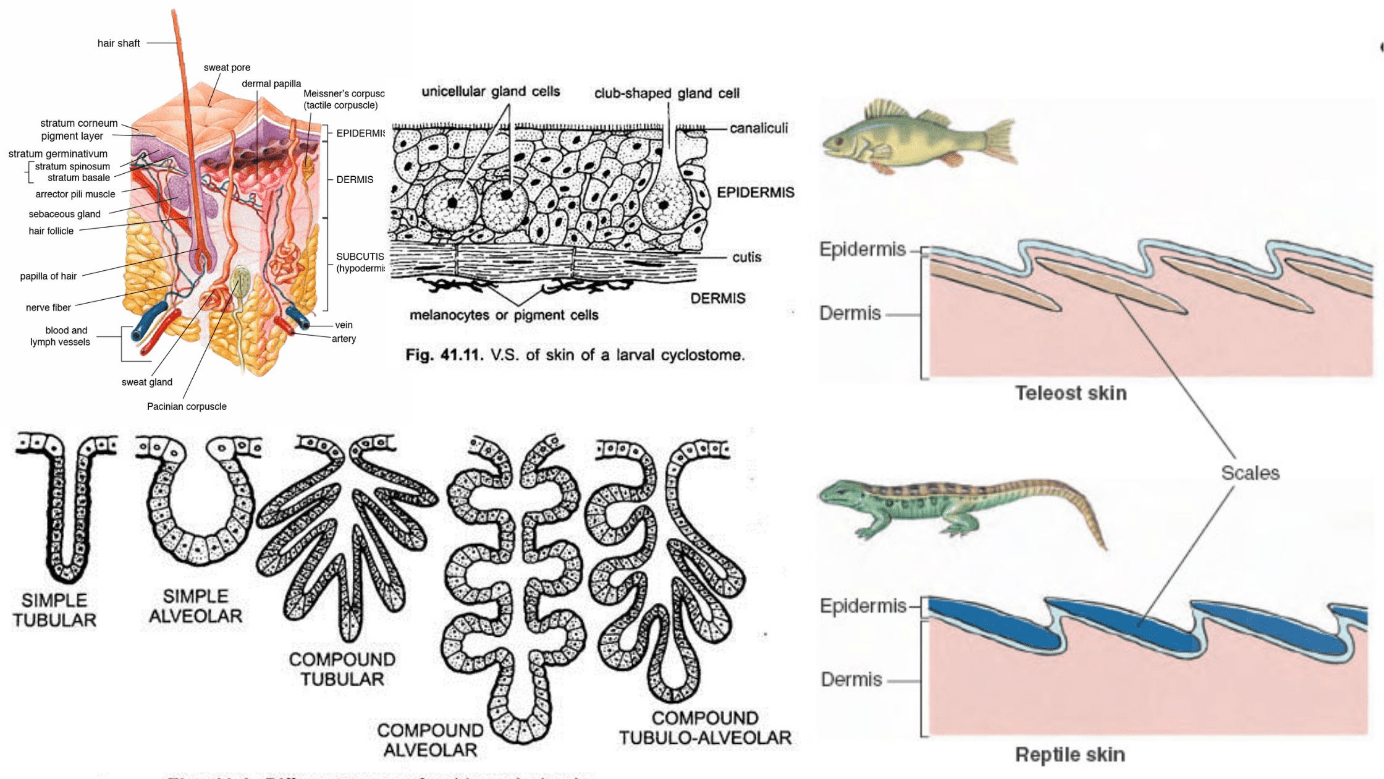
- Cross-section of Skin: Showing epidermis, dermis, and hypodermis.
- Scales in Fish: Types of scales (placoid, cycloid, etc.).
- Feather Structure: Parts of a typical feather (rachis, barbs, etc.).
- Mammalian Skin: Showing hair follicles, glands, and fat layers.
Conclusion:
The integumentary system and its derivatives play a crucial role in the survival and adaptation of vertebrates to their environment. By providing protection, insulation, and sensory perception, these structures enable vertebrates to thrive in a variety of habitats.