
Explain the mechanism of spermatogenesis in mammals with suitable diagram. (IAS 2022/15 Marks)
Explain the mechanism of spermatogenesis in mammals with suitable diagram. (IAS 2022/15 Marks)

Introduction
Spermatogenesis is the process by which sperm cells are produced in the testes of male mammals. It is a complex and highly regulated process that involves the differentiation of spermatogonia into mature sperm cells. The mechanism of spermatogenesis is crucial for understanding male reproductive biology.
Mechanism of Spermatogenesis in Mammals
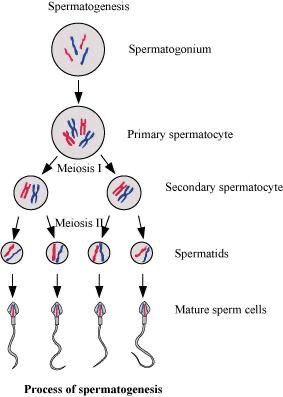
1. Spermatocytogenesis
- Location: Occurs in the seminiferous tubules of the testes.
- Initiation: Begins with spermatogonial stem cells that divide mitotically to produce primary spermatocytes.
- Spermatogonia Types:
- Type A Spermatogonia: Act as stem cells, maintaining the germ cell population.
- Type B Spermatogonia: Differentiate into primary spermatocytes.
- Role of Mitosis: Spermatogonia undergo several mitotic divisions to increase their numbers before differentiating.
- Cellular Changes: The cells increase in size, prepare for meiosis, and become primary spermatocytes.
2. Meiosis
- Primary Spermatocytes: Each primary spermatocyte undergoes the first meiotic division to produce two secondary spermatocytes.
- Secondary Spermatocytes: These cells quickly enter the second meiotic division, leading to the formation of four haploid spermatids.
- Chromosome Reduction: Meiosis reduces the chromosome number from diploid (2n) to haploid (n), ensuring genetic diversity.
- Genetic Recombination: Occurs during prophase I, where homologous chromosomes exchange genetic material.
- Result of Meiosis: Four genetically diverse haploid spermatids are produced from a single primary spermatocyte.
3. Spermiogenesis
- Transformation: Spermatids undergo a series of morphological changes to become mature spermatozoa.
- Formation of Acrosome: The Golgi apparatus forms the acrosome, which covers the anterior part of the nucleus and contains enzymes necessary for penetrating the egg.
- Condensation of Nucleus: The spermatid’s nucleus becomes highly condensed, making the DNA more compact.
- Development of Flagellum: The cell forms a tail (flagellum) that aids in sperm motility.
- Shedding of Cytoplasm: Excess cytoplasm is removed as residual bodies, which are phagocytosed by Sertoli cells.
4. Role of Sertoli Cells and Hormones
- Sertoli Cells: Provide nourishment, structural support, and facilitate the progression of germ cells to spermatozoa.
- Hormonal Regulation:
- Follicle-Stimulating Hormone (FSH): Stimulates Sertoli cells to support spermatogenesis.
- Luteinizing Hormone (LH): Stimulates Leydig cells to produce testosterone, which is essential for the maturation of spermatids.
- Testosterone: Critical for the final stages of sperm maturation and release.
5. Spermiation
- Release of Spermatozoa: Mature spermatozoa are released from the Sertoli cells into the lumen of the seminiferous tubules.
- Transport to Epididymis: Spermatozoa are transported to the epididymis, where they undergo further maturation and gain motility.
- Functional Maturation: In the epididymis, sperm develop the ability to move actively and become capable of fertilization.
Conclusion
Spermatogenesis is a complex process that involves the differentiation of spermatogonia into mature sperm cells. By studying the process of spermatogenesis, researchers can gain insights into male infertility and develop new treatments for reproductive disorders.