
Give an account of the structure and life cycle of Wucheraria bancrofti. Add a note on the pathogenecity and control of the disease caused by this parasite. (IAS 2018/15 Marks)
Give an account of the structure and life cycle of Wucheraria bancrofti. Add a note on the pathogenecity and control of the disease caused by this parasite. (IAS 2018/15 Marks)

Introduction:
Wuchereria bancrofti is a parasitic nematode that causes lymphatic filariasis in humans. It is transmitted through the bite of infected mosquitoes and primarily affects the lymphatic system.
Structure of Wuchereria bancrofti:
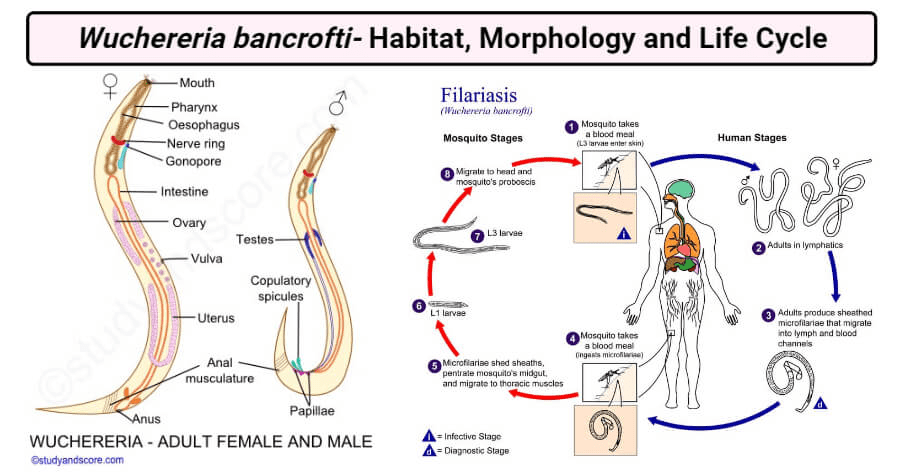
• Morphology: Wuchereria bancrofti is a parasitic nematode with a thread-like, elongated body. The adult female measures around 80–100 mm in length, while males are around 40 mm.
• Cuticle: The outer layer is a tough cuticle that provides protection and flexibility, aiding survival in the host's lymphatic system.
• Digestive System: It has a simple digestive tract with a mouth at one end and an anus at the other.
• Reproductive System: The species is dioecious (separate male and female), with females releasing microfilariae into the bloodstream of the host.
• Microfilariae: The larval form, known as microfilariae, is about 250–300 µm long and circulates in the blood.
• Sheath Covering: Microfilariae have a protective sheath that aids in their survival in the bloodstream.
• Nocturnal Periodicity: Microfilariae exhibit nocturnal periodicity, being more abundant in the blood during the night.
• Vector Dependency: The parasite relies on mosquito vectors, primarily Culex, Anopheles, and Aedes species, for transmission.
Life Cycle of Wuchereria bancrofti:
Please refer to IAS 2010 question.
Pathogenicity and Control of Disease Caused by Wuchereria bancrofti (Lymphatic Filariasis)
Pathogenicity:
• Lymphatic Blockage: The adult worms obstruct lymphatic vessels, leading to swelling and fluid retention, primarily in the legs and genitals.
• Elephantiasis: Chronic infection results in extreme swelling and thickening of skin tissues, a condition known as elephantiasis.
• Fever and Inflammation: Initial infection may cause fever, lymphangitis (inflammation of lymph vessels), and lymphadenitis (inflammation of lymph nodes).
• Immune Response: The presence of worms triggers a host immune response, causing inflammation and tissue damage.
• Hydrocele Formation: Infection in males often leads to hydrocele, an accumulation of fluid around the testes.
• Microfilariae Effects: Circulating microfilariae can cause secondary infections and further complications.
• Allergic Reactions: Some patients may experience allergic reactions to microfilariae in the bloodstream, causing itching and rashes.
• Secondary Infections: Impaired lymphatic function increases susceptibility to bacterial and fungal infections in affected areas.
Control Measures:
• Mass Drug Administration (MDA): Administering drugs like diethylcarbamazine (DEC), ivermectin, and albendazole to reduce microfilariae in the population.
• Mosquito Control: Controlling mosquito populations through insecticides, mosquito nets, and elimination of stagnant water to reduce vector transmission.
• Early Diagnosis and Treatment: Early detection of infection and treatment can prevent severe symptoms and halt the progression of the disease.
• Health Education: Community education about prevention, symptoms, and treatment encourages early intervention and hygiene practices.
• Surveillance Programs: Regular monitoring and mass screening in endemic areas help to assess and control the spread of the parasite.
• Vaccination Research: Ongoing research aims to develop a vaccine for long-term prevention against Wuchereria bancrofti.
• Improved Sanitation: Enhancing sanitation and waste management practices in communities to reduce mosquito breeding sites.
• Personal Protection Measures: Individuals in endemic areas are encouraged to use mosquito repellents and wear long sleeves to avoid bites.
Conclusion:
Understanding the structure and life cycle of Wuchereria bancrofti is essential for controlling the spread of lymphatic filariasis. By targeting the transmission of the parasite through mosquito control measures and mass drug administration, we can work towards eliminating this debilitating disease.