Olfactory pathways and physiology of olfaction. (2024/10 Marks)
Olfactory pathways and physiology of olfaction. (2024/10 Marks)

Olfactory Pathways
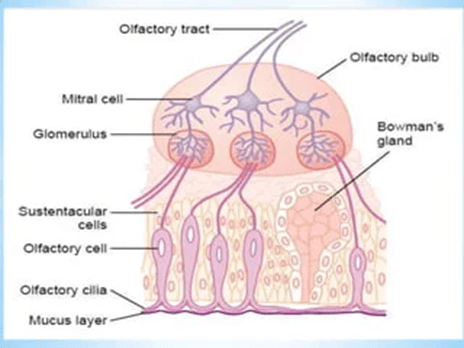
- Olfactory Receptors in Nasal Epithelium
- Located in the upper region of the nasal cavity, the olfactory epithelium contains specialized olfactory receptor cells. These cells detect chemical odorants in the air.
- Each receptor cell has cilia (tiny hair-like structures) that interact with odor molecules, initiating the olfactory signaling process.
- Transduction of Odor Signals
- When odor molecules bind to receptors on the cilia, they trigger a cascade of cellular events that lead to the generation of an electrical signal.
- This transduction process involves G-protein-coupled receptors, which activate intracellular signaling pathways, leading to changes in ion flow that create an action potential.
- Transmission to Olfactory Bulb
- The action potentials generated in the olfactory receptor cells travel along the axons to the olfactory bulb in the brain.
- The olfactory bulb, located just above the nasal cavity, processes these signals and organizes them into recognizable odor patterns.
- Glomeruli and Olfactory Mapping
- Within the olfactory bulb, the axons of receptor cells synapse in specialized structures called glomeruli.
- Each glomerulus processes input from receptor cells that detect the same type of odor molecule, creating a spatial map of odorant information.
- Higher Brain Centers
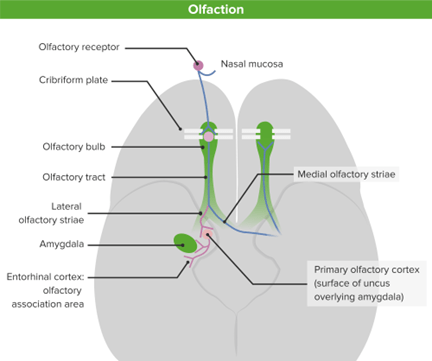
- From the olfactory bulb, signals are transmitted to the olfactory cortex and other brain regions, such as the amygdala and hippocampus.
- These brain areas are responsible for identifying odors, linking them to memories, and triggering emotional responses.
Physiology of Olfaction
- Odor Detection and Binding
- The process of olfaction begins when odor molecules bind to specific receptors on the olfactory cilia in the nasal epithelium.
- Each receptor type is sensitive to particular molecules, contributing to the ability to detect a vast range of odors.
- Signal Transduction Mechanism
- Binding of odor molecules activates G-proteins, which in turn activate enzymes like adenylate cyclase. This leads to an increase in cyclic AMP (cAMP).
- cAMP opens ion channels, allowing positive ions to enter the cell, creating a depolarizing potential and eventually triggering an action potential.
- Neural Processing in the Olfactory Bulb
- In the olfactory bulb, neurons analyze the patterns of odor information. This step helps in distinguishing different odors and refining the olfactory signal.
- Interneurons (like granule and periglomerular cells) modulate these signals, contributing to odor contrast and enhancing specific odor recognition.
- Projection to Olfactory Cortex
- The olfactory bulb projects information directly to the olfactory cortex and indirectly to other brain areas through the thalamus.
- The olfactory cortex plays a primary role in conscious perception of smell and is involved in complex processes like odor discrimination.
- Integration with Limbic System
- Olfactory signals are also relayed to the limbic system, which includes structures like the amygdala and hippocampus.
- This pathway links odors to emotions and memories, which is why certain smells can evoke powerful emotional reactions and recall specific memories.