
What is hypothalamo-pituitary axis? Draw a well-labelled diagram of pituitary gland and describe the functions of its hormones. (IAS 2021/20 Marks)
What is hypothalamo-pituitary axis? Draw a well-labelled diagram of pituitary gland and describe the functions of its hormones. (IAS 2021/20 Marks)

Introduction
The hypothalamo-pituitary axis is a crucial regulatory system in the endocrine system that involves the hypothalamus and pituitary gland. The hypothalamus, located in the brain, produces releasing and inhibiting hormones that control the secretion of hormones from the pituitary gland.
Hypothalamo-Pituitary Axis
- Hypothalamus: The hypothalamus is a small region at the base of the brain that controls many autonomic functions of the body. It sends signals to the pituitary gland through hormones and neural impulses.
- Pituitary Gland: Known as the "master gland," the pituitary gland is located just below the hypothalamus and is responsible for releasing a variety of hormones that regulate critical body functions. It is divided into two parts:
- Anterior Pituitary (Adenohypophysis)
- Posterior Pituitary (Neurohypophysis)
Functions of the Hypothalamo-Pituitary Axis
- Feedback Mechanism: The hypothalamus communicates with the pituitary gland through releasing and inhibiting hormones. The anterior pituitary releases stimulating hormones that regulate the function of other endocrine glands. The release of these hormones is often controlled through a feedback mechanism (either positive or negative) that ensures balance in the body.
Diagram of the Pituitary Gland
- Pituitary Gland Structure:
- Anterior Pituitary – Larger, composed of glandular tissue.
- Posterior Pituitary – Smaller, composed of neural tissue.
- Infundibulum – The stalk that connects the hypothalamus to the pituitary gland.
- Hypothalamus – The region that controls the release of hormones into the pituitary.
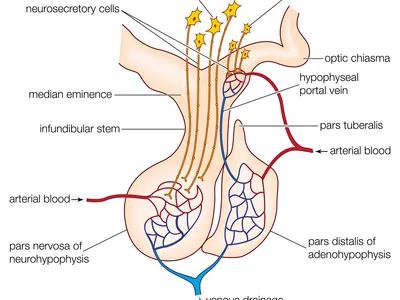
Functions of Pituitary Hormones
1. Hormones of the Anterior Pituitary
- Growth Hormone (GH):
- Stimulates growth and development, particularly in bones and muscles.
- Regulates metabolism by stimulating the liver to produce insulin-like growth factors (IGFs).
- Thyroid-Stimulating Hormone (TSH):
- Stimulates the thyroid gland to produce thyroid hormones (T3 and T4), which regulate metabolism, energy production, and temperature.
- Adrenocorticotropic Hormone (ACTH):
- Stimulates the adrenal cortex to release cortisol, which plays a role in stress response, metabolism, and immune regulation.
- Follicle-Stimulating Hormone (FSH):
- In females, stimulates the ovaries to produce eggs and secrete estrogen.
- In males, stimulates the testes to produce sperm.
- Luteinizing Hormone (LH):
- In females, triggers ovulation and the formation of the corpus luteum.
- In males, stimulates the testes to produce testosterone.
- Prolactin (PRL):
- Stimulates milk production in the mammary glands after childbirth.
- Regulates reproductive and metabolic functions.
2. Hormones of the Posterior Pituitary
- Oxytocin:
- Stimulates uterine contractions during childbirth.
- Facilitates the release of milk during breastfeeding.
- Antidiuretic Hormone (ADH):
- Regulates water balance by promoting water reabsorption in the kidneys, thereby reducing urine output.
- Plays a role in blood pressure regulation.
Conclusion
The hypothalamo-pituitary axis is a complex system that plays a crucial role in regulating various physiological processes in the body. The pituitary gland produces a variety of hormones that control growth, metabolism, reproduction, and stress response.