
Protostomes vs. Deuterostomes (IFS 2023/8 Marks)
Protostomes vs. Deuterostomes (IFS 2023/8 Marks)

Introduction
Protostomes and Deuterostomes are two major groups of animals classified based on their embryonic development. This classification is crucial in understanding the evolutionary relationships and developmental processes of different animal species.
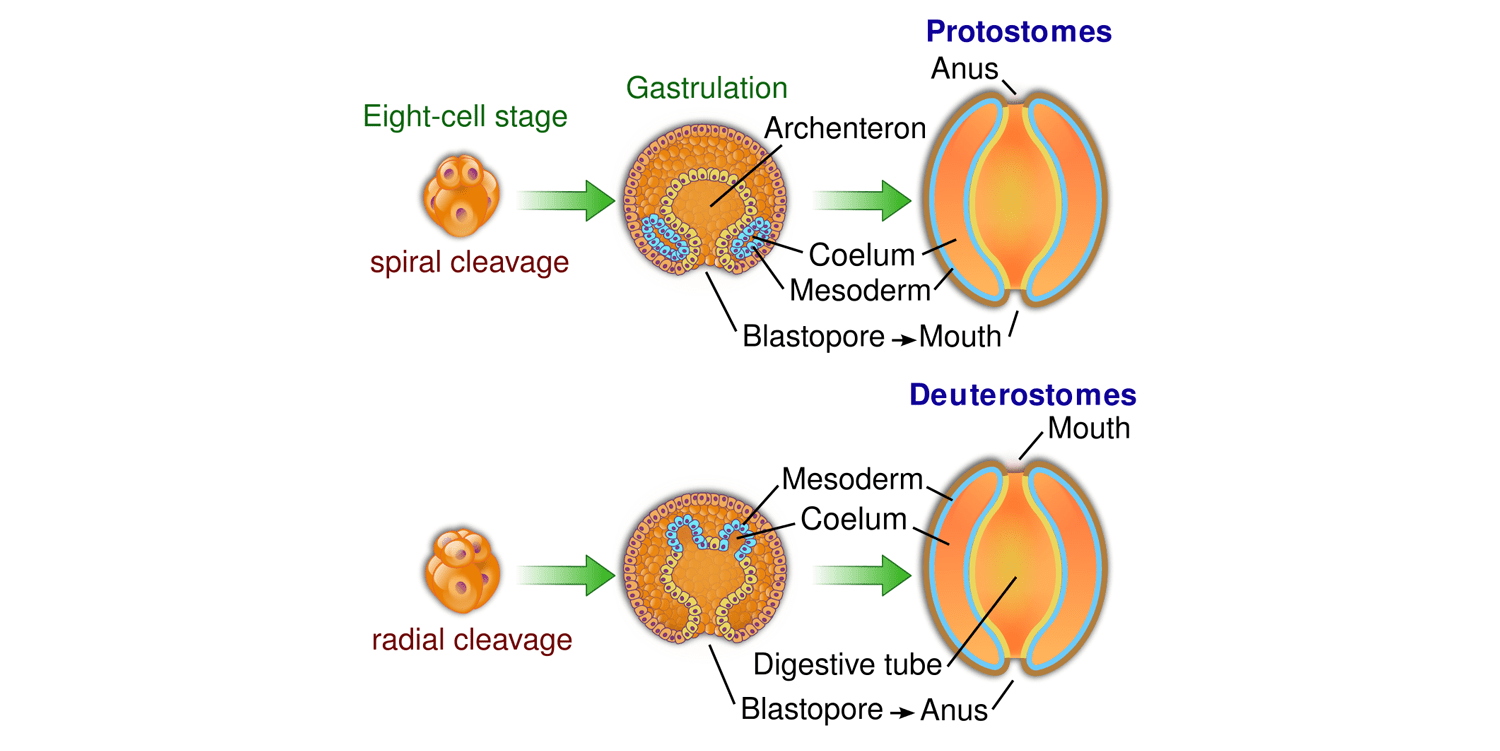
Protostomes vs. Deuterostomes
| Feature | Protostomes | Deuterostomes |
|---|---|---|
| Definition | Animals in which the mouth develops from the blastopore. | Animals in which the anus develops from the blastopore. |
| Developmental Patterns | Spiral cleavage; the fate of each cell is determined early. | Radial cleavage; the fate of cells is indeterminate. |
| Coelom Formation | Schizocoelous formation (coelom formed by splitting mesoderm). | Enterocoelous formation (coelom formed from pouches of archenteron). |
| Body Symmetry | Typically, bilateral symmetry. | Typically, bilateral symmetry; some show radial symmetry in adults. |
| Examples | Mollusks (e.g., snails, clams), Arthropods (e.g., insects, spiders). | Chordates (e.g., vertebrates like mammals, birds), Echinoderms (e.g., sea stars, sea urchins). |
| Nervous System | Ventral nervous system with paired nerve cords. | Dorsal nervous system with a hollow nerve cord. |
| Circulatory System | Open circulatory system (e.g., in arthropods) or closed system (e.g., in annelids). | Generally closed circulatory system (e.g., in vertebrates). |
| Metamerism | Present in some groups (e.g., annelids) but not in others. | Often present (e.g., in chordates and some echinoderms). |
| Examples of Organisms | Mollusca: Snails, octopuses, clams. | Chordata: Humans, birds, fish. |
Conclusion
Protostomes and Deuterostomes represent two distinct evolutionary lineages with unique characteristics in their embryonic development. These differences is essential for studying the diversity and evolution of animal species.