
Daily Current Affairs UPSC 24 August 2024
Welcome to our daily current affairs blog post for UPSC aspirants! In today's edition, we will be discussing the most significant events and news updates that took place on 24th August 2024. Staying updated with current affairs is crucial for UPSC preparation, as it not only helps you stay informed but also enhances your understanding of various subjects. So, let's dive into the important happenings of the day and explore their potential impact on the upcoming UPSC examinations.

Bharatiya Nagarik Suraksha Sanhita (BNSS)
- The Supreme Court has confirmed that first-time offenders can benefit from the retrospective application of section 479 of BNSS.
- BNSS will replace the Code of Criminal Procedure (CrPC) starting from July 1, 2024.
- Section 479 of BNSS allows undertrials who have served at least half of the maximum sentence for their offense in detention to be eligible for bail.
- For first-time offenders, the requirement is reduced to one-third of the maximum sentence.
- The provision does not apply to offenses that carry a punishment of life imprisonment or death.
Rights issue
- SEBI has published a consultation paper to gather feedback on how to speed up the process of Rights Issues.
- The goal is to make Rights Issues more popular compared to other methods of fundraising like QIP and Preferential Allotments.
- Rights Issue involves issuing more shares to current shareholders to raise more capital.
- Benefits of Rights Issues include lower cost of raising capital for the company, debt repayment, discounted share purchase for shareholders, and the ability to trade rights entitlement.
Surety bonds
- The IRDAI has established a task force to tackle obstacles and promote the growth of surety bond insurance.
- A surety bond is a form of risk transfer where an insurer guarantees that a contractor will fulfill their contractual obligations to a beneficiary.
- The three parties involved in a surety bond are the principal (owner or contractor), the obligee (government entity or person requiring the bond), and the surety (providing financial guarantee).
- Surety bonds offer a more comprehensive and efficient solution compared to traditional bank guarantees, especially in sectors like construction.
Creative Economy
- The Indian Chamber of Commerce (ICC) introduced the All India Initiative on Creative Economy (AIICE) to create a platform for collaboration among India's creative industries.
- The concept of Creative Economy, also known as the orange economy, focuses on the connection between human creativity, intellectual property, knowledge, and technology.
- The creative economy encompasses various sectors such as advertising, architecture, arts and crafts, design, fashion, performing arts, and electronic publishing.
- India's creative economy is valued at $30 billion and provides employment for 8% of the working population.
National Plant Protection Organization (NPPO)
- The Ministry of Agriculture in India has approved the import of blueberries from Poland, but only from orchards registered with the National Plant Protection Organization (NPPO).
- India imports blueberries from various countries including the US, Canada, Poland, and Peru.
- The NPPO is a country-level institution that serves as the official authority for plant protection under the International Plant Protection Convention (IPPC) of 1951.
- The IPPC is an international treaty aimed at safeguarding plants, agricultural products, and natural resources from plant pests, with India being a signatory.
- The Directorate of Plant Protection Quarantine and Storage, part of the Ministry of Agriculture, acts as the NPPO in India and is responsible for implementing phytosanitary certification programs in accordance with the IPPC.
Bandicoot Mini
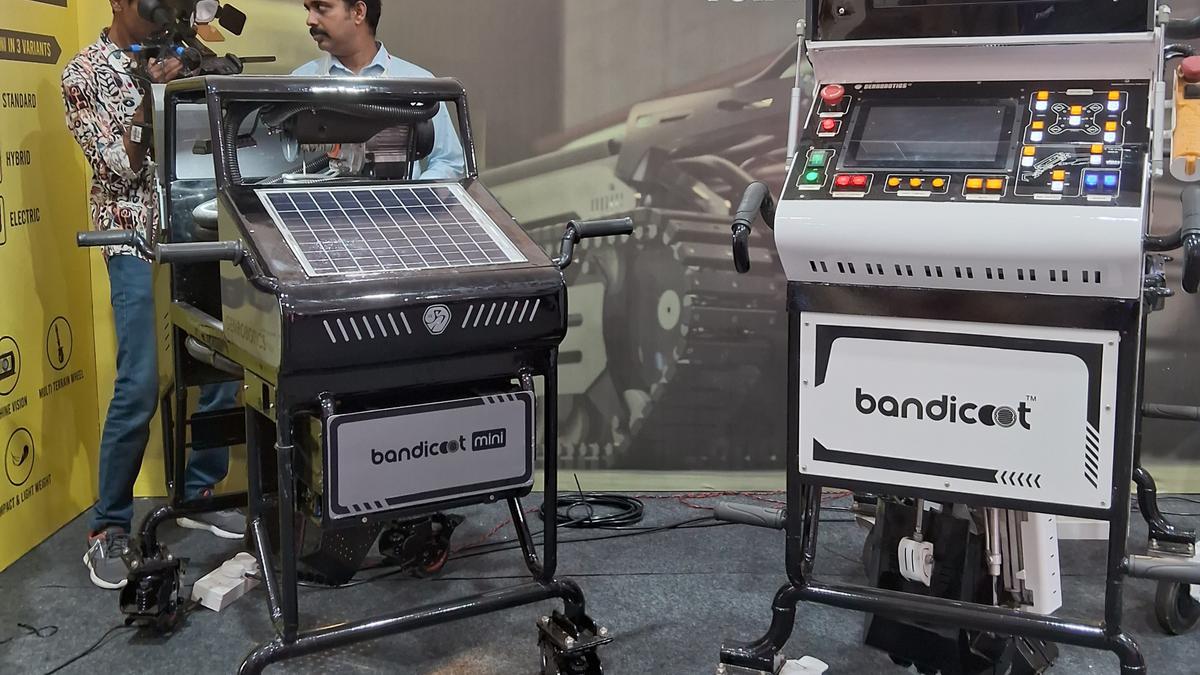
- Start-up Genrobotic Innovations has released the Bandicoot Mini, a smaller and more cost-effective version of the Bandicoot robot.
- The Bandicoot robot is designed for cleaning manholes and performs tasks that are typically done manually inside the manhole.
- It can be operated and supervised from a control panel located outside the manhole.
- The robot features a robotic arm that is comparable to a human arm, allowing it to clear blockages in sewer lines effectively.
- The Bandicoot robot is expected to contribute to the elimination of manual scavenging.
Tanager-1
- The Tanager-1 satellite, developed by Planet Labs PBC, is the first satellite of the Carbon Mapper's Coalition.
- Carbon Mapper is a nonprofit organization that aims to reduce greenhouse gas emissions.
- The satellite's goal is to detect and map high priority areas for methane and carbon dioxide with high resolution.
- Methane is much more potent at retaining heat in the atmosphere than CO2, contributing significantly to global temperature rise.
- The satellite uses imaging spectrometer technology developed at Jet Propulsion Laboratory, NASA.
Lothal
- The Ministry of Ports, Shipping and Waterways is working on the development of the National Maritime Heritage Complex (NMHC) in Lothal, Gujarat under the Sagarmala programme.
- Lothal, which means "mound of the dead" in Gujarati, is located near the Gulf of Khambat in Gujarat, beside a tributary of the Sabarmati River.
- Notable features of Lothal include the world's oldest artificial dock, fire altars in houses and public places, an advanced drainage system made of burnt bricks, a storehouse with seals and sealings, and mud brick houses.
- Lothal was a significant trade center, known for trading beads, gems, and ornaments with West Asia and Africa, as it was located near sources of carnelian, steatite, and metal.
Botswana (Capital: Gaborone)
- The second-largest diamond in the world was discovered in Botswana.
- Botswana is a major diamond producer, responsible for 20% of global diamond production.
Political Features
- A country in the heart of Southern Africa with no coastline.
- Shares borders with Namibia to the west and north, Zambia and Zimbabwe to the northeast, and South Africa to the southeast and south.
Geographical Features
- The Tropic of Capricorn passes through Botswana, and the majority of the country is covered by the Kalahari Desert.
- Botswana is home to major rivers such as the Okavango, Limpopo, and Zambezi, as well as the unique Okavango Delta.
- The country boasts a diverse range of biodiversity, including savanna grasslands and the largest concentration of African elephants in the world.

"Europe Launches mRNA Lung Cancer Vaccine Trials"
- Vaccine BNT116 is specifically designed to target non-small cell lung cancer, which is the most common type of lung cancer worldwide.
- Lung cancer is responsible for approximately 1.8 million deaths annually, making it the leading cause of cancer-related deaths globally.
- This vaccine utilizes mRNA (messenger Ribonucleic Acid) technology, which is considered a promising advancement in cancer treatment.
About mRNA Vaccine Technology
Working Mechanism:
- mRNA technology involves introducing a segment of mRNA that corresponds to a viral protein, typically a small portion of a protein found on the virus's outer membrane.
- mRNA serves as a genetic molecule that provides instructions for cells to produce a protein using their natural machinery.
- By prompting cells to generate viral proteins, the immune system is activated to produce antibodies and enhance immune response.
- For example, the mRNA vaccine for COVID-19 instructed cells to produce copies of the spike protein found on the coronavirus's surface.
Benefits:
- mRNA vaccines are considered safer as they do not contain live or weakened viruses.
- They can be developed rapidly compared to traditional vaccines, which often require months to produce by cultivating weakened virus strains.

"Call for Inter-ministerial Committee to Cut Pesticide Use"
- The initiative aims to ensure food safety, safe and sustainable agricultural practices, and protect consumers from health risks by regulating pesticide application at the farmer level.
Pesticides and Their Usage in India
- Pesticides are used in India to kill, prevent, reduce, destroy, or repel pests, including insecticides, fungicides, herbicides, and biopesticides.
- Herbicides, which control the growth of weeds, hold the largest market share at 44% as of 2023.
- India uses over 60,000 tonnes of chemical pesticides annually between 2019-20 and 2021-22, with a consumption rate of 0.5 kg/hectare compared to 17 kg/hectare in some countries.
- States with the highest pesticide consumption include Maharashtra, Uttar Pradesh, Punjab, and Telangana.
- Pesticides are regulated under the Insecticides Act of 1968.
Impact of Pesticides
- Pesticides can have harmful effects on humans, such as causing cancer or affecting the hormone or endocrine system, as seen with Acephate, classified as a Potential Carcinogen by the US EPA.
- They can also impact agriculture by leading to the decline of pollinators and have negative effects on the environment, including surface and groundwater contamination and harm to non-target plants and fish.
Measures to be Taken
- Measures to address pesticide issues include encouraging Integrated Pest Management and the use of biopesticides.
- Establishing an appropriate body to administer the Insecticides Act of 1968, such as the Standing Committee on Chemicals and Fertilizers.
- The Act is currently administered by the Department of Agriculture and Farmers Welfare and is kept separate from the Department of Chemicals and Petrochemicals.
Initiatives Taken
Global Level
- The Stockholm Convention on Persistent Organic Pollutants aims to address pesticide issues on a global scale.
- The Financing Agrochemical Reduction and Management (FARM) program, implemented by UNEP and other agencies and financed through the Global Environment Facility (GEF), works to reduce pesticide use.
India
- The Pesticide Management Bill of 2020 aims to regulate pesticide use in India.
- The National Pest Surveillance System, an Artificial Intelligence (AI)-based platform, helps monitor and manage pests in the country.
"Microplastics Found in Human Brain"
Increasing scientific research indicates that microplastics are building up in important human organs like the lungs, placenta, liver, kidneys, blood vessels, bone marrow, and brain.
Microplastics
- Microplastics are small plastic particles that can be up to 5 mm in diameter.
- Primary microplastics are intentionally made for products like cosmetics and detergents.
- Secondary microplastics come from the breakdown of larger plastic items.
Hazards of Microplastics
- The dangers of microplastics come from their physical properties and the chemicals they contain, like BPA and heavy metals.
- Microplastics can also contribute to particulate air pollution.
Impacts of Microplastics
- On Humans: Microplastics can lead to cancer, disrupt the endocrine and immune systems, and harm brain cells.
- On Aquatic Ecosystems: Microplastics can bioaccumulate, affect gene expression, and inhibit growth in aquatic organisms.
- On Benthic Organisms: Microplastics can disrupt important ocean processes like energy transfer and nutrient cycling.
- On the Environment: Microplastics can enter the food chain and affect soil water evaporation rates.
Present Methods for removal of Microplastics
- Coagulation
- Membrane Bioreactor System
- Magnetic Separation
- Biofiltration and Biodegradation
- Incineration
"RHUMI-1: India's First Reusable Hybrid Rocket Launched"
- RHUMI-1, a project by Space Zone India and Martin Group, was launched from Thiruvidandhai in Chennai using a mobile launcher.
- The rocket carried 3 Cube Satellites and 50 PICO Satellites to collect data on global warming and climate change.
- Cube satellites are small satellites weighing between 1-10 kg, while Pico satellites typically weigh between 0.1 and 1 kg.
Features of RHUMI-1
- Hybrid Rocket Engine: RHUMI-1 utilizes a hybrid rocket engine that combines solid and liquid propellants for improved efficiency and reduced operational costs.
- Adjustable Launch Angle: The rocket can make precise adjustments from 0 to 120 degrees for meticulous trajectory control.
- Electrically Triggered Parachute System: An innovative descent mechanism ensures safe recovery of rocket components in an eco-friendly and cost-effective manner.
- Environment Friendly: RHUMI-1 is pyrotechnic-free and does not use TNT, making it environmentally friendly.
Reusable Rockets
- Reusable rockets can release payloads, land back on Earth, and be relaunched with new payloads.
Benefits:
- Cost Savings: Reusing rockets can be up to 65% cheaper than building new rockets for each launch.
- Reduce Space Debris: By minimizing discarded rocket components, reusable rockets help reduce space debris.
- Increased Launch Frequency: Reusable rockets have a shorter turnaround time, allowing for more frequent launches and utilization of the rocket.

"India's Inaugural National Space Day Celebrated on August 23"
- The theme for this year's National Space Day is focused on India's achievements in space exploration, particularly its successful landing on the moon in 2023.
- India's space agency, ISRO, successfully landed the Vikram Lander and deployed the Pragyan Rover on the lunar surface as part of the Chandrayaan-3 mission.
- The landing site on the moon was named 'Shiv Shakti' point, marking a significant milestone in India's space exploration journey.
Significance of Moon Exploration
- Moon exploration provides valuable insights into the formation and evolution of the solar system, as well as the impact of asteroid impacts on Earth's history.
- The moon serves as a testing ground for space technologies, flight capabilities, and life support systems for future deep-space explorations.
- Lunar water can be utilized for rocket fuel components, supporting further space exploration efforts.
- Moon exploration also opens up opportunities for commercial ventures such as space tourism and extraction of rare earth elements, as well as advancements in medical and technological innovations.
India's Space Economy
- India has achieved significant milestones in space exploration with missions like Mars Orbiter Mission, Chandrayaan-2, and Aditya-L1 solar mission.
- Future missions include the Lunar Polar Exploration Mission (LUPEX) in 2026, the Bharatiya Antariksha Station (BAS) commissioning by 2035, and an Indian astronaut landing on the moon by 2040.
- India's space economy is projected to grow from $8 billion to $44 billion in the next decade, showcasing the country's potential in the space sector.
"Indian PM's Visit to Ukraine"
This marked the inaugural visit of an Indian Prime Minister to Ukraine since the establishment of diplomatic relations between the two nations in 1992.
Key highlights of the Visit
- Four agreements and MoUs were signed for cooperation in Agriculture and Food Industry.
- Humanitarian Grant Assistance was provided for implementing High Impact Community Development Projects.
- Cultural cooperation and an agreement on medicines and drugs were also part of the agreements.
- Four BHISHM Cubes were provided, each containing medicines and equipment for first line care in various medical situations.
Significance of India’s Ukraine Visit
- Demonstrates India’s strategic autonomy by showing a separate view on Ukraine compared to Russia.
- India aims to de-hyphenate relations between Russia and Ukraine.
- India's pivot towards Eastern Europe by expanding engagement with countries like Ukraine, Poland, and Greece.
- Signifies India’s larger push towards Europe, moving beyond traditional partners like Russia, Germany, France, and Britain.
Significance of India-Ukraine ties
- Importance of Ukraine in agriculture, defense, post-war recovery, and other areas.
- Ukraine was a major source of sunflower oil for India before the war.
- Defense agreements worth $70 million signed in 2021 for weapons sale and maintenance.
- Potential involvement of Indian companies in Ukraine’s reconstruction and recovery efforts.
India’s Stand on Ukraine-Russia Conflict
- India advocates for peaceful resolution through dialogue and diplomacy.
- India is not neutral and has chosen the side of peace from the beginning.