
Daily Current Affairs UPSC 20 September 2024
Welcome to our daily current affairs blog post for UPSC aspirants! In today's edition, we will be discussing the most significant events and news updates that took place on 20th September 2024. Staying updated with current affairs is crucial for UPSC preparation, as it not only helps you stay informed but also enhances your understanding of various subjects. So, let's dive into the important happenings of the day and explore their potential impact on the upcoming UPSC examinations.

Contempt of Court
- The Jharkhand government has taken legal action against the Centre for allegedly delaying the appointment of the Chief Justice of the High Court.
- Contempt of Court is defined in the Contempt of Courts Act, 1971.
- Article 129 and Article 215 grant the Supreme Court and High Courts the authority to penalize contempt.
- There are two types of contempt: Civil contempt involves disobeying a court order or breaching a court undertaking, while Criminal contempt includes actions that scandalize a court, interfere with judicial proceedings, or obstruct justice.
Revised Guidelines for Electric Vehicle Charging Stations
- The Government has released guidelines for EV charging stations to support the new PM E-DRIVE Scheme.
- The guidelines aim to increase EV adoption by ensuring safe, reliable, and accessible charging stations and developing a national charging network.
- The guidelines will apply to privately-owned areas like office buildings and public spaces like petrol pumps and railway stations.
- A new revenue-sharing model between the government and private players will be implemented.
- The tariff for electricity supply to charging stations will not exceed the 'Average Cost of Supply' until March 31, 2028.
- The guidelines also specify a minimum density of public charging stations.
Asia’s Largest Bio-CNG Plant
- The Indore Municipal Corporation's facility produces 17,000 kilograms of Bio-CNG daily, making it Asia's largest municipal solid waste-based facility.
- The plant was established in 2022 as part of the GOBARdhan initiative, which aims to convert waste into valuable resources.
- The GOBARdhan initiative is coordinated by the Department of Drinking Water and Sanitation under the Ministry of Jal Shakti.
- The goal of the initiative is to convert biodegradable/ organic waste into biogas, compressed biogas (CBG), and organic manure, while promoting a circular economy.
Fast Track Immigration - Trusted Travellers' Programme (FTI-TTP)
- Over 18,000 people signed up for the initial FTI-TTP list.
- The FTI-TTP was officially launched at the Indira Gandhi International Airport in New Delhi in June 2024.
- The FTI-TTP is under the Ministry of Home Affairs and aims to expedite immigration clearance through electronic gates at select major airports.
- The program will be implemented in two phases, with Indian citizens and OCI cardholders included in the first phase and foreign travelers in the second phase.
- A total of 21 major airports across the country will be included in the program, with the Bureau of Immigration serving as the nodal agency.
Amur Falcon
- Tamenglong district in Manipur has implemented a ban on hunting Amur Falcons, known locally as 'Kahuaipuina'.
- The Amur Falcon is a migratory raptor that travels from breeding grounds in Russia and China to southern Africa, covering a distance of 22,000 km which includes a sea crossing.
- During their migration, Amur Falcons pass through Manipur and Nagaland where they face the threat of illegal trapping and killing.
- These birds feed on dragonflies that also migrate over the Arabian Sea.
- The IUCN Red List classifies the Amur Falcon as 'Least Concern'.

Pagers
- Recently, there were multiple explosions of Pagers used by Hezbollah in Lebanon.
- Pagers, also known as beepers, were first patented in 1949 by Alfred J. Gross.
- Pagers are used to receive and display alphanumeric or voice messages via radio frequencies from a base station or central dispatch.
- The benefits of pagers include long battery life, ease of use, and the fact that one-way pagers are generally untraceable.
- Pagers provide message alerts through tones, beeps, or vibrations, making them ideal for noisy environments like hospitals.
- Pagers are reliable in situations like natural disasters because they do not depend on cellular networks.
Project 200
- Bellatrix Aerospace, a space startup based in Bengaluru, introduced Project 200, which is a unique satellite designed for Ultra-Low Earth Orbit (180 km-250 km).
- The advantage of operating at Ultra-LEO, specifically at 200 km, includes improved satellite capabilities such as reduced communication latency and enhanced image resolution, as well as lower costs.
- Traditional LEO satellites usually orbit at higher altitudes, around 400-450 km, due to limitations in propulsion technology that have prevented satellites from operating at lower orbits like Ultra-LEO.
Exercise AIKYA
- The National Disaster Management Authority and Southern Command of the Indian Army will be organizing Exercise AIKYA in Chennai, Tamil Nadu.
- The main goal of the exercise is to enhance disaster preparedness and promote cooperation among important stakeholders.
- The exercise will include simulations, technology talks, and expert perspectives on different disaster management responsibilities.
- According to SBI Ecowrap 2023, India has experienced economic losses of $150 billion since 1900, with floods and storms causing the most significant damage.
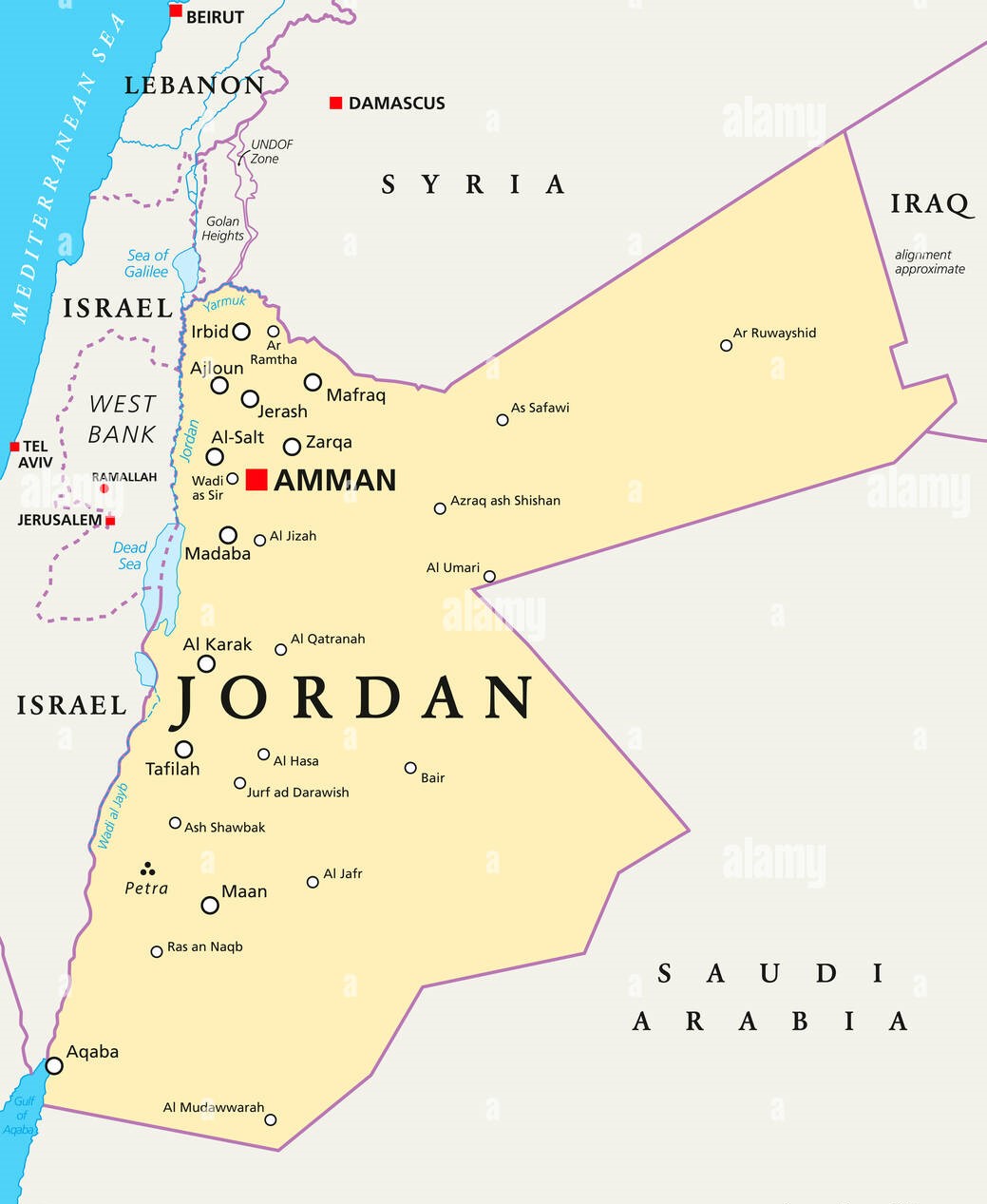
Jordan (Capital: Amman)
WHO declares Jordan as first country to eliminate leprosy
- Jordan's political features
- Location in north of Arabian Peninsula and West Asia
- Bordering nations include Syria, Iraq, Saudi Arabia, Israel, Palestine (West Bank)
- Bordering water bodies include Jordan River, Dead Sea, Gulf of Aqaba
- Geographical features of Jordan
- Highest Point: Jabal Umm Ad Dami
- Rivers: Yarmūk River, Jordan River
"MoD Speaks at Naval Commanders' Conference"
- The Naval Commanders' Conference is a top-level event held twice a year where Naval Commanders discuss important strategic, operational, and administrative issues.
- The Ministry of Defence praised the Indian Navy for being prepared to protect the country's maritime interests, establishing itself as the primary responder in the Indian Ocean Region (IOR).
Importance of Indian-Ocean Region
- Geopolitical importance: IOR is becoming a key area for global powers to compete, such as the USA and France, making it crucial for India to establish itself as a net security provider and counter China's influence.
- Security concerns: Various incidents like piracy, hijacking, and missile attacks in the region highlight the sensitivity of the area.
- Economic importance: With a significant amount of global cargo traffic and oil shipments passing through the IOR, it remains vital for international trade and transport.
- Climate security: The Indian Ocean has experienced rapid warming, making it important for countries to address climate-related challenges in the region.
India's efforts to lead in the IOR
- Indian Ocean Rim Association (IORA): Established in 1997 to enhance regional cooperation within the IOR.
- Information Fusion Centre – Indian Ocean Region (IFC IOR): Hosted by the Indian Navy to improve maritime safety and security in the region.
- MAHASAGAR initiative: Indian Navy's outreach program aimed at promoting security and growth in the IOR.
- Neighbourhood First policy: India's initiatives like SAGAR and HADR, including efforts such as Vaccine Maitri and Operation Karuna, demonstrate its commitment to providing humanitarian assistance and disaster relief in the region.
"Cooperation Minister Boosts Cooperative Sector"
Key Initiatives Launched:
- Margdarshika: Action plan for establishing 200,000 new Multi-Purpose Primary Agricultural Cooperative Societies (PACS), Dairy, and Fishery Cooperatives.
- PACS serve as the foundation of the short-term cooperative credit system.
- Guidelines for 'White Revolution 2.0' aimed at empowering women through dairy projects.
- The goal is to raise milk procurement to 1,000 lakh kilograms per day by 2029.
- Guidelines for 'Cooperation among Cooperatives' to promote financial inclusion.
- This initiative facilitated the opening of cooperative bank accounts for members of cooperative societies.
Significance of Cooperatives Sector:
- Removing inequality: Cooperatives distribute wealth in a fairer way compared to capital-centered systems.
- Empowerment of farmers: Cooperatives like NAFED, IFFCO, and AMUL have played a vital role in the social and economic development of farmers.
- Financial inclusion: Cooperative banks provide low-interest loans to their members, promoting financial stability.
- Women empowerment: Cooperatives help increase women's representation and income in the agricultural sector.
About White Revolution:
- The White Revolution, or milk revolution, began in 1970 with Operation Flood.
- Operation Flood was implemented in three phases, linking milksheds to major cities and establishing village cooperatives.
- India is currently the highest milk producer, with a production of 230.58 million tonnes in 2022-23.
"AI Governance: UN Advisory Body Report"
An advisory group was established in the previous year to conduct research and propose suggestions for the global regulation of Artificial Intelligence (AI).
Need for Global Governance of AI
- The rapid advancement of AI technology is concentrating power and wealth globally, leading to geopolitical and geoeconomic implications.
- There is a lack of understanding of how AI works, making it difficult to control its outputs or predict its future development.
- AI technology is transboundary and should not be solely controlled by market forces to ensure equitable distribution of opportunities in areas like energy grids, public health, and agriculture.
Gap in Global AI Governance
- Despite various AI governance documents and initiatives, there is a lack of truly global and comprehensive frameworks.
- Many countries, particularly in the global South, are not represented in AI governance efforts, leading to implementation issues and unequal sharing of AI opportunities.
Recommendations
- Establish an independent international scientific panel on AI.
- Hold twice-yearly intergovernmental and multi-stakeholder policy dialogues on AI governance.
- Create an AI standards exchange to bring together stakeholders.
- Develop an AI capacity development network.
- Establish a global fund for AI to improve access to AI technology.
- Create a global AI data framework through a process led by a relevant agency.
- Establish an AI office within the UN Secretariat to support and coordinate global efforts in AI risk management and governance.
"Cabinet Committee Approves India-Myanmar Border Fencing"
- The government has approved fencing the entire 1,643 km porous India-Myanmar border at a cost of Rs 31,000 cr.
- Only 30km of the border with Myanmar is currently fenced.
About Porous border
Porous borders are areas along a border that are not adequately protected to prevent people from crossing, whether they are open (unfenced) or closed (fenced).
Current Status
- India shares open borders with Nepal and Bhutan in addition to Myanmar.
- Porous border issues are also present with Pakistan, Bangladesh, and China.
Threats to National Security
- Porous borders facilitate cross-border terrorism, insurgency, arms smuggling, human trafficking, drug trafficking, and refugee influx.
- Myanmar's involvement in the Golden Triangle makes drug trafficking a significant concern.
Challenges in Border Fencing
- Rugged terrain, including marshy land and riverine borders, pose technological and financial challenges.
- Lack of demarcation due to border disputes with neighboring countries.
- Popular discontent due to cross-border ethnic ties, such as protests against fencing the India-Myanmar border.
Initiatives for effective border management
- Comprehensive Integrated Border Management System (CIBMS): This system involves the integration of manpower, sensors, networks, intelligence, and command control solutions to enhance border security.
- Border Electronically Dominated QRT Interception Technique (BOLD-QIT): Deployed under CIBMS, this technique utilizes various intrusion detection sensors such as radar and electro optics to improve border surveillance.
- Border Infrastructure and Management (BIM) Scheme: This scheme is a Central Sector Scheme aimed at constructing border fence, border flood lights, and other infrastructure to strengthen border security.
- Forest (Conservation) Amendment Act, 2023: This amendment exempts strategic projects related to national security located within 100 km of International Borders, LAC, and LoC from certain prior approvals required by the Act.
"FATF Releases MER for India"
- India has been placed in the 'regular follow-up' category by MER for its efforts in anti-money laundering and counter-terrorist financing measures.
- This designation acknowledges India's successful adherence to FATF standards in AML/CFT initiatives.
Key highlighted
- Areas for improvement include understanding money laundering and terror financing risks, national coordination and cooperation, use of financial intelligence, and predicate offences and terrorism financing investigations.
- Main sources of money laundering include illegal activities within the country such as cyber-enabled fraud, corruption, and drug trafficking.
- Security threats in India include Islamic State or al-Qaeda linked groups in Jammu and Kashmir, regional insurgencies in the Northeast and North, and Left-Wing Extremist groups.
- Despite an increase in investigations under the Prevention of Money Laundering Act (PMLA), there has not been a proportional increase in prosecution complaints and concluded trials.
Key recommendations
- Enforcing specific financial sanctions to quickly freeze funds and assets.
- Clarifying the definition of domestic politically exposed persons (PEPs) in the Prevention of Money Laundering Act (PMLA).
- Currently, the PMLA only defines foreign PEPs.
- Safeguarding non-profit organizations (NPOs) from terrorist exploitation by implementing risk-based enhanced measures.
- MER evaluates a country's efforts to address money laundering, terrorist financing, and the spread of weapons of mass destruction.
- India is grouped with four other G20 nations in the highest level of assessment called "regular follow-up."
- Developing countries typically receive more scrutiny, with annual reports required for those in the "enhanced follow-up" category compared to every three years for "regular follow-up" countries.
"New Climate Resilient City Plans Unveiled for 2070"
Ahmedabad released its Net zero CRCAP 2070 during the U20 Mayoral Summit last year in line with India's goal of achieving Net-zero emissions by 2070.
Key highlights from the eight Net-zero CRCAP
- Climate Finance: All 8 cities require more than USD 85,000 billion until 2070 for financing climate action projects like water supply and sanitation, energy efficiency, etc.
- Emission Reduction: Current efforts could lead to a 91% reduction in city emissions.
- Creation of Green jobs: Implementation of climate actions are expected to create approximately 8 lakh green jobs.
About Climate Resilience:
- The concept involves being able to predict, plan for, and react to dangerous events, trends, or disruptions associated with the climate.
- It includes evaluating risks related to climate and implementing strategies to manage those risks.
Need for Climate Resilient Cities
- Extreme Weather Events: Cities need to strengthen resilience capabilities to withstand climate-related shocks like flooding, sea level rise, and urban heat islands.
- Climate change mitigation and adaptation: Cities are major contributors to global energy use and greenhouse gas emissions, making it crucial for them to address climate change.
Initiatives for Climate Resilient Cities
- Capacity Building for Low-carbon and Climate Resilient City Development (CapaCITIES) Project: A project by the Swiss Agency for Development and Cooperation (SDC) to mainstream climate action in urban development.
- India's ClimateSmart Cities Assessment Framework: Assessment of Smart cities' performance based on five themes to tackle climate change.
- Resilient Cities Network (R-Cities): Launched in 2020 to improve climate resilience based on three pillars - Climate Resilience, Circularity, and Equity.