
Daily Current Affairs UPSC 22 and 23 September 2024
Welcome to our daily current affairs blog post for UPSC aspirants! In today's edition, we will be discussing the most significant events and news updates that took place on 22nd and 23rd September 2024. Staying updated with current affairs is crucial for UPSC preparation, as it not only helps you stay informed but also enhances your understanding of various subjects. So, let's dive into the important happenings of the day and explore their potential impact on the upcoming UPSC examinations.

Infrasound
- CTBTO is hosting a workshop for scientists to learn about using infrasound for monitoring nuclear tests in collaboration with the industry.
- Established in 1996, CTBTO is an organization responsible for developing the verification system of the CTBT, although India has not signed the treaty.
- Infrasound consists of low-frequency sound waves ranging from 0.002 to 20 Hertz that are not audible to humans.
- Microbarometers are utilized to detect small changes in atmospheric pressure caused by infrasound.
- Infrasound can originate from natural sources like earthquakes and volcanic explosions, as well as non-natural sources such as mining, chemical explosions, and nuclear explosions.
- Infrasound has various applications including detecting distant nuclear explosions through CTBTO's International Monitoring System, assessing the structural integrity of infrastructure, and tracking wildlife.
FIDE Chess Olympiad
- The Indian contingent recently achieved Gold in both the open and women's categories at the 45th FIDE Chess Olympiad.
- The 45th FIDE Chess Olympiad was held in Budapest, Hungary, while the previous 44th edition took place in Chennai, India.
- The Hamilton-Russell Cup is awarded to the winning team in the open section, while the Vera Menchik Cup is given to the winning team in the women's section.
- FIDE is the governing body of chess, overseeing all international competitions and recognized as a Global Sporting Organization by the International Olympic Committee in 1999.
Exercise Eastern Bridge VII
- The Exercise Eastern Bridge between the Indian Air Force and the Royal Air Force of Oman recently finished its 7th edition.
- The exercise took place in Masirah, Oman.
Cigarettes and Other Tobacco Products Act (COTPA), 2003
- The Ministry of Education and Ministry of Health & Family Welfare collaborated to issue an advisory to all States and UTs for the strict implementation of the ToFEI manual in accordance with COTPA, 2003.
- The Tobacco-Free Educational Institution (ToFEI) initiative was introduced under the National Tobacco Control Program.
- According to the Global Youth Tobacco Survey, 2019, 8.5% of school students aged 13 to 15 use tobacco in various forms nationwide.
- COTPA, 2003 aims to restrict advertising and regulate the trade, production, supply, and distribution of cigarettes and other tobacco products.
- COTPA, 2003 also prohibits the sale of tobacco products within a 100-yard radius of any educational institution.
Nanozymes
- A CSIR-CLRI study discovered that nanozymes can protect collagen and improve its resistance to enzymatic breakdown.
- Collagen is a vital protein in the human body, present in bones, skin, muscles, and tendons.
- Nanozymes are artificial enzymes made from nanomaterials with enzyme-like properties.
- Unlike natural enzymes, nanozymes are typically made from inorganic materials like metals, metal oxides, or carbon-based nanostructures.
- Nanozymes offer benefits such as high stability, easy customization, design flexibility, simple preparation, and cost-effectiveness.
- Nanozymes have various applications in fields like biomedicine (biosensing, drug delivery, diagnosis, therapy) and environmental remediation (water purification, air purification).
ASEAN-India Trade in Goods Agreement (AITIGA)
- India urged for a quick review of the AITIGA during the 12th East Asia Summit Economic Ministers Meeting in Lao PDR.
- The AITIGA was signed in 2009 and came into effect in 2010, with the mandate that each party must treat goods of other parties as they would their own in accordance with GATT, 1994.
- The need for a review of the AITIGA arises from concerns that goods from China and other non-ASEAN nations are entering India through the agreement and benefiting from duty concessions.
- ASEAN accounts for approximately 11% of India's global trade.
- The Economic Research Institute for ASEAN and East Asia (ERIA) is collaborating on a joint study of the AITIGA.
Legacy Waste
- Ministry of Housing & Urban Affairs' data shows that only 16% of land has been reclaimed under the 'legacy waste management project of Swachh Bharat Mission (SBM) 2.0'.
- SBM 2.0 requires all cities to clear legacy waste sites.
- Legacy waste refers to aged municipal solid waste in landfills or dumpsites, causing issues like greenhouse gas emissions and soil contamination.
- To address legacy waste, strategies include implementing sustainable solid waste management plans, maximizing the use of recovered materials, enhancing urban department capabilities, and sustainably reusing reclaimed land.
Nagar Van Scheme
- 111 Nagar Vans have been approved in the last 100 days under the Nagar Van Scheme.
- The Nagar Van Scheme was launched in 2020 with the goal of developing 1000 Nagar Vans by 2027, funded by the National Fund of National Compensatory Afforestation Management & Planning Authority (CAMPA).
- The scheme was initiated by the Union Ministry of Environment, Forest and Climate Change to promote urban forestry and greenery by involving local communities, NGOs, educational institutions, and local bodies.
- Plantation details can be uploaded on the MeriLiFE portal as part of the scheme.
- The Nagar Van Scheme is important for protecting urban forests and addressing environmental issues such as air pollution, urban heat islands, and biodiversity loss.
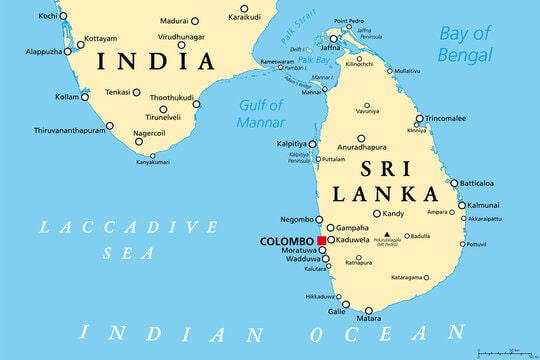
Sri Lanka [Capital: Colombo]
Sri Lanka recently held elections to choose its 10th President, with Colombo serving as the capital for the Executive and Judicial branches, and Sri Jayewardenepura Kotte, a suburb of Colombo, serving as the capital for the Legislative branch.
Political Features of Sri Lanka
- Capital cities: Colombo (Executive and Judicial) and Sri Jayewardenepura Kotte (Legislative)
- Recent election of the 10th President
Geographical Features of Sri Lanka
- Location: Island country in the Indian Ocean, separated from peninsular India by Palk Strait
- Maritime Boundaries: India (North) and Maldives (South-west)
- Geologically considered a southerly extension of peninsular India
- Longest river: Mahaweli Ganga River
- Highest Peak: Pidurutalagala
Biodiversity and Environmental Features of Sri Lanka
- Western Ghats of India and Sri Lanka biodiversity hotspot
- Gulf of Mannar and Palk Bay transboundary area
- Populations of dugongs and large seagrass meadows in the area
Cultural Aspects of Sri Lanka
- Majority population practises Theravada Buddhism
Promoting Gender Equality in Rural Development
- The conclave organized by DAY-NRLM aimed to enhance gender-responsive community institutions (GRCI).
- DAY-NRLM is a key initiative by MoRD to reduce poverty by empowering marginalized groups, especially women.
- The DAY-NRLM program acknowledges that violence against women and girls is a significant barrier to their personal and societal progress.
About GRCI:
- Gender-responsiveness involves recognizing and addressing the specific needs of females, appreciating their viewpoints, and empowering girls and women.
- GRCI, or Gender-Responsive Community Institutions, typically refers to organizations that incorporate gender considerations into their policies and practices to impact outcomes.
- Examples of GRCIs include Self Help Groups, Village Organizations, Cluster Level Federations, and Women-Led Organizations.
Role of GRCI:
- Gender-sensitive society: These organizations work to educate people about the risks faced by women and girls, ensure that policies are implemented effectively to support women, and hold individuals and institutions accountable for their actions.
- Inclusive development: These organizations are crucial in providing necessary services to women, girls, and other marginalized groups to ensure that everyone has access to resources and opportunities for growth and development.
- Better response to crisis: These organizations can also assist in community outreach during times of crisis, ensuring that all individuals are included in humanitarian response efforts and that no one is left behind.
Initiatives towards Gender-responsiveness:
- Nayi Chetna – Pahel Badlav ki is a national campaign aimed at eliminating gender-based discrimination and violence, supported by DAY-NRLM, UNICEF, Gates Foundation, and civil society partners.
- Uddeshya - Towards Gender Responsive Urban Mobility Systems is a nationwide initiative by World Resource Institute- India to promote gender-responsive mobility planning.
- Gender Budgeting involves setting up Gender Budgeting Cells in Ministries and Departments to ensure budgeting is responsive to gender needs.
- The Nirbhaya Fund is a non-lapsable corpus fund administered by the Department of Economic Affairs (Ministry of Finance) for the safety and security of women.
"NGT mandates Nainital town classification for sustainability"
The National Green Tribunal issued an order during a hearing on unauthorized large-scale tree cutting, which was believed to be damaging forest areas and impacting the recharging of Naini Lake.
Key Highlights of the Order
- Towns are categorized into development, prohibited, and regulated zones depending on environmental factors.
- The state government was instructed to carry out catchment area treatment plans for lakes in the district to improve their condition.
- Master plans are being developed for Nainital, taking into account factors like hydrology, sanitation, vegetation, and tourism trends to determine its carrying capacity.
What is Carrying Capacity?
- Carrying capacity is the maximum number of individuals that an area can support with its available resources.
- It is determined by both living (biotic) and non-living (abiotic) factors in the environment.
- There are two main methods for evaluating carrying capacity:
- The planetary boundaries approach is used to address environmental crises like global warming, land degradation, pollution, and water stress.
- The biocapacity overshoot approach measures the demand humans place on Earth's systems by consuming the total annual productivity of natural systems in just a few months, as seen on Earth Overshoot Day.
- Significance: Evaluating carrying capacity using precautionary principles, as shown in the infographic, offers a practical way to address the conflict between 'developmental governance' and 'sustainable development'.
Precautionary Principle for Assessment of Carrying Capacity
- Being proactive in uncertain situations by taking preventive measures
- Requiring those proposing an activity to prove its safety and benefits
- Considering other options to avoid potential harm
- Encouraging more involvement from the public in making decisions.
"India Makes History with IPEF Agreements"
- India recently signed unique agreements under the Indo-Pacific Economic Framework (IPEF) for Prosperity, focusing on Clean Economy, Fair Economy, and IPEF Overarching arrangement.
- The IPEF is based on four pillars: Trade, Supply Chain Resilience, Clean Economy, and Fair Economy.
- India had previously ratified the Agreement on Supply Chain Resilience in February 2024 and held observer status in Pillar I.
IPEF Clean Economy Agreement (Pillar-III)
- Advancing clean energy technologies to enhance energy security, climate resilience, and emissions reduction within IPEF partnerships.
- Supporting industries, particularly MSMEs, and connecting Indian businesses to global value chains through initiatives like the IPEF Catalytic Capital Fund and IPEF Accelerator.
IPEF Fair Economy Agreement (Pillar-IV)
- Creating a clear and consistent trade and investment atmosphere by addressing corruption and promoting efforts to increase tax transparency, domestic resource mobilization, and tax administration.
- Improving communication and cooperation by sharing information, aiding in asset recovery, and bolstering cross-border investigations and prosecutions.
Overarching IPEF Agreement
- Goal: Create a political oversight framework at the Ministerial level for multiple IPEF agreements.
- Importance: Give the group a clear identity and ensure the long-term success of IPEF partnerships by establishing a formal mechanism. This could also help improve India's productivity and integration into supply chains.
About IPEF
- Establishment and Launch: The Indo-Pacific Economic Framework (IPEF) was established in 2022 in Tokyo, Japan.
- Member Countries: The IPEF consists of 14 member countries including Australia, Brunei, Fiji, India, Indonesia, Japan, Republic of Korea, Malaysia, New Zealand, Philippines, Singapore, Thailand, Vietnam, and USA.
- Objective: The main goal of the IPEF is to enhance economic engagement and cooperation among partner countries to promote growth, economic stability, and prosperity in the region.
- Initiatives under IPEF:
- IPEF Upskilling Initiative: This initiative focuses on providing upskilling opportunities for women and girls in emerging and middle-income partner countries of the IPEF.
- Critical Mineral Dialogue: The aim of this initiative is to strengthen the critical mineral supply chain and promote sustainable mining practices in the region.
- Others: The IPEF also includes initiatives such as the Tech Council and Cooperative Work Program (CWP) to further economic cooperation among member countries.
"Quad's DPI Development and Deployment Principles"
- DPI is a digital network that plays a crucial role in transforming societies and achieving the UN 2030 Agenda for Sustainable Development.
- DPI is like a digital road network that connects people and provides access to economic opportunities and social services.
Quad's Key Principles for DPI
- Inclusivity: Focus on eliminating barriers and biases, empowering end-users, and ensuring access for all.
- Collaboration: Encourage user-centric solutions, sustained adoption, and innovation in service development.
- Modularity and Extensibility: Allow for easy modifications and scalability without disruption.
- Scalability: Design for flexibility to accommodate unexpected increases in demand.
- Sustainability: Ensure financial and technological support for long-term viability.
- Other Principles- Interoperability, human rights respect, grievance redress, contribution to SDGs, protection of intellectual property rights, governance for public benefit, trust, transparency, security, and privacy are also important considerations.
Other Global Initiatives for Adoption of DPI
- One Future Alliance: A voluntary initiative to help low- and middle-income countries implement DPI
- Global DPI Repository (GDPIR) portal: Created by India to support DPI implementation
- Social Impact Fund (SIF: A fund to speed up DPI implementation in Global South nations
- International organizations: World Bank, UNDP, Gates Foundation, and others are creating programs to focus on DPI.
"Union Cabinet Approves Wildlife Habitat Development"
- The Union Cabinet recently approved the continuation of the Integrated Development of Wildlife Habitats (IDWH) scheme for the 15th Finance Commission cycle.
- The scheme aims to enhance the existing key components and fundamental aspects while also focusing on incorporating technological advancements in various thematic areas within tiger and wildlife habitats.
About IDWH
Goal: The Ministry of Environment has introduced a centrally sponsored umbrella scheme aimed at developing wildlife habitats in India.
Components of IDWH
- Assistance provided to designated areas such as national parks, wildlife sanctuaries, conservation reserves, and community reserves.
- Safeguarding of wildlife in areas not officially protected.
- Initiatives in place to rescue and preserve species and habitats facing extreme risk.
- Currently, 22 species are part of the Species recovery program.
Sub-schemes Under IDWH
- Project Tiger, established in 1973, covers 55 Tiger Reserves in 18 states across 5 landscapes in India.
- Project Cheetah is also supported by Project Tiger.
- Development of wildlife habitats includes Project Dolphin and Project Lion.
- Project Elephant, started in 1992, aims to protect elephants, their habitats, and corridors to address human-animal conflict and welfare of captive elephants.
- Project Elephant is implemented in 22 states and Union Territories with elephant populations.
Note: The schemes of Project Tiger and Project Elephant have been combined starting from the fiscal year 2023-24 and are now referred to as Project Tiger & Elephant.
"PM Participates in Sixth Quad Leaders' Summit in Wilmington"
The Leaders' Summit reaffirmed the Quad's positive impact on the world and approved the 'Quad Wilmington Declaration' to advance their goals.
Key Announcements in the Declaration
- Health Security: The 'Quad Cancer Moonshot' partnership aims to combat cervical cancer in the Indo-Pacific region.
- Quality Infrastructure: The 'Quad Ports of the Future Partnership' will support sustainable port infrastructure development.
- Critical and Emerging Technologies: The 'Semiconductor Supply Chains Contingency Network Memorandum of Cooperation' will enhance resilience of semiconductor supply chains.
- Climate and Clean Energy: The Quad will work together to boost energy efficiency and deploy high-efficiency cooling systems in the region.
- Space: India will establish a space-based web portal for Mauritius to support open science for space-based monitoring of extreme weather events.
- Maritime Security: The 'Maritime Initiative for Training in the Indo-Pacific (MAITRI)' and the 'Quad-at-Sea Ship Observer Mission' in 2025 aim to improve maritime safety and interoperability.
About Quadrilateral Security Dialogue (Quad)
- Members of the Quad: The Quad is a diplomatic partnership between Australia, India, Japan, and the US, not a military alliance.
- Purpose of the Quad: The Quad is committed to supporting an open, stable, and prosperous Indo-Pacific region that is inclusive and resilient.
- Key Summit: Quad Leaders' Summits and Foreign Ministers' Meetings are held annually to discuss and coordinate on important issues.
- Quad Leaders' Summit 2025: India will host the Quad Leaders' Summit in 2025, providing a platform for leaders to come together and further strengthen cooperation within the partnership.