
PT 360 IR (International Relations) September 2024: UPSC Prelims 2025
Tip: For reading free UPSC Prelims 2025 Current Affairs for International Relations online, use the Next/Previous buttons or refer to the Sidebar. If you are using a mobile device, click the menu icon (three horizontal lines) to access the sidebar.
Click here for Printable PDF and Lectures.

AXIS OF RESISTANCE
About the Axis of Resistance
- The Axis of Resistance is a coalition of independent militant Islamist groups, primarily led by Iran, with origins tracing back to the Iranian Revolution of 1979.
- It comprises:
- Hezbollah (a Shia militant organization from Lebanon)
- Hamas (a Sunni militant group from Palestine)
- Palestinian Islamic Jihad
- Houthis (a militant group from Yemen)
- Hezbollah, meaning "Party of God," was established in the early 1980s in Lebanon and is considered the largest and most powerful entity within the Axis of Resistance.
FAST TRACK IMMIGRATION - TRUSTED TRAVELLERS' PROGRAMME (FTI-TTP)
- Over 18,000 people registered on the initial list for the FTI-TTP.
- The FTI-TTP was launched in June 2024 at Indira Gandhi International Airport in New Delhi.
About FTI-TTP
- Nodal Ministry: Ministry of Home Affairs
- Goal: To expedite the immigration clearance process for eligible individuals at designated major airports using electronic gates.
- Phases: The program will be implemented in two phases: the first phase will include Indian citizens and OCI cardholders, while the second phase will extend to foreign travelers.
- Airports Included: A total of 21 major airports across the country will participate.
- Nodal Agency: Bureau of Immigration
G4 NATIONS
- The External Affairs Minister engages with the foreign ministers of the G4 nations in New York.
- The group reiterated its dedication to the urgent reform of the United Nations Security Council through text-based discussions.
About the G4 Nations:
- The G4 comprises Brazil, Germany, India, and Japan.
- These nations back each other's aspirations for permanent seats on the United Nations Security Council.
- The group has proposed expanding the Council's membership from 15 to 25-26 by adding six permanent members and four or five non-permanent members.
INDIA-BRUNEI DARUSSALAM ELEVATE BILATERAL TIES TO ‘ENHANCED PARTNERSHIP’
- The term ‘Enhanced Partnership’ marks a new era in India-Brunei relations, emphasizing collaboration and shared strategic goals.
- This visit was the first time an Indian Prime Minister visited Brunei.
- India and Brunei established diplomatic relations in 1984.
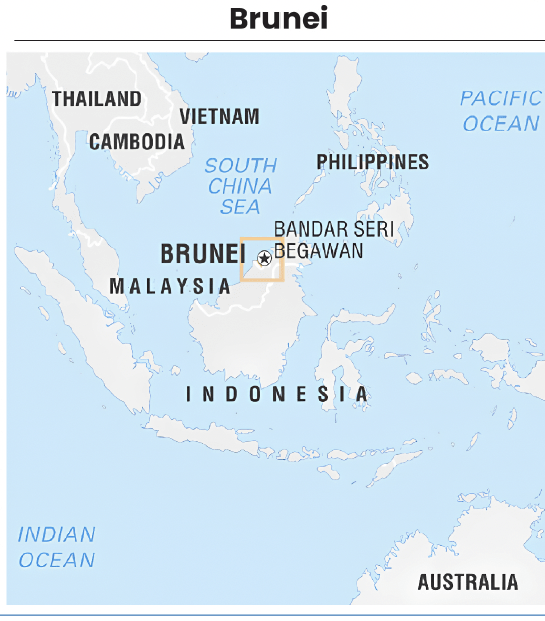
Key Highlights of the Visit:
- Both nations committed to strengthening defense ties through joint exercises, training programs, and more.
- They underscored the need for a development-oriented approach in Southeast Asia, contrasting with expansionist policies, viewed by experts as a response to China’s influence.
- They agreed to promote a more inclusive and current approach to multilateralism.
- Cooperation was extended to the operation of Telemetry, Tracking, and Telecommand Stations for satellites and launch vehicles.
- Plans to leverage each country's strengths, particularly in technology, finance, manufacturing, and processing sectors.
Significance of Brunei Darussalam for India:
- Strategic Importance: Brunei holds a key position in India's Act East Policy and Indo-Pacific Vision as a member of ASEAN.
- Indian Diaspora: Brunei is home to around 14,000 Indians.
INDIA-DENMARK GREEN STRATEGIC PARTNERSHIP
Recently, Memoranda of Understanding (MoUs) were established under the Green Strategic Partnership to enhance maritime relations between India and Denmark.
About the Green Strategic Partnership (GSP):
- Initiated in 2020, the GSP aims to broaden economic ties and promote green growth, generate employment, and bolster cooperation in tackling global challenges.
- The GSP prioritizes the implementation of the Paris Agreement and the UN Sustainable Development Goals.
- A Joint Action Plan for the Green Strategic Partnership (2021-2026) was also developed to advance the GSP.
- The collaboration under the GSP has expanded into critical areas such as quality shipping, cooperation on Port State Control, and maritime training and education.
INDIA, GCC ADOPT ACTION PLAN FOR JOINT ACTIVITIES
India-Gulf Cooperation Council (GCC) Joint Ministerial Meeting: Key Highlights
- Joint Action Plan 2024-2028: The first-ever India-GCC Joint Ministerial Meeting for Strategic Dialogue marked the adoption of a comprehensive Joint Action Plan for 2024-2028, outlining collaborative activities across sectors such as health, trade, security, agriculture and food security, transportation, energy, and culture, among others. The plan remains open to additional areas of cooperation based on mutual agreement.
- 3P Framework: India emphasized the 3Ps—People, Prosperity, and Progress—as the cornerstone to strengthening the India-GCC partnership.
- Humanitarian Crisis in Gaza: India’s External Affairs Minister reiterated India’s consistent stance, emphasizing that any response must adhere to humanitarian law principles.
India-GCC Relations Overview
- Political Relations: India’s political engagement with the GCC began with the first India-GCC Political Dialogue in 2003. Strategic partnerships now exist with Saudi Arabia, UAE, and Oman.
- Trade & Investment: Bilateral trade reached USD 161.59 billion in FY 2023-24, with the UAE ranking as India’s 7th largest source of Foreign Direct Investment (FDI).
- Diaspora: Around 8.9 million Indian nationals (66% of NRIs) live in GCC countries, contributing to approximately 30% of India’s inward remittances (2020-21).
- Energy: GCC nations are key energy suppliers to India, providing 35% of its oil imports and 70% of its gas imports (2021-22).
INDIA'S MILITARY DIPLOMACY
In recent months, India has ramped up its military diplomacy, engaging in a series of exercises with various countries across the globe involving all three branches of its armed forces.
What is Military Diplomacy?
- Commonly referred to as Defense Diplomacy, this approach entails achieving foreign policy goals through the peaceful use of defense resources and capabilities.
- India’s military diplomacy includes participation in UN peacekeeping missions, offering humanitarian aid, and conducting joint military exercises.
What are the Significances of Military Diplomacy?
- Fostering Trust and Confidence: Ongoing dialogue and military interactions can diminish distrust and lower the risk of conflicts.
- Enhancing Alliances and Partnerships: Defense collaboration agreements, technology exchanges, and joint military drills can lead to improved cooperation within regional security frameworks, such as the QUAD Security Dialogue.
- Advancing Defense Modernization and Capabilities: This can be achieved through technology transfers, knowledge sharing, and training, exemplified by the joint development of BrahMos missiles between India and Russia.
- Additional Benefits: Strategic balancing in geopolitically delicate areas and increased soft power through humanitarian assistance, among other things.
Challenges in India’s Military Diplomacy:
- India faces the challenge of managing strategic partnerships with major global powers like the US and Russia, overcoming the perception of being a 'Big Brother' among South Asian countries, and addressing gaps in domestic manufacturing capabilities.
- India's proactive approach—through military exercises, capacity-building initiatives, and peacekeeping missions—reflects its dedication to enhancing security cooperation and influencing the future security landscape of the Indo-Pacific and beyond.
INDO-PACIFIC OCEANS INITIATIVE (IPOI)
News Context
The Indo-Pacific Oceans Initiative (IPOI) marks its fifth anniversary.
About the Indo-Pacific Oceans Initiative (IPOI)
- Nature: IPOI is a voluntary, non-treaty-based framework designed to foster collaboration for an open and free Indo-Pacific region, grounded in a rules-based regional order.
- Background: India introduced the initiative in 2019 at the East Asia Summit (EAS) held in Bangkok, Thailand.
- Objective: IPOI aims to cultivate a sense of community through practical partnerships with countries that share similar values and interests.
- Foundation: The initiative builds on India’s 2015 vision of ‘Security and Growth for All in the Region’ (SAGAR), emphasizing integrated economic development and maritime security within the framework of international maritime laws and norms.
Seven pillars of the IPOI and their leading countries:
- Maritime Security - Led by the United Kingdom and India
- Maritime Ecology - Spearheaded by Australia and Thailand
- Maritime Resources - Guided by France and Indonesia
- Capacity Building and Resource Sharing - Germany takes the lead
- Disaster Risk Reduction and Management - Managed by India and Bangladesh
- Science, Technology, and Academic Cooperation - Italy and Singapore are leading
- Trade, Connectivity, and Maritime Transport - Headed by Japan and the United States
What is the Indo-Pacific?
- The Indo-Pacific concept has diverse interpretations, each with distinct perspectives.
- Geo-spatial & strategic view: The Indo-Pacific represents a unified space encompassing the Indian and Pacific Oceans, linked through the Malacca Strait, a vital trade route.
- This region hosts over half of the global population and accounts for nearly two-thirds of the world economy.
- India’s perspective: India envisions the Indo-Pacific extending from Africa’s eastern coast to the Americas.
- USA’s perspective: The U.S. defines the Indo-Pacific from the western coast of India to the Americas, aligning with the geographical limits of its Indo-Pacific Command.

INDIA’S ROLE IN CONFLICT RESOLUTION
News Context
- The Russian President mentioned that he is in regular communication with leaders from India, Brazil, and China regarding efforts to find a solution to the Ukraine conflict.
- The Russian President’s comments follow the Indian Prime Minister’s visit to Kyiv, where discussions were held with the Ukrainian President.
- Previously, the Indian Prime Minister had also visited Russia.
- The Russia-Ukraine conflict, now in its second year and the largest conflict in Europe since World War II, continues with no clear end in sight.
- Russia chose not to participate in the peace summit held in Switzerland.
- A six-point proposal led by Brazil and China, which includes a suggestion for a Russia-Ukraine summit, was rejected by Ukraine.
Conflict Resolution in International Relations
- Diplomatic Negotiations and Mediation by Neutral Parties: Neutral countries often mediate to resolve disputes, as seen when Qatar facilitated a hostage exchange in the Israel-Hamas conflict.
- International Organizations and Forums Supporting Dialogue: Organizations help conflicting nations reach agreements; for example, the Indus Waters Treaty (1960) between India and Pakistan was brokered by the World Bank.
- Economic Sanctions to Encourage Compliance: Bodies like the UN Security Council have the authority, under Article 41 of the UN Charter, to impose sanctions to influence nations' actions.
- Peacekeeping Missions by Multinational Forces: Countries, such as India, actively contribute to UN peacekeeping missions in Lebanon, Sudan, South Sudan, the Golan Heights, and Ivory Coast to support stability.
- Legal Avenues for Dispute Resolution: International courts, like the ICJ, can issue opinions on territorial control, exemplified by its advisory for the UK to relinquish the Chagos Islands.
India's stance on Ukraine emphasizes the following points:
- An urgent halt to violence and hostilities is essential.
- Humanitarian access to affected areas must be prioritized.
- The international order should be grounded in law, adherence to the UN Charter, and respect for territorial integrity and sovereignty.
- Conflict resolution should follow a path of dialogue and diplomacy.
India's Emerging Role as a Proactive Mediator in Global Conflict Resolution
- India's proactive diplomacy in conflict mediation: India's diplomatic stance has grown more assertive, enhancing international alliances and intervening in regional disputes.
- Example: In 2018, India helped facilitate the end of Saudi Arabia's 70-year ban on flights to Israel passing through its airspace.
- 5-S Approach in Foreign Policy: India's '5-S' strategy—Samman (Respect), Samvaad (Dialogue), Sahyog (Cooperation), Shanti (Peace), and Samriddhi (Prosperity)—underscores its independent foreign policy, strengthening its potential as a mediator.
- Commitment to Dialogue and Diplomacy: India consistently advocates for diplomatic resolutions to conflicts, exemplified by the Prime Minister's involvement in deterring a potential nuclear escalation by Moscow against Kyiv in 2022 (CNN report).
- Champion for the Global South: Through its G20 presidency, India emphasized the severe impact of conflicts like the Russia-Ukraine war on developing nations, reinforcing its stance as a global peacemaker.
- Guided by the Philosophy of 'Vasudhaiva Kutumbakam': Rooted in its ancient ethos of 'the world as one family,' India’s long-standing dedication to peace supports its role as a mediator.
- Example: Historically, India has refrained from adopting militaristic or aggressive doctrines.
- Proactive Global Engagement: India is quick to assist in humanitarian crises, fostering dialogue and goodwill worldwide.
- Example: India was the first to deliver drinking water to the Maldives during its 2014 water crisis, showcasing its readiness to support the global community.
- Expertise in Conflict Resolution: With substantial experience in managing both internal and regional disputes, India is well-positioned to serve as a peacemaker on the global stage.
India’s longstanding role in peace mediation:
- In 1955, India acted as a mediator between the USSR and Austria, facilitating the withdrawal of Soviet troops from Austria and encouraging Austria to adopt a stance of neutrality.
- In 1956, India played a mediating role in the Korean crisis, engaging diplomatically with the US, China, and the USSR.
- Throughout the 1950s and 60s, India served as Co-Chair of the International Commission for Supervision and Control during the Vietnam conflict.
- In 1979, India’s Finance Minister canceled a planned visit to China, showing strong support for Vietnam in response to China’s aggression.
INDIA-SINGAPORE RELATIONS
News Context
The Prime Minister of India recently visited Singapore as part of a two-country tour in Southeast Asia, with the first stop being Brunei Darussalam.
Key Outcomes of the Singapore Visit
- Enhanced Strategic Partnership: The 2015 Strategic Partnership between India and Singapore was elevated to a Comprehensive Strategic Partnership.
- Memorandums of Understanding (MoUs): India and Singapore signed four MoUs covering digital technology, semiconductors, health cooperation, and skill development.
- India-Singapore Semiconductor Ecosystem Partnership: This MoU focuses on collaboration in semiconductor cluster development, talent cultivation, and advanced manufacturing, aiming to strengthen resilient supply chains.
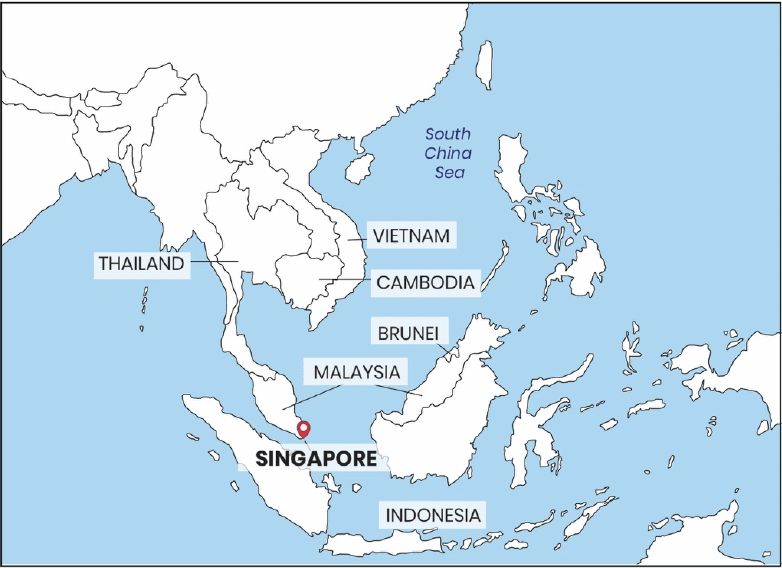
Overview of India-Singapore Relations
- Historical Ties: Singapore was established as a trading post by Sir Stamford Raffles in 1819 and was administered from Kolkata. India was among the first countries to recognize Singapore's independence in 1965.
- Trade and Economic Cooperation: Singapore ranks as India's largest trading partner within ASEAN and the 6th largest globally (2023-24).
- Bilateral trade saw significant growth following the Comprehensive Economic Cooperation Agreement (CECA), reaching USD 35.6 billion in 2023-24.
- India signed a Direct Tax Avoidance Agreement (DTAA) with Singapore in 2016 to counter tax evasion.
- Defense Cooperation: Defense partnerships strengthen India's strategic maritime presence up to the South China Sea and reinforce Singapore’s role as a security partner in the Indian Ocean.
- Notable joint exercises include Exercise Agni Warrior (Army), Exercise SIMBEX (Navy), and the Joint Military Training (JMT) for Air Forces.
- Fintech Collaboration: The launch of RuPay and the UPI-PayNow linkage marks significant progress in cross-border fintech integration.
- Multilateral Engagements: India and Singapore are members of several multilateral organizations, such as the East Asia Summit, G20, Commonwealth, IORA, and IONS.
- Singapore has joined the International Solar Alliance and the Global Bio-fuel Alliance and supports the Indo-Pacific Economic Framework for Prosperity (IPEF).
- Indian Community in Singapore: Ethnic Indians make up around 9.1% of Singapore's resident population.
- Additionally, of the 1.6 million foreign residents in Singapore, about 20% are Indian citizens.
- Tamil is one of Singapore’s four official languages.
INDIA SIGNED FIRST-OF-ITS-KIND AGREEMENTS UNDER IPEF
- India recently signed pioneering agreements centered on Clean Economy, Fair Economy, and an overarching Indo-Pacific Economic Framework (IPEF) for Prosperity.
- IPEF is based on four core pillars (see infographic).
IPEF Clean Economy Agreement (Pillar III)
- Advancing clean energy technology: Aims to bolster energy security, climate resilience, and emissions reduction among IPEF members.
- Investments and capacity building: Targets MSMEs and seeks to integrate Indian companies into global value chains through initiatives like the IPEF Catalytic Capital Fund and IPEF Accelerator.
IPEF Fair Economy Agreement (Pillar IV)
- Promoting a transparent trade and investment environment: Focuses on tackling corruption and enhancing tax transparency, resource mobilization, and tax administration.
- Improving cooperation: Aims to boost information sharing, facilitate asset recovery, and strengthen cross-border investigations and legal actions.
Overall IPEF Agreement
- Objective: Establish high-level political oversight at the Ministerial level for the various IPEF agreements.
- Importance: Provides identity and continuity to the IPEF partnership, with potential to elevate India's productive capacity and integrate it into global supply chains.
About IPEF (Indo-Pacific Economic Framework)
- Launch Year: 2022, Tokyo, Japan.
- Member Countries (14): Australia, Brunei, Fiji, India, Indonesia, Japan, Republic of Korea, Malaysia, New Zealand, Philippines, Singapore, Thailand, Vietnam, and the USA.
- India's Participation: India is a member and participates actively in Pillars II to IV of IPEF, holding observer status in Pillar I.
- Objective: To bolster economic partnerships and collaboration among Indo-Pacific nations.
- Four Core Pillars: Trade; Supply Chain Resilience; Clean Economy; Fair Economy.
Key Initiatives under IPEF
- IPEF Upskilling Initiative: Focused on empowering women and girls in IPEF’s emerging and middle-income partner nations.
- Critical Mineral Dialogue: Enhances the critical mineral supply chain and promotes sustainable mining practices across the region.
- Additional Programs: Includes the Tech Council, Cooperative Work Program (CWP), and more.
NORTHERN UNITED-2024
Recently, China and Russia announced the initiation of joint naval and air exercises named "Northern United-2024," set to take place in the Sea of Japan and the Sea of Okhotsk.
About Northern United 2024:
- The purpose of these drills is to enhance strategic collaboration between China and Russia, aiming to "boost their capacity to collaboratively address security threats."
About the Sea of Japan and the Sea of Okhotsk:
- The Sea of Japan is a marginal sea within the western Pacific Ocean, bordered by Japan and Sakhalin Island to the east, and by Russia and Korea to the west.
- The Sea of Okhotsk is enclosed by the Kamchatka Peninsula and the Kuril Islands to the east and southeast, the northern coast of Japan's Hokkaido island to the south, and Sakhalin Island to the southwest.
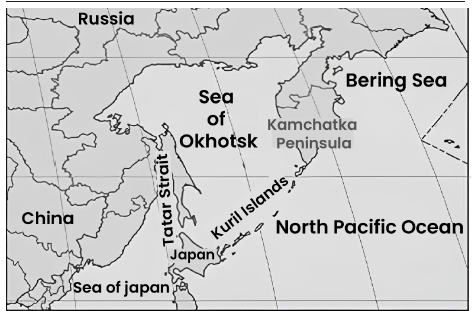
OPERATION SADBHAV
- India initiated Operation Sadbhav to deliver humanitarian assistance and disaster relief (HADR) to Laos, Myanmar, and Vietnam.
- This operation was launched in response to the devastation caused by Typhoon Yagi.
- Operation Sadbhav is a component of India's wider commitment to providing HADR in the ASEAN region, aligning with its longstanding 'Act East Policy.'
PACIFIC ISLANDS FORUM (PIF)
- The Pacific Islands Forum (PIF) has endorsed the Australia-funded Pacific Policing Initiative (PPI).
- The PPI aims to strengthen law enforcement in Pacific nations, helping them tackle law and order issues and internal security threats more effectively.
- It aligns with the Pacific Islands Forum's 2050 Strategy for the Blue Pacific Continent.
- Experts view the initiative as an effort to curb China’s influence over security in the Pacific.
About the PIF
- As the region’s leading political and economic policy organization, the PIF pursues a Pacific Vision focused on peace, harmony, and prosperity.
- Established in 1971, the PIF includes 18 member states across the Pacific Ocean.
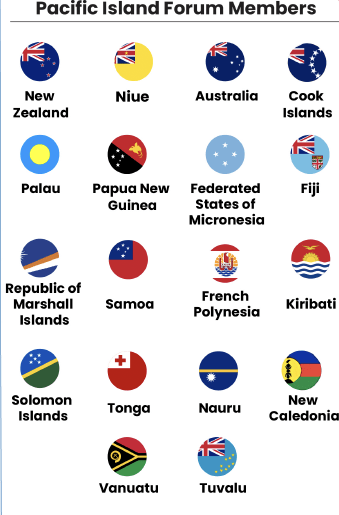
Challenges Facing Pacific Nations
- Climate Change: PIF members are significantly affected by rising sea levels, ocean warming, acidification, and other climate-related issues.
- Geopolitical Tensions: The Pacific region experiences a power struggle between China and the United States for influence.
- Drug Trafficking: The Pacific Islands serve as transit points for transnational drug smuggling routes from Asia to the Americas.
India’s Engagement with the Pacific Region
- Importance: The Pacific Islands are crucial for India’s energy security and maritime interests, aligning with a broader vision for a free, open, and inclusive Indo-Pacific region.
- Key Initiatives: These include the Indo-Pacific Oceans Initiative (2019) and the Forum for India-Pacific Islands Cooperation (2014).
RECENT MILITARY EXERCISES
- Exercise Varuna: The Indian Navy's P8I Poseidon Aircraft is making its first deployment in Europe to take part in the 2024 edition of Exercise Varuna, a bilateral naval exercise between India and France, conducted in the Mediterranean Sea.
- Exercise Eastern Bridge VII: The seventh iteration of Exercise Eastern Bridge, a collaboration between the Indian Air Force (IAF) and the Royal Air Force of Oman (RAFO), has concluded in Masirah, Oman.
- Exercise Al Najah V: The Indian Army contingent participated in the fifth edition of the India-Oman Joint Military Exercise, Al Najah V, held at the Rabkoot Training Area in Salalah, Oman.
- Yudh Abhyas: A bilateral army exercise between India and the United States.
- Tarang Shakti: A multilateral air exercise featuring participation from countries such as Australia, Greece, and Sri Lanka.
- Malabar Naval Exercise: A naval exercise involving India, Australia, Japan, and the United States.
- Indra: A bilateral exercise conducted between India and Russia.
SECURITY OF SUPPLIES ARRANGEMENT (SOSA)
News Context
India and the United States recently signed a Security of Supply Arrangement (SOSA) and a Memorandum of Understanding (MoU) for assigning Liaison Officers during the Indian Defence Minister's visit to the U.S.
Highlights of the Agreement:
- Security of Supply Arrangement (SOSA):
- Supporting National Defense: The arrangement enables both governments to ensure timely mutual access to defense goods and services in times of peace, emergencies, and conflict.
- Fulfilling National Security Requirements: SOSA permits both nations to request priority delivery of select defense items as needed.
- India as the 18th Partner: With this non-binding arrangement, India becomes the 18th SOSA partner of the U.S. Meanwhile, both countries are also working towards a binding Reciprocal Defence Procurement (RDP) Agreement.
- MoU for Liaison Officers: Aimed at enhancing information-sharing, this MoU will place Indian armed forces officers in strategic U.S. military commands.
- First Deployment: An Indian Liaison Officer will soon be positioned at the U.S. Special Operations Command in Florida.
Key Milestones in India-U.S. Defense Cooperation:
- Framework for U.S.-India Defense Relationship (2015): This formalized mutual commitment to defense sector collaboration.
- India as a Major Defense Partner (2016): India's designation led to Strategic Trade Authorization tier 1 status in 2018, allowing license-free access to various military and dual-use technologies.
- 2+2 Meetings (2018): These meetings, involving both countries' Foreign and Defense Ministers, aim to deepen strategic ties amidst global shifts.
- Roadmap for Defense Industrial Cooperation (2023): This includes prioritized areas like Intelligence, Surveillance, and Reconnaissance (ISR), Undersea Domain Awareness, and Air Combat Support.
- U.S.-India Initiative on Critical and Emerging Technology (iCET) (2023): Launched to strengthen strategic technology and defense industrial partnerships.
- INDUS-X: Advances iCET’s commitment to creating a defense innovation bridge.
- Foundational Agreements: India and the U.S. have also signed four foundational agreements to bolster military cooperation.
The four foundational defense agreements, also known as "enabling" agreements, are as follows:
- General Security of Military Information Agreement (GSOMIA) - 2002: Established to support the exchange of military intelligence. In 2019, the Industrial Security Annex (ISA) was added to GSOMIA to enable the exchange of classified information between the defense industries of the two nations.
- Logistics Exchange Memorandum of Agreement (LEMOA) - 2016: Set out fundamental terms, conditions, and guidelines for the mutual provision of logistics support, supplies, and services between the armed forces of both countries.
- Communications Compatibility and Security Agreement (COMCASA) - 2018: Designed to ensure secure military communication, improve access to advanced defense systems, and enable India to maximize the potential of its US-origin defense platforms.
- Basic Exchange and Cooperation Agreement (BECA) - 2020: Created to enable the sharing of military data, including maps, nautical charts, and other non-classified imagery and information.
TAPI GAS PIPELINE PROJECT
News Context
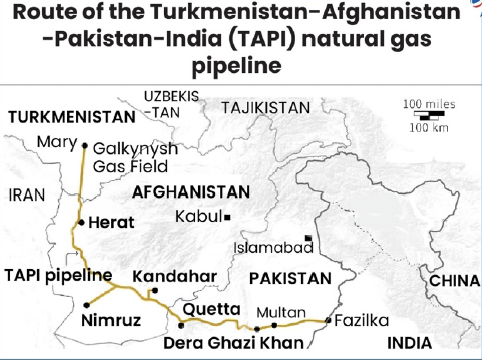
Afghan and Turkmen officials recently inaugurated the Turkmenistan-Afghanistan-Pakistan-India (TAPI) gas pipeline on the Turkmenistan side, with Afghanistan announcing plans to initiate its segment of the project.
About the TAPI Project
- TAPI Pipeline: Conceived in the mid-1990s, this pipeline is intended to carry natural gas from the Galkynysh gas field in southeastern Turkmenistan.
- Galkynysh Gas Field: Previously known as the Ýolöten Gas Field, it was discovered in 2006, situated 75 km southeast of Mary, Turkmenistan. Recognized as one of the world’s top five gas fields, it has estimated reserves between 4 to 14 trillion cubic meters and proven commercial reserves of 2.8 trillion cubic meters. It also contains around 300 million tons of oil.
- Pipeline Route: Extends roughly 1,800 km through Turkmenistan, Afghanistan, Pakistan, and India.
- Gas Transport: Projected to carry about 33 billion cubic meters of natural gas each year.
- Funding: The Asian Development Bank (ADB) is financing the project and serves as the transaction advisor.
UN ADOPTS PACT FOR THE FUTURE AT THE UN SUMMIT FOR THE FUTURE
- A Declaration on Future Generations aims to address 21st-century challenges, such as climate change, conflict, human rights, and militarism.
- The Pact has been adopted by member countries through consensus, although a small coalition of seven countries, led by Russia, has withheld support.
Key Deliverables in the Pact:
- Sustainable Development and Financial Inclusion
- Enhancing the voice of developing countries in international financial institutions.
- Bolstering the global financial safety net to safeguard the most vulnerable.
- International Peace and Security
- Renewing commitment to nuclear disarmament with the aim of complete elimination of nuclear weapons.
- Preventing the weaponization and misuse of emerging technologies, including lethal autonomous weapons.
- Science, Technology, and Digital Innovation
- Conducting scientific research responsibly and ethically, safeguarding human rights.
- Protecting indigenous and traditional knowledge, empowering women, and mitigating gender risks posed by new technologies.
- Youth and Future Generations
- Incorporating considerations for future generations into decision-making processes.
- Reforming Global Governance
- Strengthening international frameworks that govern outer space, including preventing an arms race.
- Improving the effectiveness and inclusivity of the UNSC, especially by addressing Africa's under-representation.
Annexures of the Pact for the Future
- Global Digital Compact: An international framework aimed at regulating AI and digital technologies to advance sustainable development, tackle digital inequalities, enhance cybersecurity, and prevent technology misuse.
- Declaration on Future Generations: Focused on safeguarding the well-being of future generations by prioritizing environmental protection and fostering fairness between current and future generations.
QUAD
News Context
- The Prime Minister of India recently participated in the Quad Leaders’ Summit held in Wilmington, USA.
- In the past four years, Quad leaders have convened six times, including two virtual meetings.
- This year, 2024, marks the 20th anniversary of the formation of the Quad grouping.
- The Wilmington Declaration was officially adopted at this summit.
- India is set to host the 2025 Quad Leaders’ Summit.

Key Announcements in the Wilmington Declaration:
- Health Security: Launch of the ‘Quad Cancer Moonshot’ initiative aimed at saving lives in the Indo-Pacific by tackling cervical cancer.
- Quality Infrastructure: Establishment of the ‘Quad Ports of the Future Partnership’ to leverage the Quad’s expertise in developing sustainable port infrastructure.
- Critical and Emerging Technologies: The signing of a ‘Semiconductor Supply Chains Contingency Network Memorandum of Cooperation’ to strengthen the resilience of Quad semiconductor supply chains.
- Quad Investors Network (QUIN): Efforts to mobilize significant investments for enhancing supply chain resilience and fostering joint research.
- Climate and Clean Energy: Quad collaboration to promote energy efficiency, including the deployment of affordable, high-efficiency cooling systems in the region.
- Space: India’s creation of a space-based portal for Mauritius, supporting open science and space-based monitoring for extreme weather events and climate impacts.
- Maritime Security:
- The ‘Maritime Initiative for Training in the Indo-Pacific (MAITRI)’ aims to optimize tools provided through the Indo-Pacific Partnership for Maritime Domain Awareness (initiated in 2022) and other Quad initiatives.
- The ‘Quad-at-Sea Ship Observer Mission’ set for 2025 to enhance interoperability and promote maritime safety.
About the Quadrilateral Security Dialogue (Quad):
- Nature: The Quad is a collaborative framework of maritime democracies, functioning as a Global Force for Good, with the mission of delivering positive, sustainable outcomes for the Indo-Pacific.
- Members: It consists of a diplomatic partnership between Australia, India, Japan, and the United States. It is not a military alliance or mutual defense pact.
- Purpose: The Quad is dedicated to fostering an open, stable, prosperous, inclusive, and resilient Indo-Pacific.
- Key Summit Meetings: Annual Quad Leaders' Summits and Foreign Ministers' Meetings take place.
- Scope of Mandate: The Quad’s mandate has expanded to include six working groups focused on health, climate, critical and emerging technologies, space, infrastructure, and cyber.
Other Key Initiatives of the Quad:
- The Quad Fellowship provides annual opportunities for 100 doctoral and master’s students from Quad countries to pursue degrees at top American STEM universities.
- The Quad Climate Change Adaptation and Mitigation Package (Q-CHAMP) aims to boost resilience against climate change impacts.
- The Quad Debt Management Resource Portal helps address issues related to unsustainable debt financing.
- The Quad Partnership for Cable Connectivity and Resilience focuses on enhancing regional internet connectivity by coordinating support for secure undersea cable infrastructure.
India’s Concerns Regarding QUAD:
- Hesitation Toward a Military Alliance: India remains cautious about QUAD evolving into a formal military alliance, preferring it as a platform for non-traditional security collaboration. It is concerned that a collective military agenda could undermine its strategic autonomy.
- Potential Tensions with China: Among QUAD nations, India is the only one sharing a land border with China, making it crucial for India that QUAD does not transform into an anti-China bloc, which could escalate regional tensions.
- Emergence of Similar Groupings: Other coalitions, such as SQUAD (comprising Australia, Japan, the Philippines, and the U.S.), could shift the focus away from QUAD, potentially diluting its impact.
- India’s Flexible Diplomacy: India prefers to maintain versatile partnerships, even with nations less aligned with QUAD's stance, such as the Shanghai Cooperation Organization (SCO) members.
- Effect on Other Strategic Relationships: Active participation in QUAD may strain India’s relationships with other key partners like Russia and Iran, potentially impacting broader geopolitical interests.
Quad’s ‘Principles for Digital Public Infrastructure (DPI)’
- Overview of DPI Principles The Quad has released key principles for Digital Public Infrastructure (DPI), emphasizing the role of digital transformation in advancing societal change and supporting the UN’s 2030 Agenda for Sustainable Development.
Understanding DPI
- DPI refers to digital networks that empower nations to securely and efficiently provide economic opportunities and social services to all citizens.
- Analogous to physical road networks that connect individuals and grant access to various goods and services, DPI forms a digital bridge for connectivity and access.
- India’s ‘India Stack’ represents a foundational example of DPI.
Quad’s Core Principles for DPI
- Inclusivity: Strive to remove economic, technical, and social barriers, empower users, and minimize algorithmic biases.
- Collaboration: Support the development of user-centered solutions and enable continuous adoption, encouraging innovators to design new services.
- Modularity and Extensibility: Build adaptable frameworks to accommodate changes smoothly without causing disruptions.
- Scalability: Ensure the design can handle any increase in demand through flexibility.
- Sustainability: Provide adequate financial and technical support to maintain long-term operations.
Additional Principles: Promote interoperability, uphold human rights, ensure grievance redress mechanisms, contribute to SDGs, protect intellectual property, and prioritize governance for public benefit, trust, transparency, security, and privacy.
Other Global Initiatives for the Adoption of DPI
- International Organizations: Development entities such as the World Bank and philanthropic bodies like the Gates Foundation are launching dedicated programs focused on DPI.
- One Future Alliance: A voluntary alliance working to build capacity for DPI implementation in low- and middle-income countries.
- Global DPI Repository (GDPIR) Portal: Designed, developed, and launched by India to serve as a global resource for DPI.
- Social Impact Fund (SIF): Announced to accelerate the implementation of DPI across nations in the Global South.