
PT 360 Economy July 2024: UPSC 2025
Tip: For reading free UPSC Prelims 2025 Current Affairs for Economy online, use the Next/Previous buttons or refer to the Sidebar. If you are using a mobile device, click the menu icon (three horizontal lines) to access the sidebar.
Click here for Printable PDF and Lectures.

ANGEL TAX
News Context
In the 2024-25 Budget, the government announced the removal of angel tax for all types of investors to foster entrepreneurship and encourage innovation.
Additional Details
- The Department for Promotion of Industry and Internal Trade (DPIIT), part of the Ministry of Commerce and Industry, had previously advised the abolition of angel tax before the budget announcement. The Confederation of Indian Industry (CII) also made a similar recommendation.
What is Angel Tax?
- Angel tax is the income tax imposed by the government on funds raised by unlisted companies or startups when their valuation exceeds the fair market value. For example, if a startup's fair market value is Rs 10 per share but it offers shares to investors at Rs 20, the Rs 10 difference is taxed as income.
- Objective: This tax was introduced in 2012 to combat money laundering and tax evasion.
- Legal Provision: It is applied under Section 56(II)(viib) of the Income Tax Act, 1961.
- Coverage: Initially, it was applicable only to domestic investors, but the 2023-24 Budget expanded its scope to include foreign investments (with some exceptions).
Key Funding Sources for Start-ups
- Venture Capital/Private Equity/Angel Funds: These sources provide investment for emerging and nascent startups.
- Venture capital funds, including angel funds, are classified as Alternative Investment Funds (AIFs).
- AIFs aggregate private investments to support startups and other enterprises and are divided into three categories:
- Category I: Comprises venture capital funds (including angel funds), social venture funds, and infrastructure funds.
- Category II: Includes funds not classified in Category I or III, and which do not use leverage, such as debt funds.
- Category III: Consists of funds that utilize varied or complex trading strategies and are permitted to use leverage, including hedge funds.
- Venture Capitalists: They manage pooled investments from institutional backers and tend to invest substantial amounts.
- They usually target startups with established market presence, proven business models, and potential for growth.
- They aim for significant equity stakes to gain greater influence over strategic decisions.
- Angel Investors: They often use their personal funds to invest smaller amounts at earlier stages when founders are attempting to launch their ventures.
- Investments from angel investors carry a higher level of uncertainty and risk.
Concerns Regarding the Abolition of Angel Tax
The elimination of Angel Tax could significantly impact government revenue. There are also concerns that start-ups may be exploited for money laundering or that fraudulent shell companies could be established.
What Further Steps Can Be Taken to Enhance the Startup Financial Ecosystem?
The Standing Committee on Finance, in its report titled "Financing the Startup Ecosystem," proposed the following recommendations:
- Scaling Up Unicorns: Increase the capacity of the Small Industries Development Bank of India (SIDBI) Fund-of-Funds to facilitate greater financial support for start-ups. This fund invests in other funds, including Alternative Investment Funds (AIFs).
- Listing of AIFs: AIFs should be permitted to list on capital markets to secure a steady source of funding.
- Expansion of Sectors for FVCI: Foreign venture capital investors (FVCI) should be allowed to invest in any sector where foreign direct investment (FDI) is permitted.
- Mobilizing Domestic Institutional Funds: Major banks should have the opportunity to establish fund-of-funds and invest in Category-III AIFs.
CREDIT-DEPOSIT (CD) RATIO
- The Reserve Bank of India (RBI) has expressed concerns regarding the high credit-deposit (CD) ratio of banks, urging them to reconcile the discrepancy between credit and deposit growth and to lower the CD ratio.
- The CD ratio is a financial indicator that measures the proportion of loans issued by a bank compared to its total deposits.
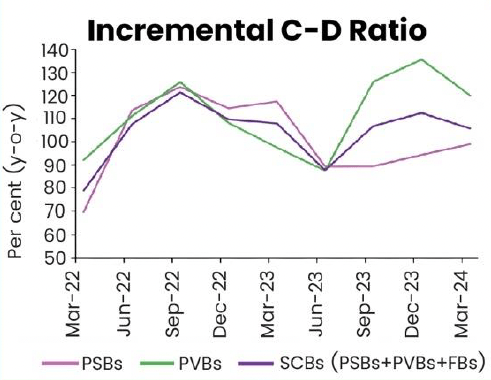
- As highlighted in the RBI's Financial Stability Report (see graph):
- The CD ratio has been increasing since September 2021, reaching a peak of 78.8% in December 2023.
- Over 75% of banks with CD ratios exceeding 75% are private sector banks.
Key Factors Contributing to the High CD Ratio:
- Increased Credit Growth:
- There is a significant rise in retail credit (including vehicle loans, personal loans, etc.).
- From April 2022 to March 2024, bank lending in the retail sector experienced a compound annual growth rate (CAGR) of 25.2%.
- There has been a growing number of loans issued to businesses and MSMEs.
- There is a significant rise in retail credit (including vehicle loans, personal loans, etc.).
- Slower Deposit Growth:
- Banks are encountering intense competition amongst themselves.
- Moreover, customers are shifting from being savers to investors, redirecting funds to capital markets, which has contributed to the slowdown in deposit growth.
Consequences of a High CD Ratio:
Banks may experience:
- Pressure on Net Interest Margins (NIM): NIM measures the net return on a bank's earning assets, such as loans and investment securities.
- Liquidity Risk: Banks might struggle to meet their payment obligations promptly.
- Credit Risk: There is a heightened risk that borrowers may default on their repayment commitments.
CITY GAS DISTRIBUTION (CGD) NETWORK
News Context
Recently, FICCI, in partnership with PWC, published a report entitled “Charting the Path Forward in City Gas Distribution: Emerging Trends and Insights.”
About City Gas Distribution (CGD)
- Pipeline Network: The CGD network consists of a system of underground pipelines that transport Piped Natural Gas (PNG) and Compressed Natural Gas (CNG). Natural gas is a cleaner-burning fossil fuel primarily made up of Methane (CH4), along with minor amounts of other higher hydrocarbons.
- Segments: CNG is mainly utilized as a fuel for vehicles, while PNG serves domestic, commercial, and industrial sectors.
- Regulation: The PNGRB Act of 2006 empowers the Petroleum and Natural Gas Regulatory Board (PNGRB) to authorize companies to develop CGD networks within designated geographical areas (GAs).
- Coverage: The country has authorized over 33,753 kilometers of natural gas trunk pipelines, with about 24,623 kilometers currently in operation. Following the latest (12th) round of bidding, coverage is expected to approach 100%, excluding the Andaman and Nicobar and Lakshadweep Islands.
- Growth: The Indian government aims to increase the share of natural gas in the energy mix from approximately 7% now to 15% by 2030.
Value Chain in the CGD Sector
- Sourcing of gas
- Transportation of gas
- Network for gas distribution
- Final consumers
Advanced Technologies in Compressed Gas Distribution (CGD)
- SCADA Technology: Monitors data from compressors and flame detectors, ensuring both safety and operational efficiency.
- GIS Mapping: Offers location-specific information, enabling companies to oversee their entire pipeline networks from any remote site.
- Smart Meters: Facilitate accurate billing and enhance leak detection capabilities.
- Example: Gujarat Gas Limited implements automated meters in GIFT City.
- Intelligent Pigging: Evaluates the condition of pipelines by identifying corrosion, metal loss, and other irregularities in real-time.
- IT-OT Convergence: Promotes quicker decision-making.
- Example: Mahanagar Gas Limited installed 5,000 smart meters in Mumbai, utilizing a low-power, long-range network for concurrent monitoring.
Importance of the CGD Network
- Clean Energy Transition: Moving towards a gas-based economy is anticipated to bolster India’s climate commitments, including:
- Achieving net zero emissions by 2070,
- Reducing emissions intensity by 45%,
- Decreasing total carbon emissions by 1 billion metric tons by 2030.
- Natural Gas as a Transitional Fuel: Natural gas acts as a crucial link between conventional and renewable energy sources in India. It serves as an essential energy supply during the transition, complements renewable energy, and supports increasing energy needs.
- Equitable Energy Access: The network will guarantee sufficient availability and fair distribution of natural gas throughout the country.
- Cost-Effective and Safe: The natural gas pipeline system offers an economical and secure way to transport natural gas from production sites to end-users.
- Advantages of CNG: It features very low emissions, a high ignition temperature that minimizes the risk of ignition, and the lowest injury and fatality rates per vehicle mile.
- Advantages of PNG: It ensures a safe and reliable supply, is easy to use, eliminates wastage, and removes the need for cylinder replacements or bookings.
Efforts to Enhance the CGD Network
- Exclusive Market Rights for CGD Firms: Companies awarded contracts to develop the CGD network are granted market exclusivity for 8 years, which can be extended to 10 years.
- Infrastructure Recognition for Gas Pipelines: The Reserve Bank of India grants this status, enabling easier access to financing from commercial banks and other financial institutions.
- Preference for Domestic Gas Supply: The government emphasizes the sourcing of domestic gas for household (PNG) and transportation (CNG) needs.
- Reform of Unified Tariffs: This initiative aims to realize the goal of a "One Nation, One Grid, and One Tariff."
- Investment Plans: The government has set a target to invest $67 billion in the natural gas sector over the next six years.
COAL SECTOR IN INDIA
News Context
The Ministry of Coal has reported a significant decline in the Compound Annual Growth Rate (CAGR) of imported coal, dropping from 13.94% during 2004-05 to 2013-14 to -2.29% from 2014-15 to 2023-24.
Key Reforms/Initiatives in the Coal Sector Contributing to Reduced Imports:
- Coal Mines (Special Provisions) Act, 2015: This legislation enabled the auctioning of coal mines for commercial mining by private companies. The first auctions for commercial coal mining were conducted in 2020.
- Mines and Minerals (Development and Regulation) Amendment Act, 2021: This amendment aimed to improve transparency and efficiency in the allocation of mining licenses and introduced the Composite Prospecting Licence-cum-Mining Lease (PL-cum-ML) for coal. This two-stage concession allows for seamless prospecting and mining operations and relaxed end-use restrictions for captive miners.
- National Coal Index (NCI): The NCI is a price index that aggregates coal prices from various sales channels, including Notified Prices, Auction Prices, and Import Prices, serving as a reliable gauge of market trends and price changes.
- Foreign Direct Investment (FDI) and Technological Innovation: The allowance of 100% FDI in coal mining has drawn international expertise and cutting-edge technologies to the sector.
- Amendments to the New Coal Distribution Policy (NCDP): Changes to the 2007 NCDP have made the sale of coal from closed, abandoned, or discontinued mines more transparent and objective.
Recent Initiatives to Further Boost Domestic Production:
- Integrated Coal Logistic Policy and Plan, 2024: Developed by the Ministry of Coal, this policy aims to create a resilient and cost-effective coal evacuation logistics system.
- Investment in Coal Gasification: The Cabinet has approved a comprehensive scheme with an allocation of ₹8,500 crore to promote Coal and Lignite Gasification Projects.
- PM Gati Shakti - National Master Plan for the Coal Sector: This initiative aims to enhance the overall efficiency and effectiveness of coal sector operations.
About Coal
- Coal is a flammable sedimentary rock that ranges in color from black to brownish-black and is primarily composed of carbon.
- Peat, which is a soft organic material made up of partially decomposed plant and mineral matter, serves as the precursor to coal.
Types of Coal Found in India:
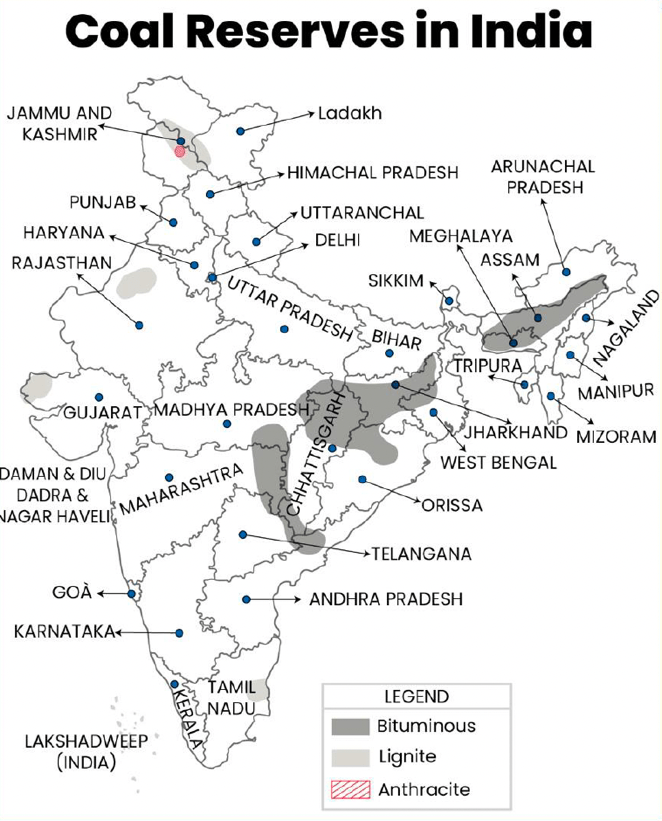
- Anthracite: This is the highest quality coal, characterized by a significant percentage of fixed carbon. It is hard, brittle, black, and shiny, and is found in limited quantities in Jammu and Kashmir.
- Bituminous: This medium-grade coal has a high heating capacity and is the most widely used type for electricity generation in India. Major reserves are located in Jharkhand, Odisha, West Bengal, Chhattisgarh, and Madhya Pradesh.
- Subbituminous: This coal is dull black and has a greater heating value than lignite.
- Lignite: The lowest grade of coal, lignite has the least carbon content and is located in Rajasthan, Tamil Nadu, and Jammu & Kashmir.
The top three states with the largest coal reserves in India are Odisha, Jharkhand, and Chhattisgarh, collectively holding about 69% of the nation’s total coal resources.
DIGITAL PUBLIC INFRASTRUCTURE (DPI)
News Context
The 'Report of India’s G20 Task Force on Digital Public Infrastructure for Economic Transformation, Financial Inclusion, and Development' has been published by India’s G20 Task Force.
About of the Report
- Established in 2023 under India's G20 Presidency, the Task Force aims to prioritize Digital Public Infrastructure (DPI) and Financial Inclusion, enhancing global adoption of DPI.
- The report provides a definition of DPI and introduces a three-part framework to promote its global advancement.
Digital Public Infrastructure (DPI)
- DPI consists of a collection of shared digital systems that:
- Must be secure and able to work together.
- Can be developed using open standards and specifications to ensure equitable access to public and/or private services at a societal scale.
- Are governed by relevant legal frameworks and rules to foster development, inclusion, innovation, trust, and competition, while also upholding human rights and fundamental freedoms.
What Does Not Qualify as DPI?
- Interventions that complement DPI, such as connectivity infrastructure that enhances access to mobile and internet through physical means.
- Digital processes that do not facilitate private innovation, like digitizing existing physical workflows to establish a government portal.
Five Key DPI Categories Across Various Sectors
- Identifiable Verification & Registries: Establishing the verified identities and registries of individuals, organizations, and objects.
- Data Exchange, Credentials, & Models: Facilitating the sharing of data (including history, profiles, and attributes) either directly between peers or in public forums.
- Signatures & Permissions: Ensuring that all data or agreements are accompanied by consent from the original source.
- Discovery & Access to Services: Enabling access to products and services through open protocols and APIs.
- Financial Transactions: Streamlining the process of making payments.
Examples:
- National ID Number (Nigeria), DNI (Peru), etc.
- India’s Digilocker
- Aadhaar eSign
- India’s Open Network for Digital Commerce (ONDC)
- Brazil’s Pix, Singapore’s PayNow, etc.
About India’s Digital Public Infrastructure (DPI)
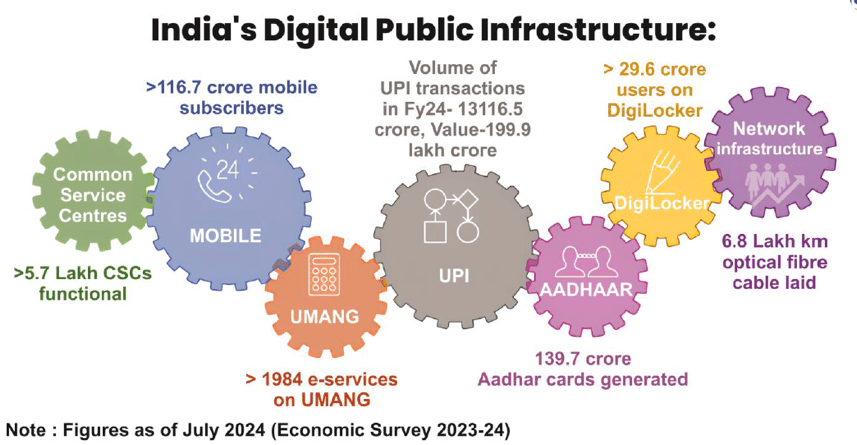
- India Stack: This is India's foundational digital public infrastructure, comprising three interconnected layers:
- Identity Layer (e.g., Aadhar, e-KYC, etc.)
- Payment Layer (e.g., UPI, Aadhar Payment Bridge, etc.)
- Data Governance Layer (e.g., DigiLocker, Account Aggregator, etc.)
Global Efforts for Digital Public Infrastructure (DPI)
- Digital Economy Working Group (DEWG): Countries have officially accepted the first consensus on the DPI approach during an international forum.
- One Future Alliance: This voluntary initiative, proposed by the G20 India Presidency, aims to enhance capacity, offer technical assistance, and provide sufficient funding to support the implementation of DPI in low and middle-income countries.
- Global DPI Repository (GDPIR): Launched during the G20 virtual leaders' summit in 2023, this initiative focuses on establishing a dedicated institution for DPI. Additionally, a Social Impact Fund (SIF) was introduced to expedite DPI implementation in nations of the Global South.
- EU Trade and Technology Council (TTC): India and the European Union have committed to advancing the development and deployment of DPI in various countries.
Three Pillars of the DPI Approach
- Technology Design:
- Interoperable and integrated systems, rather than a one-size-fits-all solution
- Emphasis on minimalist components instead of comprehensive solutions
- Systems that are federated, adaptable, and customizable
- Focus on a people-centric and inclusive approach
- Incorporation of privacy and security from the outset
- Promotion of innovation through public-private partnerships
- Governance Features:
- Establishment of legal regulations
- Clearly defined institutional responsibilities and the introduction of new institutional frameworks
- Development of collaborative contractual arrangements
- Implementation of obligations coded into the system
- Programmatic mechanisms for grievance resolution
- Commitment to open access to foster healthy competition
- Safeguards against unfair practices
DOMESTIC MONEY TRANSFER (DMT)
- The Reserve Bank of India (RBI) has updated its framework for domestic money transfers.
- The objective of this framework is to oversee the money transfer services provided by regulated entities in India.
- The Domestic Money Transfer (DMT) framework was originally established in 2011.
- This revision by the RBI is carried out under the Payment and Settlement Systems Act of 2007.
- The review was prompted by a notable increase in the number of banking outlets and advancements in payment systems for transferring funds.
- The revised framework will be implemented starting November 1, 2024.
E-MOBILITY
News Context
- The Principal Scientific Adviser to the Government of India has released the "e-mobility R&D Roadmap for India" report, aimed at reaching net-zero emissions targets.
Additional Details
- The report outlines specific technical domains and research initiatives that necessitate urgent attention in the next five years to promote self-reliance and position India as a global frontrunner in innovative mobility solutions.
Proposed R&D Roadmap
- Area of Focus: Measures Needed
- Energy Storage
- Cell: Speed up the search for additional lithium reserves, apply established extraction technologies for lithium that are available globally, and leverage existing supply chain strategies in lithium battery and cell production.
- EV Aggregates: Focus on Hybrid Energy Storage Systems (HESS) that integrate various energy storage technologies, such as batteries and supercapacitors.
- Materials and Recycling
- Conduct an economic assessment of the recycling value chain and implement strategies for tracking and reporting environmental impacts.
- Charging and Refueling
- Develop appropriate road infrastructure for the installation of transmitting pads beneath the road, create scalable systems for dynamic wireless charging technology, and design adaptive charging techniques.
Government Initiatives to Promote the Electric Vehicle Manufacturing Ecosystem:
- Electric Mobility Promotion Scheme 2024 (EMPS 2024): This initiative has been launched by the Ministry of Heavy Industries (MHI).
- Production Linked Incentive (PLI) Schemes: These are aimed at enhancing domestic manufacturing in the Advanced Automotive Technology sector.
- PLI for Advanced Chemistry Cells (ACC): This scheme aims to reduce battery costs in the country.
- Faster Adoption and Manufacturing of Electric Vehicles (FAME) India: Under Phase II of the FAME India Scheme, a Phased Manufacturing Programme (PMP) has been established.
- Goods and Services Tax (GST) Adjustments:
- The GST rate on electric vehicles has been reduced from 12% to 5%.
- The GST rate on electric vehicle chargers and charging stations has been decreased from 18% to 5%.
- Enhancing Charging Infrastructure: The Ministry of Power has released guidelines and standards for charging infrastructure for electric vehicles.
- The Bureau of Energy Efficiency (BEE) has been appointed as the Central Nodal Agency (CNA) to oversee the national rollout of charging facilities.
- State-Level Initiatives: Karnataka, Telangana, Maharashtra, and Uttar Pradesh have introduced their own electric vehicle policies.
- Additional Initiatives: The National Electric Mobility Mission Plan (NEMMP) 2020, the EV30@30 campaign (which aims for 30% of new vehicle sales to be electric by 2030), and the National Mission on Transformative Mobility and Storage, among others.
FINANCIAL INCLUSION INDEX
The Reserve Bank of India (RBI) has published the Financial Inclusion Index for March 2024.
- The Index value for March 2024 is recorded at 64.2, compared to 60.1 in March 2023.
About of the Financial Inclusion Index:
- This index provides a detailed assessment of various sectors, including banking, investments, insurance, postal services, and pensions.
- It reflects the level of financial inclusion across the nation.
- The index is expressed as a single value ranging from 0 to 100, where 0 indicates complete exclusion and 100 signifies full inclusion.
- It comprises three key components: Access (35%), Usage (45%), and Quality (20%).
- The index is released annually in July.
GIG ECONOMY
News Context
The Karnataka government has recently released a draft of the Karnataka Platform-based Gig Workers (Social Security and Welfare) Bill.
Key Aspects of the Bill
- Welfare Board: The bill proposes the creation of a 'Welfare Board' at the state level to promote the welfare of gig workers.
- Welfare Fund Establishment: This fund will consist of welfare fees collected from transactions between workers and aggregators, as well as contributions from both Union and State governments.
- Rights-based Approach: It aims to safeguard the rights of gig workers, imposing responsibilities on aggregators regarding social security and the occupational health and safety of these workers.
- Additional Features: The bill includes provisions to protect against unfair dismissals, introduces a two-tier grievance redressal system, and enhances transparency in automated monitoring and decision-making processes used by platforms.
- Current Legislative Context: As of now, Rajasthan is the only state with laws aimed at the welfare of gig workers.
Concerns Regarding the Bill
- Algorithmic Monitoring: The requirement for disclosure regarding algorithmic monitoring and the rationale for terminations could hinder business operations.
- Lack of Wage Regulation: The bill fails to address minimum wage standards or working hours for gig workers.
- Welfare Board Limitations: While the welfare board model offers some schemes for gig workers, it does not provide equivalent institutional social security benefits, such as provident funds, gratuity, or maternity benefits.
- Scope of Regulation: In contrast to the Code on Social Security, 2020, which clearly distinguishes and regulates both 'gig workers' and 'platform workers,' this bill focuses solely on a specific group of platform-based gig workers.
Definition of Gig Workers
According to the Code on Social Security, 2020, gig workers are individuals who engage in work or participate in work arrangements that generate income outside the traditional employer-employee framework. They can be broadly categorized into two groups:
- Platform-based Workers: Those whose employment relies on online software applications or digital platforms, such as delivery personnel for Zomato.
- Non-platform-based Workers: Casual wage earners in traditional sectors, whether they work part-time or full-time, such as domestic workers.
Growth Drivers:
- Key factors contributing to the growth of gig work include technological advancements, urbanization, increasing consumption demands from the rising middle class, shifts in consumer preferences towards on-demand services, and a growing desire among workers for a better work-life balance.
Measures Implemented for the Gig Economy in India:
- Code on Social Security, 2020: This legislation extends social security benefits to gig workers.
- Code on Wages, 2019: This law establishes a universal minimum wage and a floor wage applicable to both organized and unorganized sectors, including gig workers.
- e-SHRAM Portal: A national database designed for unorganized workers, which encompasses gig workers.
- Pradhan Mantri Suraksha Bima Yojana (PMSBY): Eligible registered unorganized workers, including gig workers, are entitled to an accidental insurance cover of ₹2 lakh for one year.
- Collaboration with NLSUI: The Centre for Labour Studies at the National Law School of India University (NLSUI) in Bangalore has been enlisted to help develop a new scheme for gig and platform workers, as well as those in the unorganized sector.
- An MoU has been signed between the Employees Provident Fund Organisation (EPFO) and NLSUI for this purpose.
INVERSE ETF
- SEBI has proposed the introduction of a new asset class for investors, which would provide investment strategies such as long-short equity funds and inverse ETFs.
Regarding Inverse ETFs (also known as "Short ETFs" or "Bear ETFs"):
- These are Exchange Traded Funds (ETFs) designed to utilize various derivatives to profit from a decline in the value of an underlying benchmark.
- ETFs are tradable securities that mirror an index, commodity, bonds, or a collection of assets, similar to an Index Fund.
- Inverse ETFs benefit from decreases in the value of their underlying benchmark.
- They are primarily intended for short-term holding periods.
INDIA’S STRUCTURAL TRANSFORMATION
News Context
The IMF has published a Working Paper titled "Advancing India’s Structural Transformation and Catch-up to the Technology Frontier."
Further details:
- The paper assesses India's economic growth and recommends structural reforms to boost growth further.
- While India has enjoyed strong economic growth, averaging over 6% real GDP since 2000, this growth has not been uniform across all sectors.
- Structural Transformation: This refers to the shift of an economy from low productivity and labor-intensive activities to those that are higher productivity and skill-intensive.
Indicators of Structural Transformation:
- Shift from Agriculture: Resources (labor, capital, and technology) are redirected from low-productivity primary sectors (like agriculture) to modern, high-productivity sectors (such as services).
- Sectoral Distribution: An increase in the proportion of the manufacturing and service sectors within the economy, typically assessed via employment distribution, value-added distribution, and final consumption expenditure distribution.
- Capital Accumulation: Growth in physical and human capital, alongside changes in demand composition, production, employment, and trade.
- Migration: Movement from rural to urban areas driven by developments in both rural and urban contexts.
- Demographic Transition: A shift from high birth and death rates (often seen in underdeveloped and rural regions) to low birth and death rates (common in developed and urban areas).
Status of India's Structural Transformation:
- Changes in Output Structure:
- The contribution of agriculture and related activities to total output fell from 42% in 1972-73 to 15% in 2019-20.
- The industrial sector, which includes mining, construction, manufacturing, and utilities, saw an increase in its share from 24% in 1972-73 to 25.9% in 2020-21.
- The services sector experienced a substantial growth in its output share, rising from 34.5% in 1970 to 55.3% in FY 2020.
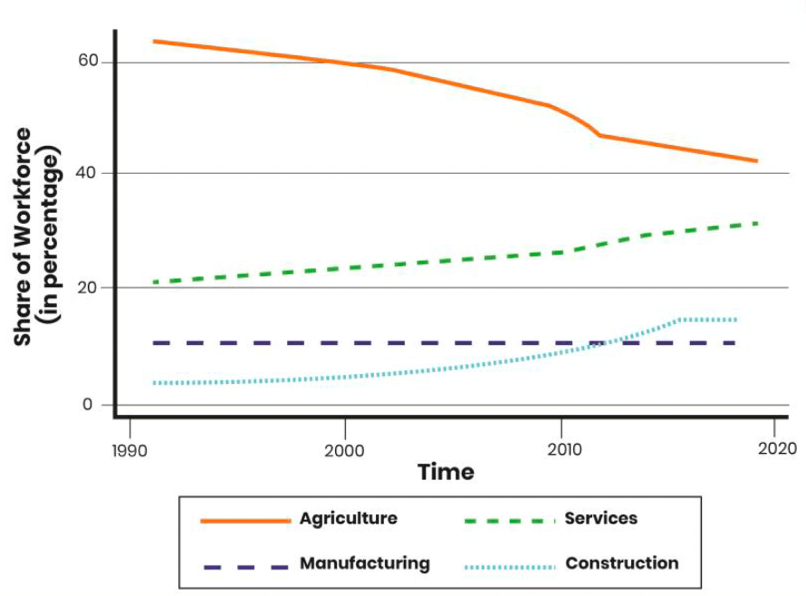
- Changes in Employment Structure:
- The proportion of employment in agriculture dropped from 73.9% in 1972-73 to 42% in 2018-19.
- Employment in the industrial sector increased from 11.3% in 1972-73 to 24% in 2019-20 over the span of five decades.
- The share of services in total employment grew significantly, from 14.8% in 1972-73 to 30.7% in 2019-20.
- Informal Sector Presence: From 1983 to 2019, the non-farm sector's share in employment increased by 20%, yet most of these jobs were informal in nature.
- Urbanization Trends: India is undergoing rapid urbanization, with projections indicating that by 2036, 600 million people, or 40% of the population, will reside in urban areas, up from 31% in 2011 and 20% in 1971.
Actions Implemented for Structural Reforms
- Tax Reforms: Implementation of the Goods and Services Tax (GST) and rationalization of corporate taxes aimed at enhancing competitiveness, addressing growing inequality, and fostering sustainable economic growth.
- Production-Linked Incentive (PLI) Scheme: This initiative is designed to attract investments in critical sectors and advanced technologies, aiming to achieve economies of scale in the manufacturing industry.
- Insolvency and Bankruptcy Code (IBC): This code has been introduced to enhance the credit culture and improve the resource allocation process.
- Labour Reforms (Four Codes): These reforms are intended to boost the Ease of Doing Business in the country, promote job creation, and increase worker productivity.
- Expansion of Digital Infrastructure: Initiatives such as Bharat Net and India Stack aim to reduce business costs, formalize the economy, support financial inclusion, and generate new business opportunities.
Key Policy Recommendations:
- Enhancing Education and Skills Development: Improving educational quality and offering vocational training can assist workers in moving to more productive sectors. Currently, India's workforce has less formal education compared to its counterparts, and the quality of education remains inadequate (ASER, 2023).
- Implementing Labor Market Reforms: Collaborating with state governments to ease restrictive employment protection laws is crucial for increasing labor market flexibility.
- Promoting Trade Integration: Strengthening trade policies by signing bilateral agreements and eliminating tariff and non-tariff barriers will facilitate integration into global markets.
- Reducing Bureaucratic Obstacles: Streamlining regulations and minimizing red tape can stimulate private sector growth, resulting in greater job creation.
- Sustaining Public Investment: Investing in robust physical infrastructure, alongside India's exceptional digital public infrastructure, will enhance the productivity of the private sector.
- Additional Measures: Enhancing the social safety net, improving access to credit for small and medium enterprises, and other related initiatives.
NEW SEBI GUIDELINES FOR CREDIT RATING AGENCIES (CRAS)
- Guidelines issued under the SEBI Act (1992) and Regulation 20 of the CRA Regulations are designed to improve the ease of doing business for Credit Rating Agencies (CRAs) while safeguarding investor interests.
Key guidelines include:
- Communication of Ratings: CRAs are required to inform companies of their ratings within one working day following the rating committee meeting.
- Appeal Process: Companies have the option to request a review or appeal the rating decision within three working days of the rating committee meeting.
- Public Disclosure: CRAs must release a press statement on their website and notify the stock exchange or debenture trustee within seven working days of the rating committee meeting.
- Record Keeping: CRAs are obligated to maintain records of these disclosures for a duration of ten years.
About of Credit Ratings in India:
- Credit Ratings: These reflect a CRA's assessment of the likelihood of timely debt repayment and the risk of default on interest and principal payments.
- Definition of CRA: According to SEBI (Credit Rating Agencies) Regulations, 1999, a CRA is a corporate entity that is engaged in or intends to engage in the rating of securities, whether listed or to be listed on a SEBI-recognized stock exchange.
- SEBI-Registered CRAs: There are seven CRAs registered with SEBI: CRISIL, CARE, ICRA, Acuité, Brickwork Ratings, India Ratings (Ind-Ra) and Research Pvt. Ltd, and Infomerics Valuation and Rating Pvt. Ltd.
Distinction Between CRA and Credit Bureau: A CRA provides an assessment regarding the likelihood of borrowers meeting their debt repayment obligations, while a credit bureau offers information on borrowers' past debt repayment behavior.
RBI DIRECTIONS ON FRAUD RISK MANAGEMENT
The Reserve Bank of India (RBI) has released three updated master directions concerning fraud risk management for Regulated Entities. The following groups fall under RBI's definition of Regulated Entities:
- Commercial Banks (including Regional Rural Banks) and All India Financial Institutions
- Cooperative Banks (such as Urban Cooperative Banks, State Cooperative Banks, and Central Cooperative Banks)
- Non-Banking Finance Companies (including Housing Finance Companies)
Key Points of the Master Directions:
- In line with the Supreme Court's ruling in the case of State Bank of India & Ors. Vs. Rajesh Agarwal & Ors. (2023), Regulated Entities must adhere to principles of natural justice within a specified timeframe before designating individuals or entities as fraudulent.
- The establishment of a Data Analytics and Market Intelligence Unit is required to enhance risk management frameworks.
- The protocols for identifying Early Warning Signals and flagging suspicious accounts have been reinforced to facilitate the prompt detection and prevention of fraud in Regulated Entities, including timely notifications to law enforcement and supervisory bodies.
Significance:
- The compliance load on Regulated Entities has been reduced and streamlined, as the previous 36 circulars have been rescinded.
- A strong internal audit and control framework is being established within these entities.
- These measures have been extended to Regional Rural Banks, Rural Cooperative Banks, and Housing Finance Companies to improve fraud risk management across a wider array of financial institutions.
SPACE ECONOMY
News Context
- The Budget for 2024-25 includes the announcement of a ₹1,000 crore venture capital fund aimed at fostering the space economy in India.
- This fund will offer financial support to space technology startups as well as small to medium enterprises, tailored to their specific needs throughout various stages of their development.
- It will complement programs such as the Seed Fund Scheme, initiated by the Indian National Space Promotion and Authorization Centre (IN-SPACe) in 2023.
Need for Establishing a Venture Capital Fund
- Guaranteeing access to affordable capital.
- Aiming to boost India's share in the global commercial space economy to 10% by 2030, up from the current 2%.
- Recognizing that the space sector is a capital-intensive field.
Private Sector Involvement in Space:
- Over 200 space-focused start-ups currently operate in India.
- In 2022, Vikram-S, the first privately developed Indian rocket, was launched as part of ‘Mission Prarambh’ by Skyroot Aerospace, based in Hyderabad.
- An MoU was signed between NSIL and Hindustan Aeronautics Limited (HAL) for PSLV production, with L&T collaborating with HAL in this consortium.
- Agnikul Cosmos, an IIT Madras-incubated startup, successfully test-launched the world’s first rocket featuring a single-piece 3D printed engine.
- OneWeb India became the first company to obtain approval from the Indian space regulator IN-SPACe for offering satellite broadband services.
India's Initiatives to Promote Space-Tech Entrepreneurship
Key Organizations
- IN-SPACe: This autonomous agency operates under the Department of Space (DoS) and is responsible for regulating, promoting, guiding, monitoring, and supervising the space activities of Non-Governmental Private Entities (NGPEs) in India.
- Antrix Corporation Limited (ACL): Established in 1992 as the commercial arm of ISRO, Antrix is a wholly owned company of the Government of India.
- New Space India Limited (NSIL): A Schedule 'A' Category company under DoS, NSIL was founded in 2019 to manage ISRO's commercial activities.
- Indian Space Association (ISpA): Formed in 2020, ISpA is a leading non-profit industry organization aimed at fostering the development of the private space sector in India.
Key Initiatives
- Indian Space Policy 2023: This policy facilitates comprehensive participation of Non-Government Entities (NGEs) across all aspects of space activities.
- Foreign Direct Investment (FDI): Recent changes to the FDI policy permit up to 74% foreign investment in satellite manufacturing and operations, and up to 49% in launch vehicles, spaceports, and related systems.
- SpaceTech Innovation Network (SpIN): A public-private initiative designed to support start-ups and small to medium enterprises within the space industry.
- Tax Benefits: Satellite launches are exempt from GST, providing a financial advantage.
- Atal Innovation Mission (AIM):
- ATL Space Challenge: In collaboration with ISRO and CBSE, AIM launched this challenge to encourage students to devise innovative solutions for specific real-world problems in the space sector.
- Atal Incubation Centre (AIC) Scheme: AIM has backed over 15 startups involved in Space Tech and related fields throughout India, focusing on areas such as UAVs, drones, surveillance equipment, aerotech, air taxis, space debris tracking and monitoring, and space education.
- Mentoring: A list of retired ISRO experts is available on the IN-SPACe Digital Platform (IDP), allowing NGEs to seek direct guidance from these mentors for specialized advice.
SUSTAINABLE DEVELOPMENT GOALS
News Context
The UN Department of Economic and Social Affairs (UN DESA) has released the Sustainable Development Goals Report 2024.
Key Findings of the Report:
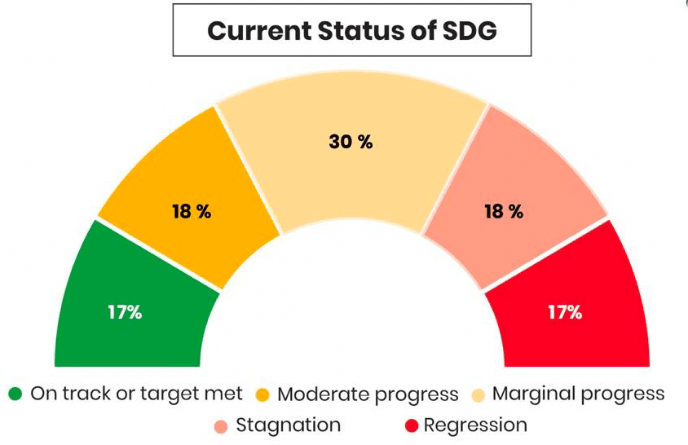
- Assessment of overall progress across various targets using global aggregate data from 2015 to 2024.
- With less than 20% of targets on track, the global community is falling short in fulfilling the promise of the Sustainable Development Goals (SDGs).
Sustainable Development Goals (SDGs)
- Background: The idea of sustainable development was articulated in the 1987 Brundtland Commission Report, defining it as development that fulfills the needs of the current generation without hindering future generations' ability to meet their own needs.
- In 2000, world leaders endorsed the United Nations Millennium Development Goals (MDGs), committing to tackle issues like poverty, hunger, disease, illiteracy, environmental degradation, and gender discrimination.
- Each MDG established targets for 2015 and included indicators to track progress from 1990 levels.
- The SDGs serve as a framework for creating a better and more sustainable future for everyone.
- They aim to confront global challenges such as poverty, inequality, climate change, environmental degradation, and the promotion of peace and justice.
- In 2015, all UN member countries embraced the 2030 Agenda for Sustainable Development, outlining a 15-year plan to achieve the Goals and their associated targets.
- This agenda consists of 17 Goals, which encompass 169 targets to be met by 2030.
India's Progress Towards Achieving Sustainable Development Goals (SDGs)
- Progress Achieved:
- SDG-3: The Maternal Mortality Ratio has decreased from 130 per 100,000 live births during 2014-2016 to 97 per 100,000 live births in 2018-2020.
- SDG-4: The Gross Enrolment Ratio for higher secondary education rose from 48.32 in 2015-2016 to 57.60 in 2021-2022.
- SDG-6: The proportion of the population with access to improved drinking water sources in rural areas increased from 94.57% in 2015-2016 to 99.29% in 2023-2024.
- SDG-7: Installed renewable energy capacity has consistently grown from 63.25 watts per capita in 2014-2015 to 136.56 watts per capita in 2023-2024.
- SDG-9: The number of patents granted has surged from 6,326 in 2015-2016 to 103,057 in 2023-2024.
- Drivers of Progress: Initiatives such as the Pradhan Mantri Awas Yojana, Ujjwala, Swachh Bharat, Jan Dhan, Ayushman Bharat-PMJAY, and PM-Mudra Yojana have played a significant role.
- Areas of Concern:
- The wage gap between male and female casual laborers has increased to Rs 178 in 2022-2023, up from Rs 96 in 2017-2018, which poses a challenge to SDG 5.
- The per capita generation of hazardous waste has risen to 9.28 metric tonnes in 2022-2023, compared to 7.19 metric tonnes in 2017-2018, which hinders progress on SDG 12.
SAARC CURRENCY SWAP ARRANGEMENT
- The Reserve Bank of India (RBI) has introduced a currency swap framework for the SAARC region for the period of 2024 to 2027.
- In agreement with the Union Government, the RBI has updated this framework, enabling it to establish bilateral swap agreements with SAARC central banks that seek to utilize the swap facility.
- A Currency Swap Arrangement (CSA) involves a contract where two parties agree to exchange two currencies at a predetermined rate, with a subsequent re-exchange of those currencies at another agreed rate on a specified future date.
- In 2012, SAARC nations established a currency swap mechanism framework to address short-term foreign exchange liquidity needs.
Key Highlights of the Revised Framework:
- For the 2024-27 period, a distinct INR Swap Window has been introduced, offering various concessions for swap support in Indian Rupees, with a total corpus of ₹250 billion.
- The RBI will also maintain swap arrangements in USD and Euro through a separate US Dollar/Euro Swap Window, which has an overall corpus of US$ 2 billion.
Significance of Currency Swap Arrangements:
- They help uphold financial stability during crises by providing a backup funding source for foreign exchange liquidity needs.
- They are instrumental in managing short-term balance of payments challenges.
Other Significant CSAs of India:
- The BRICS Contingent Reserve Agreement was signed in 2015.
- India and Japan have a bilateral CSA totaling $75 billion.
- Additional agreements include the India-UAE CSA and the India-Sri Lanka CSA, among others.
SEHER PROGRAM
- The Women Entrepreneurship Platform (WEP) has partnered with TransUnion CIBIL to launch the SEHER Program.
- WEP, established as a public-private partnership under NITI Aayog, focuses on empowering women entrepreneurs.
About of the SEHER Program:
- This program is designed to provide credit education, equipping women entrepreneurs with the financial literacy and business skills necessary for accessing financial tools to enhance their business growth.
- SEHER is part of WEP’s Financing Women Collaborative (FWC), an innovative initiative aimed at improving access to finance for women entrepreneurs.
- Currently, only 7% of the total outstanding loans to MSMEs are allocated to women-led businesses, highlighting the critical need for better credit access for women entrepreneurs.
SURVEY OF UNINCORPORATED ENTERPRISES IN INDIA
- Annual Survey of Unincorporated Sector Enterprises (ASUSE)
- The results for the years 2021-22 and 2022-23 have been published, conducted by the National Sample Survey Office under the Ministry of Statistics and Programme Implementation.
- This survey focused on unincorporated non-agricultural establishments, including proprietorships, partnerships (excluding Limited Liability Partnerships), Self-Help Groups (SHGs), cooperatives, and societies/trusts.
- About Unincorporated Enterprises
- These are producer units that are not legally recognized as separate entities from their owners. The assets utilized by unincorporated enterprises are owned by the individuals rather than the enterprises themselves.
- Consequently, these enterprises cannot engage in transactions or contractual agreements with other economic entities or incur liabilities independently.
Key Highlights from the Survey (2022-23)
- The number of establishments in this sector increased by 5.88% from the previous year, totaling 6.50 crore, with approximately 55% located in rural areas.
- The highest concentrations of establishments are found in Uttar Pradesh, West Bengal, and Maharashtra.
- Gross Value Added (GVA) rose by 9.83% compared to 2021-22.
- Women entrepreneurs lead 54% of proprietary establishments in the manufacturing sector.
- There has been a rapid increase in digitization, evidenced by a 7.2% rise in internet usage for entrepreneurial purposes.
- Improvements in credit access are indicated by an increase in the average outstanding loan per establishment, which reached Rs. 50,138 in 2022-23.
Importance of Unincorporated Enterprises
- They play a crucial role in contributing to GDP and generating employment, with 11 crore workers engaged in 2022-23.
- They are essential to the supply chain, providing support to the incorporated sector as suppliers and service providers.
Challenges Faced by Unincorporated Enterprises
- They often struggle with limited access to formal credit and a lack of registration.
- Minimal regulatory supervision makes them susceptible to economic fluctuations and changes in policy.
TRANSSHIPMENT PORT
News Context
India has received its inaugural cargo ship at the newly established semi-automated transshipment port, the Vizhinjam International Transshipment Deepwater Multipurpose Seaport in Kerala.
Additional Details
- The port is owned by the Government of Kerala.
- Its primary function is to facilitate container transshipment, along with handling multi-purpose and break-bulk cargo.
- Developed under a landlord port model, the project incorporates a Public Private Partnership (PPP) framework based on Design, Build, Finance, Operate, and Transfer (DBFOT).
- In this landlord model, the port authority serves as the regulatory body, while private companies manage port operations.
Understanding Transshipment Ports
- A transshipment port serves as a transit hub where cargo is transferred from one vessel to another en route to its final destination, which may include connections via rail and road. Smaller cargo shipments are consolidated onto larger ships capable of reaching distant international ports.

Why Vizhinjam?
- Natural Advantage: With a deep draft of 18 meters, its curvilinear coastline reduces the impact of tsunamis, and the port's location leads to only minimal erosion, which helps lower maintenance costs.
- Trans-shipment Hub: It is well-positioned to become a transshipment center, enabling the consolidation and transfer of Indian and regional cargo to mainline vessels at more competitive prices than its rivals.
- Strategic Location: Located merely 10 nautical miles from the international shipping route that links Europe, the Persian Gulf, and the Far East.
Actions Taken
- Maritime AmritKaal Vision 2047: This initiative presents a detailed strategy to enhance India's maritime industry, focusing on several key initiatives:
- Deeper Drafts: Plans to increase draft depths to 18-23 meters to accommodate larger vessels and enhance operational capabilities.
- Transshipment Hub: The establishment of a significant transshipment hub aimed at capturing a greater share of global shipping traffic.
- Reduced Vessel Charges: Implementation of strategies to decrease vessel-related fees, enhancing the cost-effectiveness of port operations.
- Private Sector Engagement: Encouraging greater participation from the private sector through projects under PM Gati Shakti – NMP and the Asset Monetization Plan.
- Development of new international Container Transshipment Terminals at Galathea Bay in Great Nicobar and Vallarpadam in Cochin (refer to the map).
- The Tariff Guidelines, 2021 offer the flexibility for PPP Operators to set market-driven tariffs, fostering healthy competition and leading to the rationalization of logistics expenses.
WORLD BANK GROUP GUARANTEE PLATFORM (WBG GP)
Here’s a paraphrased version of your content:
- The WBG GP has officially launched for business.
- Launched in 2024, WBG Guarantees brings together all guarantee products and specialists from various WBG institutions at the Multilateral Investment Guarantee Agency (MIGA).
- The World Bank offers guarantees to private lenders for infrastructure financing, particularly where there is a high demand for debt funding, significant political and sovereign risks, and the need for long-term financing crucial to a project's success.
- Before the platform's launch, the WBG provided 20 different guarantee solutions, each with its own processes, rules, and standards, which hindered client access.
- The WBG GP aims to increase the annual issuance of guarantees to $20 billion by 2030, having issued around $10.3 billion in new guarantees through the platform in 2024.
- The platform offers three types of coverage:
- Credit guarantees for loans to public or private sectors,
- Trade finance guarantees,
- Political risk insurance against non-commercial risks for private sector projects or public-private partnerships.
Significance:
- Provides a simplified and market-friendly range of guarantee options with multiple choices for World Bank clients.
- Streamlines procedures, eliminates redundancies, and enhances accessibility by reducing investment risks in developing countries.
- Focuses on high-impact projects and promotes growth.
- Aims to foster sustainable development and inclusive growth through innovative financing.
World Bank Group Global Partnership of Five Institutions
- IBRD (International Bank for Reconstruction and Development)
- IDA (International Development Association)
- IFC (International Finance Corporation)
- MIGA (Multilateral Investment Guarantee Agency)
- ICSID (International Centre for Settlement of Investment Disputes)
- IBRD and IDA constitute the World Bank. India is a member of all these institutions except for ICSID.
WAYS AND MEANS ADVANCES SCHEME
- The Reserve Bank of India (RBI) has raised the Ways and Means Advance (WMA) limit for States and Union Territories (UTs) from ₹47,010 crore to ₹60,118 crore.
- This increase will assist States and UTs in better managing their fiscal challenges.
- In addition to WMA, the Special Drawing Facility (SDF) and Overdraft (OD) facility serve as crucial financial support mechanisms for States and UTs.
- These instruments operate under the RBI Act of 1934.
About Ways and Means Advance (WMA):
- The RBI provides advances to States and UTs to address temporary cash flow mismatches between receipts and payments.
- This facility is also available for the Union Government.
- Types of WMA: Normal WMA and Special WMA (now referred to as Special Drawing Facility, or SDF).
- Initially, a State or UT receives a special WMA, and once it is depleted, it may access a normal WMA.
- The special WMA carries a lower interest rate compared to the normal WMA.
- Interest rates are linked to the Repo rate.
About Special Drawing Facility (SDF)
- The SDF is accessed by States against collateral such as the Consolidated Sinking Fund (CSF), Guarantee Redemption Fund (GRF), and Auction Treasury Bills (ATBs).
- The CSF and GRF are reserve funds held by some States with the RBI.
About Overdraft Facility:
- The overdraft facility is available when a State's financial requirements exceed its SDF and WMA limits.
- Typically, State Governments and UTs can utilize the overdraft for up to 14 consecutive days, though the RBI may provide relaxation.