PT 360 IR (International Relations) October 2024: UPSC Prelims 2025
Tip: For reading free UPSC Prelims 2025 Current Affairs for International Relations online, use the Next/Previous buttons or refer to the Sidebar. If you are using a mobile device, click the menu icon (three horizontal lines) to access the sidebar.
Click here for Printable PDF and Lectures.

ASEAN
News Context
- The Prime Minister of India participated in the 21st ASEAN-India Summit held in Vientiane, Lao PDR.
About ASEAN (Association of Southeast Asian Nations)
- Overview: An intergovernmental organization promoting political, economic, and regional stability among its members and partners in Asia.
- Establishment: Founded in 1967 in Bangkok with the signing of the ASEAN Declaration (Bangkok Declaration) by five countries: Indonesia, Malaysia, the Philippines, Singapore, and Thailand.
- Current Membership: Comprises 10 member nations (refer to the map for details).
- Headquarters: Jakarta, Indonesia.
Institutional Framework:
- ASEAN Summit:
- Annual meeting for regional issues and policy decisions.
- Chaired by a presidency that rotates annually.
- ASEAN Coordinating Council (ACC):
- Supervises the execution of ASEAN agreements and decisions.
- ASEAN Secretariat:
- Facilitates and supports ASEAN’s initiatives and activities.
- ASEAN Regional Forum (ARF):
- A platform for dialogue on political and security matters involving ASEAN members and partner nations.
- India's Role: Joined ARF in 1996.
- Decision-Making: Based on consultation and consensus.
ASEAN Future Forum:
- Proposed by Vietnam at the 43rd ASEAN Summit in 2023.
- A common platform for ASEAN members and partners to exchange ideas and propose policies.
- India is a founding member.
Key Highlights of the 21st ASEAN-India Summit
- Review and Future Plans:
- Evaluated progress in the ASEAN-India Comprehensive Strategic Partnership.
- Agreed to develop a new ASEAN-India Plan of Action (2026-2030) to strengthen the partnership.
- Adopted two joint statements and announced a 10-point plan focused on "Enhancing Connectivity and Resilience."
- Joint Statement on Strengthening ASEAN-India Comprehensive Strategic Partnership:
- Trade: Commit to accelerating the review of the ASEAN-India Trade in Goods Agreement (AITIGA) for simplified trade processes and enhanced cooperation.
- Digital Collaboration: Welcomed the launch of the ASEAN-India Fund for Digital Future to support joint activities.
- Joint Statement on Advancing Digital Transformation:
- Digital Public Infrastructure (DPI):
- Promote the exchange of best practices.
- Implement joint regional initiatives.
- Address challenges in health and other sectors.
- Financial Technology:
- Explore cross-border payment systems using innovative solutions.
- Cybersecurity:
- Strengthen cybersecurity cooperation to support the digital economy.
- Welcomed the 1st ASEAN-India Track 1 Cyber Policy Dialogue.
- Track 1 Diplomacy: Formal government-to-government dialogue conducted by official representatives, such as diplomats or heads of state.
- Other Sectors:
- Artificial Intelligence (AI), capacity building, sustainable financing, investment, and implementation mechanisms.
- Digital Public Infrastructure (DPI):
Other Tracks of Diplomacy
- Track 1.5 Diplomacy: Involves collaboration between government officials and non-governmental experts, engaging in informal discussions, bridging formal diplomacy and unofficial channels.
- Track 2 Diplomacy: Refers to informal dialogue conducted exclusively by non-governmental experts, with no direct involvement from governmental representatives.
10-Point Plan to Strengthen India-ASEAN Relations
- ASEAN-India Year of Tourism (2025): Allocation of $5 million to boost tourism exchanges between India and ASEAN member states.
- Celebrating 10 Years of the Act East Policy: Emphasis on fostering youth participation through summits, hackathons, start-up festivals, and cultural exchanges.
- Annual Women Scientists' Conclave: To be hosted under the 'India-ASEAN Science and Technology Fund' initiative.
- Review of Trade Agreements: Targeting a review of the 'ASEAN-India Trade in Goods Agreement' by 2025 to enhance trade relations.
- Health Resilience Collaboration: Institutionalizing an annual ASEAN-India Health Ministers' meeting to address health-related challenges.
- Cyber Policy Dialogue: Establishing an India-ASEAN cyber policy dialogue to enhance digital security and cyber resilience.
- Scholarship Expansion: Doubling the number of Master's scholarships at Nalanda University and introducing new scholarships in agricultural universities.
- Strengthening Disaster Resilience: Allocating $5 million from the 'ASEAN-India Fund' to improve disaster preparedness and resilience.
- Green Hydrogen Workshops: Conducting workshops to promote sustainable energy solutions, focusing on green hydrogen.
- Climate Resilience Campaign: Encouraging ASEAN leaders to join the 'Ek Ped Maa Ke Naam' (Plant for Mother) campaign to promote environmental sustainability.
Analysis of ASEAN in Comparison to Other Multilateral Organizations
- QUAD:
- Challenge to ASEAN Centrality: ASEAN views the QUAD as a potential threat to its central role in the Indo-Pacific.
- The involvement of major powers like the USA and India in the QUAD raises concerns about ASEAN's diminishing influence and leadership in regional security and diplomacy.
- Impact on ASEAN Regional Forum (ARF): The ARF, initiated by ASEAN, is a platform for political and security discussions among 27 nations, including the U.S. and China.
- The QUAD's emergence is perceived as a competing security framework, which could marginalize the ARF's role.
- Threat to the ZOPFAN Framework: ASEAN established the Zone of Peace, Freedom, and Neutrality (ZOPFAN) in 1971 to prevent external interference in Southeast Asia.
- The QUAD's activities in the region are seen as challenging this principle of neutrality.
- Challenge to ASEAN Centrality: ASEAN views the QUAD as a potential threat to its central role in the Indo-Pacific.
- South Asian Association for Regional Cooperation (SAARC):
- Economic and Trade Development: ASEAN has achieved remarkable growth in regional and global trade, contrasting with SAARC's struggles to foster economic integration and collaboration.
- Success in Regional Initiatives: ASEAN has made significant progress in areas like food security, agricultural development, humanitarian aid, and regional security, often outpacing SAARC's accomplishments in these domains.
- Bay of Bengal Initiative for Multi-Sectoral Technical and Economic Cooperation (BIMSTEC):
- Bridge between South Asia and Southeast Asia: BIMSTEC plays a pivotal role in fostering collaboration between SAARC and ASEAN countries, strengthening regional connectivity and partnerships across South and Southeast Asia.
ANACONDA STRATEGY
Taiwan's navy recently stated that China's military is using an 'anaconda strategy' to tighten its control over the island.
About the Anaconda Strategy:
- Originated as a military strategy devised by Union General Winfield Scott during the early phase of the American Civil War.
- The aim was to economically and militarily isolate the Confederacy, akin to how an anaconda snake constricts and suffocates its prey.
- China's application of the 'anaconda strategy' towards Taiwan involves:
- A combination of military posturing, psychological operations, and cyber tactics.
- The overarching goal is to compel Taiwan to capitulate without resorting to an outright invasion.
BRICS
News Context
- The 16th BRICS Summit, marking the first summit with an expanded BRICS membership, was held in Kazan, Russia.
Key Highlights of the Summit
- Kazan Declaration: Adoption of the "Kazan Declaration: Strengthening Multilateralism for Just Global Development and Security."
- Support for Brazil: Full support extended to Brazil for its BRICS Chairship in 2025 and the organization of the 17th BRICS Summit in Brazil.
About BRICS
- Origin:
- Coined in 2001 by British economist Jim O’Neill, representing emerging economies: Brazil, Russia, India, and China.
- BRIC became a formal grouping during the G8 Outreach Summit in 2006, with its first summit held in Russia in 2009.
- South Africa joined in 2010, making it BRICS.
- Current Members (10):
- Initial members: Brazil, Russia, India, China, South Africa (BRICS).
- New additions (BRICS+): Egypt, Ethiopia, Iran, Saudi Arabia, and the UAE.
- Global Representation:
- Covers 45% of the world’s population.
- Accounts for 37.3% of global GDP, surpassing the EU’s 14.5% and closely following the G7’s 29.3%.
Three Pillars of BRICS Cooperation
- Political and Security
- Economic and Financial
- Cultural and People-to-People Exchanges
Reasons for Collaboration Among BRICS Members
- Large countries in terms of area and population, facing similar developmental challenges.
- Aimed at unlocking untapped economic potential through collaboration.
- Focused on creating alternative global infrastructure in economic and financial domains.
- Desire to leverage regional markets, as member countries serve as gateways to macro-regions.
Key Initiatives of BRICS
| Key Areas | Initiatives |
|---|---|
| Financial | New Development Bank (NDB) (2014): Headquartered in Shanghai; provides financial resources for infrastructure and sustainable development projects in BRICS and other developing countries with equal voting shares among founding members. |
| Contingent Reserve Arrangement (CRA): A financial safety net offering short-term liquidity support to member nations facing balance of payments issues. | |
| BRICS Cross-Border Payments Initiative (BCBPI)/BRICS Pay: Blockchain-based payment service providing an alternative to global systems like SWIFT. | |
| BRICS Grain Exchange: A Russian initiative for establishing a commodities trading platform to create a fair agricultural trading system within BRICS. | |
| BRICS Clear Depositary: A cross-border payment settlement and depositary infrastructure. | |
| Voice to Global South | “BRICS Plus” Dialogue: Engages emerging markets and developing countries from Africa, Asia, Europe, Latin America, and the Middle East under the motto "BRICS and Global South: Building a Better World Together." |
| Endorsed BRICS Partner Country: Added 13 partner countries, including Cuba, Turkey, and Vietnam. | |
| Security | BRICS Rapid Information Security Channel: Facilitates information exchange on cyber threats among member nations' central banks. |
| International Terrorism Convention: Called for finalization and adoption of the Comprehensive Convention on International Terrorism at the UN (14th Summit, 2022). | |
| Science & Technology | BRICS Remote Sensing Satellite Constellation: Promotes cooperation in space technology and remote sensing. |
| BRICS Science, Technology and Innovation (STI) Framework Programme (2015): Supports multinational research on priority areas. | |
| R&D Vaccine Center and Early Warning System: Supported initiatives for vaccine development and preventing risks of mass infectious diseases. |
Relevance of BRICS in the Contemporary World
- Energy Security: With the inclusion of Iran, Saudi Arabia, and the UAE, BRICS countries contribute to about 44% of global crude oil production.
- Advocating for the Global South: BRICS serves as a platform for India to champion the concerns and rights of developing nations, addressing issues such as terrorism and climate change, while positioning itself as a leader of the Global South.
- Neutral Dialogue Platform: It offers a neutral space for India to engage in discussions and manage rivalries, even amidst bilateral tensions, such as during the India-China Doklam standoff.
- Pushing for Multilateral Reforms: BRICS supports India's call for reforms in global institutions like the UNSC and WTO to ensure a fairer international order.
- Notably, most BRICS+ nations, except Ethiopia and Iran, are WTO members.
About IBSA
- Overview: Established in 2003, the IBSA Dialogue Forum unites India, Brazil, and South Africa to work on global governance reforms, climate change, terrorism, and WTO negotiations, reflecting shared values of institutional accountability.
- Key Achievements:
- Development Initiatives: The IBSA Fund has supported projects in over 30 countries to combat poverty and hunger in the Global South.
- Defence Collaboration: Conducts the IBSAMAR joint naval exercise among member nations.
- Sectoral Partnerships:
- Education: Programs like the IBSA Educational Program focus on advancing expertise in reproductive medicine and endocrinology.
- Science and Technology: The IBSA Science, Technology, and Innovation Partnership encourages collaborative research.
About BASIC
- Overview: Formed in 2009, BASIC (Brazil, South Africa, India, and China) focuses on climate action and aligns with the G77 to represent developing countries' interests.
- Key Highlights:
- Together, these countries account for nearly one-third of the world’s landmass and about 40% of its population.
- Achievements:
- Unified Climate Advocacy: BASIC underscores equity and the principle of Common but Differentiated Responsibilities and Respective Capabilities (CBDRRC) in the global climate framework.
- Copenhagen Accord: Played a pivotal role in securing voluntary emission reduction commitments from major economies.
- South-South Cooperation: Promotes sharing of best practices and mutual support to advance domestic climate policies and actions.
COMMITTEE OF TEN (C-10) GROUP
- The Indian External Affairs Minister attended the inaugural Joint Ministerial Meeting of the C-10 and L.69 groups.
L.69 Group
- A coalition comprising nations from Africa, Latin America, the Caribbean, Pacific Island states, and Asia.
- India is an active member of this grouping.
C-10 Group
- Origin: Established in 2008 as the Committee of Ten African Ministers of Finance and Central Bank Governors.
- Members: Algeria, Botswana, Cameroon, Egypt, Kenya, Nigeria, South Africa, Tanzania, the Central Bank of West African States (CBWAS), and the Central Bank of Central African States (CBCAS).
- Objective: Promoting greater African representation in the governance of international financial institutions (IFIs) and related matters.
INDIA-CHINA AGREEMENT ONLINE OF ACTUAL CONTROL (LAC)
News Context
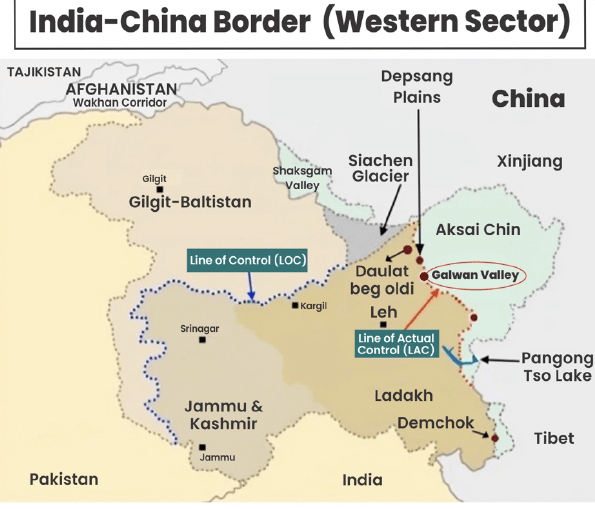
India and China have recently reached an agreement to disengage and resume patrolling in the Depsang Plains and Demchok areas along the Line of Actual Control (LAC), restoring the situation to the pre-May 2020 status.
Key Highlights of the News
- Resumption of Patrolling: As per the agreement, Indian and Chinese forces will revert to patrolling along the LAC as they did before the border tensions in May 2020.
- Earlier, disengagement was completed in other friction points of eastern Ladakh, including Galwan, Hot Springs, Gogra, and the north and south banks of Pangong Tso.
- Three-Step Process: This agreement is the first phase in a structured process consisting of:
- Disengagement
- De-escalation
- De-induction of troops from the India-China border areas.
- Strategic Importance of Depsang Plains:
- Located 30 km southeast of the Daulat Beg Oldie (DBO) post near the Karakoram Pass.
- The flat terrain is strategically significant for potential military operations, comparable to the Spanggur Gap in Chushul.
Background: 2020 India-China Standoff
- Trigger:
- The standoff began with incursions by Chinese troops, leading to:
- Clashes on the north bank of Pangong Tso in Ladakh.
- Similar incidents reported at Naku La (North Sikkim) and Galwan Valley (Ladakh).
- Galwan Incident (June 2020):
- A deadly clash without firearms, resulting in the loss of 20 Indian soldiers.
- This was the most severe confrontation since the 1962 India-China War.
- Post-2020 Build-Up: Both nations have since.
- Deployed thousands of troops along the border.
- Stationed advanced weaponry and long-range firepower.
- Undertaken significant infrastructure developments.
India-China Border Dispute Overview
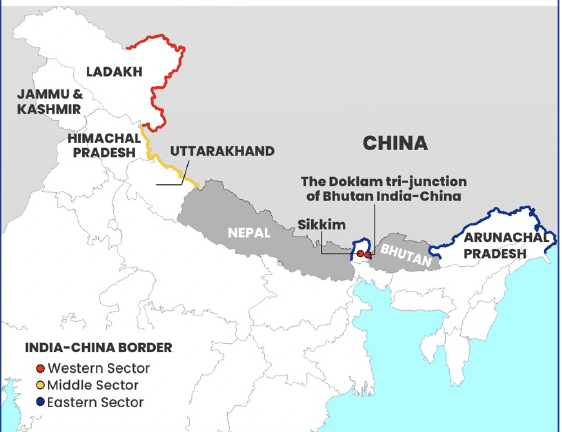
- Nature of the Dispute: The 3,488-km border remains undefined, with no mutually agreed LAC across certain sections.
- India recognizes the LAC as 3,488 km long, while China claims it is only around 2,000 km.
- Boundary Sectors:
- Western Sector (Ladakh):
- Dispute revolves around the Johnson Line (1860s), which placed Aksai Chin under Jammu & Kashmir.
- China asserts the McDonald Line (1890s), placing Aksai Chin under its control.
- Middle Sector (Uttarakhand and Himachal Pradesh):
- This sector is relatively undisputed, with exchanged maps showing general agreement.
- Eastern Sector (Arunachal Pradesh and Sikkim):
- Disputes arise from the McMahon Line, established during the 1914 Simla Convention.
- China rejects the McMahon Line and claims Arunachal Pradesh as part of the Tibet Autonomous Region.
- Cites historical ties between Tawang Monastery and Tibet's Lhasa Monastery to bolster its claims.
- Western Sector (Ladakh):
Key Steps Taken to Resolve the India-China Border Dispute
- 1993: Signed the Agreement on the Maintenance of Peace and Tranquillity along the Line of Actual Control (LAC).
- 1996: Agreed on Confidence Building Measures (CBM) in the military field along the LAC.
- 2001-2005:
- Adopted the Declaration on Principles for Relations and Comprehensive Cooperation between India and China.
- Established a Protocol on Modalities for the Implementation of CBMs along the LAC.
- 2012: Created the Working Mechanism for Consultation and Coordination (WMCC) on India-China border affairs.
- 2013: Signed the India-China Border Defence Cooperation Agreement.
Other Areas of Concern in India-China Relations
- Economic Imbalance:
- India faces a significant trade deficit with China, amounting to ~$85 billion in 2022-23.
- Dependency on China for critical supplies such as semiconductors and pharmaceutical APIs.
- China-Pakistan Nexus:
- China is a key supporter of Pakistan's military establishment, destabilizing regional security.
- Endorses Pakistan’s state-sponsored terrorism, fostering a strategic continental alliance with military and economic dimensions.
- Water Security:
- China's control over rivers feeding into northeastern India poses a strategic threat.
- Construction of dams and incidents like the 2000 dam breach in Tibet, which caused severe flooding in India, highlight this risk.
- Strategic Infrastructure Along LAC: Recent developments include a 400-meter bridge near Pangong Lake, enabling rapid troop movement between the lake’s north and south banks.
- String of Pearls Strategy: China's establishment of dual-use infrastructure in neighboring countries (e.g., Sri Lanka's Hambantota Port, Pakistan's Gwadar Port) raises concerns about India's encirclement.
- Non-reciprocity on the One China Policy:
- China’s CPEC passing through Pakistan-Occupied Kashmir (PoK) challenges India's sovereignty.
- Despite India recognizing the One China Policy in 2003, China has not reciprocated with a "One India Policy."
- Freedom of Navigation in the Indian Ocean Region (IOR): China’s territorial claims in the South China Sea threaten freedom of navigation and regional stability, impacting India's strategic interests in the IOR.
INDIA-CANADA RELATIONSHIP
News Context
- Recent escalation of diplomatic tensions between India and Canada.
Key Details
- India’s Actions:
- Expelled six Canadian diplomats.
- Announced the withdrawal of its High Commissioner to Canada amidst the dispute.
- Canada’s Demand:
- Requested India to waive diplomatic immunity of Indian officials over alleged involvement in an investigative matter, which India rejected as baseless.
- Diplomatic Immunity:
- A principle under the Vienna Convention of 1961, exempting foreign officials from the jurisdiction of local courts and authorities for both official and personal actions.

About the Vienna Convention on Diplomatic Relations, 1961:
- This is a United Nations treaty that outlines the framework for diplomatic relations between nations.
- It establishes standardized principles and guidelines for the treatment of diplomatic representatives, including the privileges and immunities granted to them.
- India became a party to the Convention in 1965 and ratified it in 1972 through the enactment of the Diplomatic Relations (Vienna Convention) Act, 1972.
Probable Impacts of the Diplomatic Fallout
- Strategic Cooperation: Western countries, including the Five Eyes Alliance, have shown a measured response, potentially affecting collaboration in security, defense, and nuclear energy sectors.
- Economic and Trade Relations: Risk of reduced bilateral trade and delays in agreements like the India-Canada Comprehensive Economic Partnership Agreement (CEPA), Foreign Investment Promotion and Protection Agreement (FIPA), and Early Progress Trade Agreement (EPTA).
- Diaspora and Student Concerns: Potential impact on the Indian diaspora in Canada, particularly the estimated 230,000 Indian students, who represent a significant proportion of Canada’s international student population.
- Immigration and Visa Processing: Possible disruptions in visa services due to security concerns, affecting travel and immigration between the two nations.
Steps to Strengthen Relations
- Constructive Diplomacy: Initiate high-level discussions to address mutual concerns transparently while maintaining the status quo.
- Security Cooperation: Strengthen collaboration on counterterrorism and extremism under the 2018 Framework for Cooperation on Countering Terrorism and Violent Extremism.
- Economic Ties: Resume negotiations on trade agreements like CEPA to rebuild economic and investment relations.
- Diaspora Engagement: Promote people-to-people connections through diaspora involvement, cultural exchanges, and Track-II diplomacy for conflict resolution.
- Strategic Interests: Enhance cooperation in the Indo-Pacific to counter China’s influence, uphold freedom of navigation, and support a rule-based order.
About the Five Eyes Alliance
- A multilateral intelligence-sharing network comprising five English-speaking countries: the USA, UK, Canada, Australia, and New Zealand.
- Focused on signals intelligence (SIGINT) and non-political oversight.
- Includes the Five Eyes Intelligence Oversight and Review Council to enhance cooperation.
INDIA-MALDIVES RELATIONSHIP
News Context
The President of the Maldives made his first bilateral state visit to India after winning the presidential elections last year.
Key Outcomes of the Visit
- Vision for Comprehensive Economic and Maritime Security Partnership:
- Development Cooperation: Both nations committed to the timely completion of projects such as the Greater Male Connectivity Project.
- Trade and Economic Cooperation: Initiated discussions on a Bilateral Free Trade Agreement and agreed to operationalize trade settlements in local currencies to reduce reliance on foreign currencies.
- Digital and Financial Initiatives: The launch of the RuPay card in the Maldives will simplify payment processes for Indian tourists.
- Health Cooperation: Steps to achieve recognition of the Indian pharmacopoeia by the Maldives, followed by establishing India-Maldives Jan Aushadhi Kendras across the country.
- Currency Swap Agreement (CSA):
- Signed under the SAARC Currency Swap Framework (2024–27), the CSA will assist the Maldives in managing its foreign exchange reserves.
- A CSA allows two parties to exchange currencies at a predetermined rate and later re-exchange them at a fixed future date.
- Infrastructure Development:
- Inaugurated the runway at Hanimadhoo International Airport.
- India pledged support for the development of a new commercial port in Thilafushi.

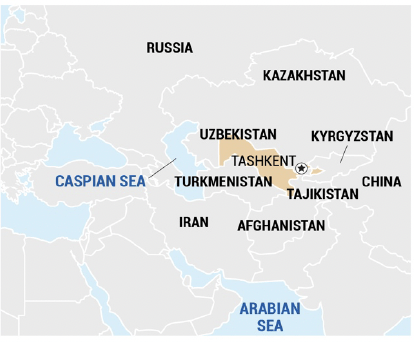
INDIA AND UZBEKISTAN SIGNED BILATERAL INVESTMENT TREATY (BIT)
Signing of BIT
- The signing of the Bilateral Investment Treaty (BIT) between the two nations will strengthen economic collaboration and foster a robust and secure investment environment.
- It is expected to enhance investor confidence and comfort.
About BIT
- BIT is a mutual agreement designed to safeguard investments made by individuals and businesses of one country in another.
- India introduced a revised Model BIT Text in 2015, replacing the 1993 version.
- The 2015 Model BIT Text has since been used for the negotiation or renegotiation of BITs and investment provisions in Free Trade Agreements (FTAs) and Economic Partnership Agreements.
Key Features of the Model BIT
- National Treatment: Ensures foreign investors receive the same treatment as domestic investors.
- Protection Against Expropriation: Restricts undue government control over foreign investments.
- Dispute Resolution: Requires exhausting local legal remedies before pursuing international arbitration.
- Additional Features: Includes an enterprise-based definition of investment and other provisions.
India-Uzbekistan Relations
- Uzbekistan holds strategic importance for India in the Central Asian region.
- Key Areas of Engagement:
- Economic Ties: India ranks among Uzbekistan's top 10 trade partners (2023-24).
- Security and Defense: Includes joint military drills like DUSTLIK.
- Multilateral Cooperation: Both nations actively collaborate in forums such as the UN, G20, BRICS, and SCO.
- Energy Security: Uzbekistan supplies uranium ore concentrates to India.
- Cultural and Community Bonds: Approximately 14,000 Indians reside in Uzbekistan, reflecting strong people-to-people connections.
INDIA-UAE BILATERAL INVESTMENT TREATY (BIT) CAME INTO EFFECT
India-UAE BIT 2024 Overview:
- The Bilateral Investment Treaty (BIT) was signed in Abu Dhabi in February 2024 and came into effect on August 31, 2024.
- The previous Bilateral Investment Promotion and Protection Agreement (BIPA) between India and the UAE, signed in 2013, expired in September 2024.
Key Features of the India-UAE BIT 2024:
- Investor-State Dispute Settlement (ISDS): Allows arbitration for disputes, but requires mandatory exhaustion of local remedies for three years before arbitration.
- Definition of Investment: Includes a closed, asset-based definition covering portfolio investments.
- Standards of Treatment: Ensures no denial of justice and no fundamental breach of due process in treating investments.
- Investment Protections: Safeguards investments against expropriation, ensures transparency, facilitates transfers, and provides for compensation in case of losses.
Significance of the BIT:
- The UAE is the seventh-largest source of Foreign Direct Investment (FDI) for India, contributing 3% (around $19 billion) of total FDI inflows from April 2000 to June 2024.
- Enhances investor confidence by assuring minimum treatment standards, non-discrimination, and an independent arbitration framework for dispute resolution.
India-UAE Relations:
- Trade: The UAE ranks as India’s third-largest trading partner after the US and China.
- Defense: The two nations conduct joint military exercises, such as "Desert Cyclone."
- Energy Security: The UAE is a significant supplier of crude oil, LNG, and LPG to India. Notably, India is the world’s third-largest importer of oil and the fourth-largest importer of LNG.
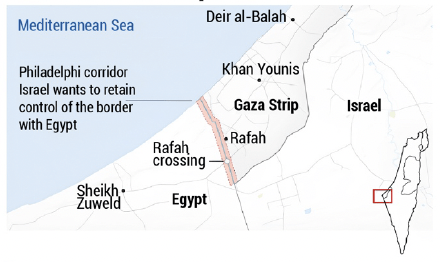
PHILADELPHI CORRIDOR
Israel has emphasized control over the Philadelphi Corridor as a key condition in ceasefire discussions with Hamas.
About the Philadelphi Corridor
- Location: A narrow strip of land, approximately 14 km long and 100 meters wide, situated along Gaza’s border with Egypt, including the Rafah crossing.
- History: Established as a demilitarized zone following Israel's withdrawal of settlements and military forces from Gaza in 2005.
- Extent: Extends from the Mediterranean Sea to the Kerem Shalom crossing with Israel.
- Management: After Israel's withdrawal, responsibility for the corridor was assigned to Egypt and the Palestinian Authority.
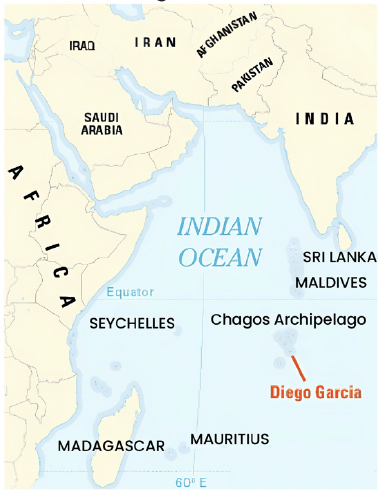
UK HANDS SOVEREIGNTY OF CHAGOS ISLANDS TO MAURITIUS
Historic Agreement on Chagos Islands
- The UK and Mauritius have reached a landmark political agreement to transfer the Chagos Islands to Mauritius, though the final treaty is still pending.
- The US-UK military base on Diego Garcia atoll will continue to operate as before.
About the Chagos Archipelago
- The Chagos Archipelago is a group of islands located about 500 km south of the Maldives in the Indian Ocean.
- It remained uninhabited until the 18th century, when it was colonized by the French, who ceded it to the British in 1814.
- In 1965, the UK established the British Indian Ocean Territory (BIOT), with the Chagos Archipelago as its central component.
- Some islands of BIOT were transferred to Seychelles in 1976.
- The UK separated the Chagos Archipelago from Mauritius in 1965, three years before Mauritius gained independence.
Significance of the Treaty
- Addressing Colonial Legacy: Resolves a longstanding dispute, marking the end of the UK's last colonial territory in Africa.
- Regional Security Dynamics: Mauritius may adjust its relationships with global powers post-transfer.
- Strategic Importance: Diego Garcia base remains critical for the US to oversee the Malacca Strait, a key global trade route, and maintain its influence in the Indian Ocean.
- Adherence to International Law: The transfer aligns with the 2019 International Court of Justice ruling and a UN General Assembly resolution.
- India supported Mauritius in the UNGA vote, reinforcing its commitment to decolonization and respect for sovereignty and territorial integrity.