
PT 360 IR (International Relations) April 2024: UPSC Prelims 2025
Tip: For reading free UPSC Prelims 2025 Current Affairs for International Relations online, use the Next/Previous buttons or refer to the Sidebar. If you are using a mobile device, click the menu icon (three horizontal lines) to access the sidebar.
Scroll down the page till the end to find the download link for Free PDF.

AUKUS
News Context
- AUKUS members are discussing potential collaboration with Japan on advanced capabilities projects
- Japan's potential inclusion in Pillar II could strengthen alliance partnerships, capability integration, and standardization
- Japan already has strong defense partnerships with Australia, the UK, and the US
- Inclusion of Japan could potentially streamline export control and information security regulations among the four countries.

About AUKUS
- Announcement and Formation: AUKUS was announced in 2021 as a new strategic defense alliance between Australia, the UK, and US.
- Objectives: AUKUS aims to enhance defense capabilities, accelerate technological integration, and expand industrial capacity among the three countries.
Pillars of AUKUS:
- Pillar I focuses on acquiring nuclear-powered submarines with the help of the UK and US.
- Pillar II is centered on developing joint capabilities in areas like cyber, artificial intelligence, quantum technologies, and undersea capabilities.
Framework for Defense Technologies: AUKUS primarily serves as a platform for advancing defense technologies rather than a defense alliance for contingencies.
Implications of AUKUS:
- Strengthening defense capabilities in the Indo-Pacific region.
- Demonstrating US commitment to security in the region.
- Re-establishing the UK's strategic presence in Indo-Pacific security.
Concerns related to AUKUS:
- Lack of clarity in narratives and strategic purpose.
- Opposition from China leading to potential regional tensions.
- Strained relations with France due to Australia's decision to acquire nuclear-powered submarines.
AUKUS vs. Quad: AUKUS focuses on defense partnership, while Quad emphasizes broader strategic cooperation in the Indo-Pacific region.
India and AUKUS
Importance of AUKUS for India:
- Strengthens the Quad: AUKUS enhances the Quad's ability to address China as a common threat and maintain a free, open, and inclusive Indo-Pacific region.
- Strategic collaboration with France: AUKUS opens up opportunities for India to collaborate strategically with France and build trust with European nations.
- Impact on Indo-Pacific dynamics: Australia's shift to AUKUS prompted France to offer India a contract for nuclear submarines, reshaping strategic dynamics in the region.
Concerns for India:
- Erosion of regional influence: India may see a decrease in influence in the Eastern Indian Ocean due to the increase in nuclear attack submarines.
- Shift in power balance: AUKUS could potentially alter the balance of power in the Indo-Pacific and reduce the effectiveness of the Quad.
ASEAN FUTURE FORUM
- Indian External Affairs Minister participated in the first 'ASEAN Future Forum' virtually
- ASEAN is an intergovernmental organization focused on economic growth and regional stability among its 10 members
- The ASEAN Future Forum was proposed by Vietnam at the 43rd ASEAN Summit in 2023
- It serves as a platform for ASEAN member states and partner countries to share new ideas and policy recommendations
- The forum aims to contribute to promoting and shaping ASEAN's development path
BIMSTEC CHARTER
- The Lower House of Nepal's Federal Parliament has approved the BIMSTEC Charter
- The BIMSTEC Charter is a foundational document that outlines the goals, principles, and structure of the BIMSTEC group
- It was signed and adopted in March 2022 during the 5th BIMSTEC Summit
- The Charter will only come into force after being endorsed by all member countries, with Nepal being the latest to do so
- BIMSTEC was established in 1997 to promote regional cooperation on various issues such as economic prosperity and social progress
- Members of BIMSTEC include Bangladesh, Bhutan, India, Myanmar, Nepal, Sri Lanka, and Thailand
DISASTER DIPLOMACY
News Context
- The 6th edition of the International Conference on Disaster Resilient Infrastructure (ICDRI) highlighted India's growing role in global crisis response efforts.
- India's participation in the conference showcased its commitment to disaster resilience and infrastructure development on a global scale.
About Disaster Diplomacy
- Disaster diplomacy is a new academic field focusing on how disasters impact international relations.
- It involves a country's efforts to provide aid and support to other nations affected by disasters or conflicts.
- The deployment of personnel, resources, and aid by a country to assist those in need is a key aspect of disaster diplomacy.
- The "Oslo Guidelines" provide guiding principles for humanitarian assistance by UN agencies, including the use of foreign military and civil defense assets in disaster relief efforts.
Coalition for Disaster Resilient Infrastructure
- Genesis: Launched in 2019 by Indian Prime Minister at UN Climate Action Summit.
- Objectives: Promote infrastructure resilience to climate and disaster risks for sustainable development.
- Members: 31 countries, 6 international organizations, and 2 private sector organizations.
- India's Membership: Yes, India is a member of the coalition.
- Key Information: Works at the intersection of the Sendai Framework for Disaster Risk Reduction and the Paris Climate Agreement, publishes biennial reports on global infrastructure resilience.
Understanding Rapprochement
- Rapprochement refers to an increase in friendliness between two countries, groups, or individuals after a period of unfriendliness.
India's Disaster Relief Initiatives
- First Responder to Natural Disasters:
- Operation Dost for earthquakes in Turkiye.
- Operation Karuna for cyclone-hit Myanmar.
- Capacity Building: Assisting countries in developing Early Warning Systems under UN's EW4All initiative.
- Helping People in Conflict Zones: Mission SAGAR providing humanitarian assistance to Mauritius and Comoros.
- Post-Conflict Relief and Rehabilitation: Focus on Nepal, Sri Lanka, and Afghanistan for relief, rehabilitation, and reconstruction.
- UN Peacekeeping: Significant contribution to peacekeeping missions for stabilization and reconstruction.
- Managing Health Disasters: COVID-19 Vaccine Maitri program assisting over 100 nations during the pandemic.
GEOPOLITICAL SIGNIFICANCE OF PORTS
News Context
- India recently signed a 10-year agreement with Iran for the development of the Shahid Beheshti Port Terminal at Chabahar Port.
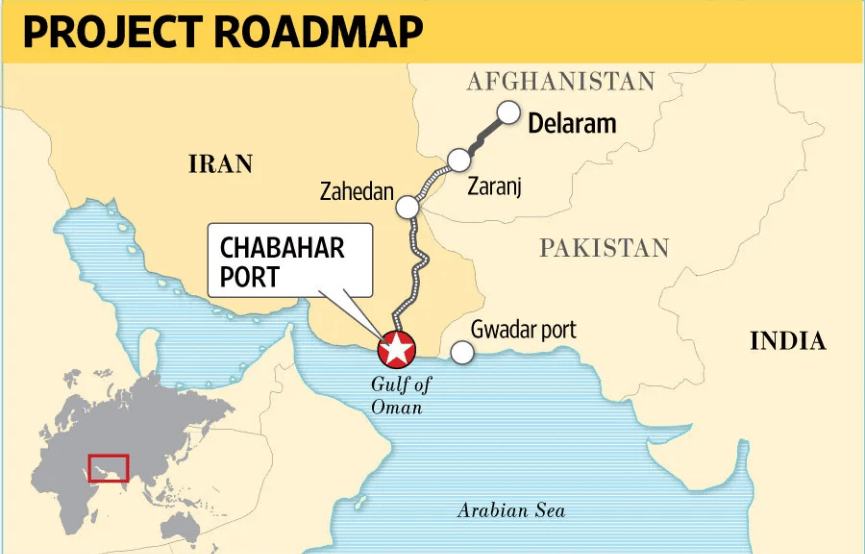
- The contract was signed between India Ports Global Limited (IPGL) and Ports and Maritime Organization (PMO) of Iran.
- IPGL is a company 100% owned by Sagarmala Development Company Limited, under the Ministry of Ports, Shipping and Waterways.
- India, Iran, and Afghanistan signed a trilateral agreement in 2016 for the development of the Chabhar port.
- The port will reduce the distance from India’s west coast to landlocked Afghanistan, Central Asia, and European nations, bypassing Pakistan.
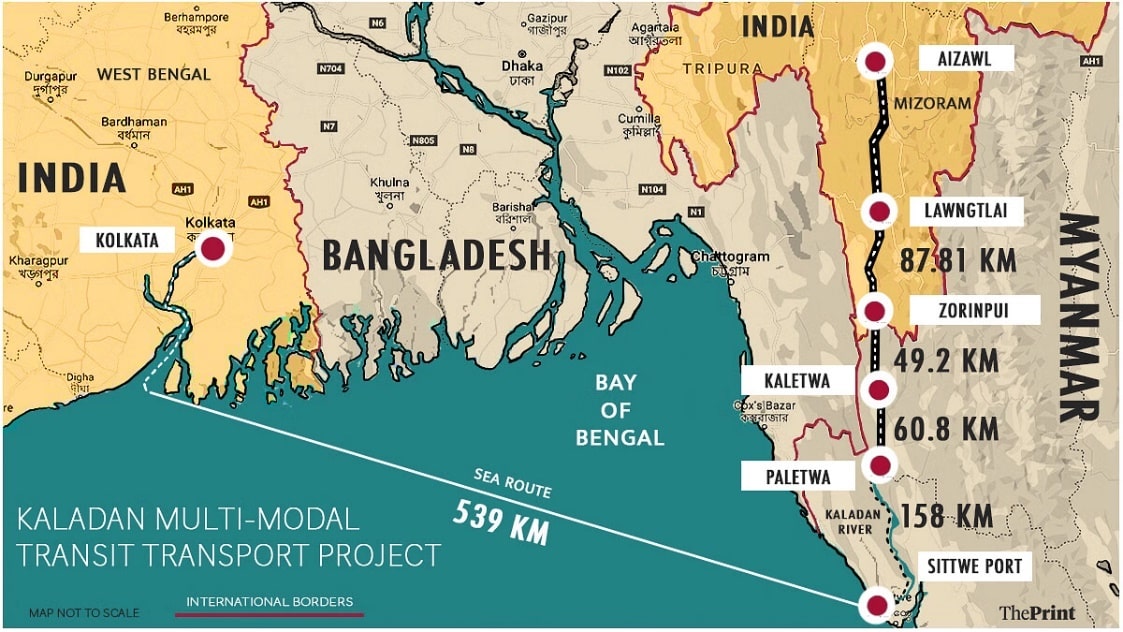
- Ministry of External Affairs (MEA) approved IPGL to take over operations of the Sittwe port in Myanmar.
- Sittwe port is part of the Kaladan Multimodal Transit Transport Project.
- These developments highlight the growing significance of ports in both economic and geopolitical aspects.
Kaladan Multimodal Transit Transport Project
- The project aims to create a multi-modal mode of transport to the North Eastern states of India through Myanmar.
- It facilitates movement from eastern ports of India to Myanmar and the North-Eastern part of India bypassing Bangladesh.
- The project aims to reduce dependency on the Siliguri Corridor, known as the chicken’s neck, squeezed between Bhutan and Bangladesh.
Strategic significance of Ports
- Act as geopolitical assets: Ports enhance strategic reach and control over sea and energy supply routes.
- Example: Indian Navy's base at Agalega Islands for marine patrols in Mozambique Channel.
- Strengthening Maritime Security: Access to Sittwe port in Myanmar improves India's maritime domain awareness.
- Enhancing Bilateral and Multilateral Relationships: Access to Duqm Port in Oman facilitates India's engagement with Gulf countries.
- Port Diplomacy: Ports are crucial for trade and projection of sea power.
- Example: Access to Chabahar port in Iran for trade partnerships in Central Asia.
- Economic Significance of Ports:
- Ports enhance connectivity, facilitate trade, and integrate procurement, production, and distribution systems.
- Ports can lead to internationalization of local currency (e.g. rupee).
- Port cities position a country at the center of global trade and financial networks.
- Ports provide alternative routes for economic and energy security.
- Example: Investment in Gwadar port in Pakistan for China to bypass Strait of Malacca.
Understanding Debt-Trap Diplomacy
- When a creditor nation lends money to a borrower nation to gain geopolitical leverage.
- Purpose: To expand the lender's influence and control over the borrower nation.
INSTABILITY IN WEST ASIA
News Context
- Israel's strike on Iranian consulate in Syria led to retaliatory attack from Iran.
- Escalation in tensions between Israel and Iran.
- Israel intercepted Iran's attack using multi-layered air defense.
- Exoatmospheric missiles used in interception.
- Houthis attacks in Red Sea reported.
- International institutions warn of economic and political threats in the region, including India.
Other major Conflicts in West Asia
- Terrorism factions: Hezbollah in Lebanon, ISIS in Syria.
- Civil Wars and Insurgency:
- Sudan: Between two factions of military.
- Yemen: Houthis conflict.
- Egypt: Insurgency in Sinai Peninsula.
About Exoatmospheric Missiles (EMs)
- EMs, also known as anti-ballistic missiles (ABMs), are designed to intercept and destroy incoming ballistic missiles during mid-course or terminal phase of their trajectory.
- They utilize advanced sensors like infrared and radar systems to detect and track incoming threats, as well as guidance systems to accurately maneuver and intercept targets moving at high speeds in space.
- Types of Exoatmospheric Missiles
- Kinetic Kill Vehicles: These missiles destroy their targets through physical impact.
- Directed Energy Weapons: These missiles use lasers or other energy beams to disable or destroy incoming threats.

What are the impacts of instability in the West Asia?
Impact on India:
- India's diplomatic and strategic balancing may be tested due to engagement with countries with conflicting interests, such as the emergence of the Iran-Russia-China axis.
- Maritime security challenges, including drone strikes and hijackings, may impact freedom of navigation in India's maritime region.
- Safety and security of the Indian diaspora in the Middle East region may become a concern.
- Threat to energy security as India is highly dependent on imports of crude oil.
- Delay in completion of infrastructure projects like the India Middle East Europe Economic Corridor.
Impact at Global Level:
- Diplomatic milestones like the Abraham Accords may get compromised.
- Intensification of maritime security challenges across the Indo-Pacific region in case of attacks on ships of USA and United Kingdom.
- Competition between nations for arms race or possession of nuclear weapons may lead to global instability.
- Higher oil prices may lead to higher food prices, intensifying food insecurity in many countries.
- International humanitarian crisis due to loss of lives, forced displacements, and instances of war crimes.
- Questions being raised on the role and relevance of international institutions like the United Nations Security Council.
INDIA AUSTRALIA SECURITY PARTNERSHIP
News Context
- Australian Government's National Defense Strategy (NDS) 2024 identified India as a top-tier security partner in the Indo-Pacific Region.
- The NDS highlighted that Australia will continue to seek opportunities with India for practical bilateral and multilateral cooperation, defense industry cooperation, and information sharing.
Concept of Indo-Pacific
- The Indo-Pacific is the world's economic and strategic center of gravity, home to more than half of the world's population and nearly 2/3rds of the global economy.
- India's definition of the Indo-Pacific stretches from the Eastern coast of Africa to the islands of the South Pacific.
- India's policy perspective on Indo-Pacific includes "inclusiveness", "openness", "ASEAN centrality", and that the concept is not directed against any country.

Initiative taken to Enhance Security Partnership
- Comprehensive Strategic Partnership (CSP): Strengthened bilateral ties in 2020 with strategic cooperation highlighted through 2+2 Ministerial dialogues and a Joint Declaration on Maritime Cooperation in the Indo-Pacific.
- QUAD Partnership: Collaborating with the US, Japan, and Australia to promote an open, inclusive, and resilient Indo-Pacific region.
- Mutual Logistics Support Arrangement (MLSA) and Defense Science and Technology Implementing Arrangement: Frameworks established to deepen defense cooperation.
- MLSA enables sophisticated logistic cooperation for military engagement and response to regional humanitarian disasters.
- Indian Navy and Air Force aircraft deployment to Australia's Cocos Keeling Islands in June and July 2023 showcased this cooperation.
- Military Exercises: Participation in AUSINDEX, PITCH BLACK, AUSTRAHIND, and Malabar Exercise to enhance military coordination.
- Australia-India Indo-Pacific Oceans Initiative Partnership (AIIPOIP): Collaboration to shape maritime cooperation in the Indo-Pacific for a rules-based maritime order.
Divergence in India Australia Security Relations
- Geopolitical Divergence: Australia's close alliance with the U.S. and India's desire for strategic autonomy create challenges in aligning their geopolitical interests fully.
- Indo-Pacific Construct Dynamics: India traditionally sees itself as an Indian Ocean power, while Australia has historically focused more on the Pacific, leading to differing perspectives on regional security.
- Asymmetric Priorities: Australia views the challenge of China in terms of politics, society, economy, and regional security, while India sees China as a direct military threat along its contested border.
- Example: India's cautious approach, such as refusing to join the US-Australia Talisman Sabre military exercise, reflects its unique perspective on security issues.
Enhancing India-Australia Security Relations
- Mutual Expansion in Indo-Pacific:
- Australia can support India's involvement in the South Pacific.
- India can collaborate with Australia in the Western Indian Ocean Region as part of the CDRI initiative.
- Deepen Technological Cooperation:
- Explore joint production opportunities for armoured vehicles, undersea sensors, radar systems, and subsystems.
- Increase Australian participation in Indian defense industry exhibitions like DEFEXPO and Aero India.
- Improve Interoperability: Enhance interoperability in maritime domain awareness, search and rescue operations, and humanitarian assistance and disaster relief.
- Implementation of Agreements: Fully implement MLSA to enable routine logistical support, tri-services exercises, cross-basing, and joint operations.
UKRAINE'S FOREIGN MINISTER PAID OFFICIAL VISIT TO INDIA
Foreign Minister's Visit and Peace Efforts
- Foreign Minister visited Ukraine to seek a peaceful resolution to the Russia-Ukraine conflict.
- Ukraine expects India to participate in a Peace summit hosted by Switzerland based on Ukrainian President's 10 points peace formula.
- The 10 points peace formula aims to bring lasting peace to Ukraine and end the war.
Inter-governmental Commission Review
- A review meeting of the Inter-governmental Commission (IGC) was held to restore cooperation to pre-war levels.
India-Ukraine Relationship
- Political: India was one of the first countries to recognize Ukraine in 1991.
- Trade and Economic Cooperation: India is Ukraine's major export destination in the Asia-Pacific as of 2020.
- Cultural: India's soft power elements like dances, yoga, philosophy, Ayurveda, and spirituality have a significant impact in Ukraine.
- People to people connect through training programs like ICCR scholarship and Kendriya Hindi Sansthan Scholarship program.
- Education: Ukraine is a preferred destination for medical education, with about 18,000 Indian students studying there before the conflict.
India's Stand on Ukraine-Russia Conflict
- India advocates for a peaceful resolution through dialogue and diplomacy.
- India is open to engaging in ways to end the war.
- India is providing continuous humanitarian assistance to Ukraine.