
Sea Level Change | ENVIRONMENTAL GEOGRAPHY Optional for UPSC
Sea Level Change | ENVIRONMENTAL GEOGRAPHY Optional for UPSC

Introduction
- Sea level change is changes in mean sea level i.e. sea level averaged over a sufficient period of time.
- These changes in mean sea level can be measured with respect to the nearby land (relative sea level) or a fixed reference frame.
- Relative sea level, which changes as either the height of the ocean surface or the height of the land changes, can be measured by a coastal tide gauge.
- Globally, sea levels are rising due to human-caused climate change.
- Sea level rise is an increase in the level of the world's oceans due to the effects of global warming.
Causes
- Continental drift and sedimentation change the volume of the ocean basins, and hence affect sea level.
Volume of mid-ocean ridge and rate of sea floor spreading also affect sea level changes - Sea level also changes when mass is exchanged between any of the terrestrial, ice, or atmospheric reservoirs and the ocean.
- Relative sea level can also be affected by local tectonic activities as well as by the land sinking when ground water is extracted or sedimentation increases.
- Sea level will change if the ocean’s temperature varies (as a result of thermal expansion) without any change in mass.
Anthropogenic factors of sea level change:
- Human activities that cause global warming, primarily through the release of greenhouse gases via the burning of fossil fuels, agricultural activities, and deforestation, had caused sea level rise.
- Global warming causes sea level rise due to melting of glaciers and thermal expansion.
Geomorphological / Geological Causes of Sea Level Change
Sea level change is influenced by various geological factors that operate over different time scales. These factors can lead to both rising and falling sea levels, contributing to changes in Earth's coastal and marine environments.
1. Tectonic Movements: Tectonic activities result from the movement of Earth's lithospheric plates, causing vertical changes in land and seafloor levels.
- Subsidence: Regions experience sinking due to the Earth's crust compressing or sinking into the mantle. Example: The sinking of the Mississippi Delta due to subsidence exacerbates sea level rise in parts of the Gulf of Mexico.
- Uplift: Portions of the Earth's crust rise, elevating coastal areas relative to sea level. Example: The uplift of the Swedish coast counters sea level rise, contributing to variations along different coastlines.
2. Isostatic Adjustment: This refers to the vertical movement of land in response to changes in weight distribution caused by ice melting or sediment deposition.
- Glacial Isostatic Adjustment (GIA): Land rebounds as the weight of ice sheets lessens after glacial retreat. Example: Northern regions like Scandinavia experience ongoing uplift due to post-glacial rebound since the last Ice Age.
- Sediment Loading: Accumulation of sediment on the seafloor leads to land subsidence as the crust adjusts to the added weight. Example: The Mississippi River delta accumulates sediment, causing subsidence and contributing to relative sea level rise.
3. Thermal Expansion: Rising temperatures cause seawater to expand, leading to an increase in sea level.
- Warmer ocean water occupies a larger volume, causing sea level to rise.
- Example: The expansion of the Pacific Ocean due to temperature increases contributes to sea level rise along the coasts of North America.
4. Isostatic Changes due to Changing Ice Sheets
- As ice sheets grow or shrink, they exert significant pressure on the crust, causing land to rise or sink.
- Glacial Loading/Unloading: Growth and retreat of ice sheets alter crustal equilibrium, causing land to sink or rebound.
- Example: The rapid melting of the Greenland Ice Sheet leads to regional uplift due to the decreased weight.
5. Seafloor Spreading and Subduction
- Plate tectonics involve the creation and destruction of seafloor, which impacts ocean basin volumes.
- Seafloor Spreading: New oceanic crust formation influences the overall ocean basin volume and sea level. Example: The Mid-Atlantic Ridge's seafloor spreading contributes to the gradual expansion of ocean basins.
- Subduction: One tectonic plate is forced beneath another, altering ocean basin volume and impacting sea level. Example: The subduction of the Pacific Plate beneath the South American Plate affects sea level on the western South American coast.
6. Volcanic Activity
- Volcanic eruptions can lead to temporary sea level changes due to various factors.
- Eruptions and Tsunamis: Volcanic Island collapses or explosive eruptions can generate tsunamis affecting coastal sea levels.
- Example: The 1883 eruption of Krakatoa triggered tsunamis that impacted sea levels across the Indian Ocean.
Anthropogenic Causes of Sea Level Changes
1. Climate Change and Global Warming:
- Greenhouse Gas Emissions: The burning of fossil fuels (coal, oil, and natural gas) releases greenhouse gases such as carbon dioxide (CO2) into the atmosphere, trapping heat and causing global temperatures to rise.
- Thermal Expansion: As the oceans absorb heat from the atmosphere, the water molecules expand, leading to an increase in sea level.
- Melting Glaciers and Ice Sheets: Higher temperatures cause glaciers and ice sheets in polar regions to melt, contributing to the rising sea levels.
- Example: The melting of the Greenland ice sheet and glaciers in Antarctica due to global warming is a major contributor to sea level rise.
2. Land Use Changes:
- Deforestation: Clearing forests for agriculture or development reduces the land's ability to retain water, leading to increased runoff into the oceans and higher sea levels.
- Urbanization: Paved surfaces in urban areas prevent water from infiltrating the ground, resulting in more runoff and elevated sea levels.
- Example: The Amazon rainforest's deforestation disrupts its role in regulating regional and global water cycles, affecting sea levels indirectly.
3. Water Extraction and Groundwater Depletion:
- Aquifer Depletion: Excessive extraction of groundwater for irrigation, industry, and municipal use reduces the amount of water stored on land, ultimately flowing into the oceans and contributing to sea level rise.
- Example: The depletion of the Ogallala Aquifer in the United States contributes to increased water flow into the oceans, raising sea levels.
4. Dam Construction and Reservoirs:
- Water Storage: The construction of large dams and reservoirs alters the natural flow of rivers and traps water that would otherwise flow into the oceans, causing a local decrease in sea levels but redistribution on a global scale.
- Example: The Three Gorges Dam in China has led to changes in regional sea levels due to the storage of water in the reservoir.
5. Coastal Engineering and Land Reclamation:
- Land Reclamation: Filling coastal areas with sediment or other materials for development reduces the volume of the ocean basin, causing local sea level rise.
- Infrastructure Development: Coastal construction and engineering alter natural sediment flows and currents, impacting sea levels and coastal erosion.
- Example: Land reclamation in areas like Dubai's Palm Jumeirah has contributed to local sea level changes.
6. Deforestation of Mangroves and Wetlands:
- Loss of Natural Barriers: Mangroves and wetlands act as natural buffers against storm surges and coastal erosion. Their destruction increases vulnerability to sea level rise impacts.
- Example: The loss of mangrove forests along coastlines leaves communities more exposed to the impacts of rising sea levels and storms.
7. Mining and Extraction Activities:
- Subsidence: Underground mining and oil/gas extraction can cause land subsidence (sinking), affecting coastal areas and leading to increased relative sea levels.
- Example: The extraction of groundwater and oil in parts of Indonesia has contributed to land subsidence and exacerbated the impacts of sea level rise.
8. Waste Disposal and Landfill:
- Land Subsidence: Improper waste disposal and landfill practices can lead to land subsidence, affecting coastal areas and contributing to relative sea level rise.
- Example: The sinking of coastal areas in Venice, Italy, due to waste disposal practices has exacerbated the impacts of rising sea levels.
Sea Level Changes Through Geological History
Sea level changes have been a prominent feature of Earth's geological history, influenced by various factors such as tectonic activity, glaciation, and global climate change. These changes have shaped landscapes, affected ecosystems, and driven evolutionary processes.
1. Paleozoic Era (541-252 million years ago):
- Transgressions and Regressions: Fluctuations in sea level led to alternating transgressions (rising sea levels) and regressions (falling sea levels).
- Example: The Ordovician-Silurian glaciation caused a regression, exposing shallow marine environments and creating unconformities in rock layers.
2. Mesozoic Era (252-66 million years ago):
- Mid-Cretaceous Highstand: A period of relatively high sea levels due to widespread tectonic rifting and volcanic activity.
- Example: Western Interior Seaway in North America, where a shallow sea covered parts of present-day central North America.
3. Cenozoic Era (66 million years ago - present):
- Eocene-Oligocene Transition: Cooling climate led to the Antarctic ice sheet's growth, causing a significant drop in sea levels.
- Example: The emergence of the Isthmus of Panama around 3 million years ago triggered major ocean circulation changes and the Great American Interchange.
4. Pleistocene Epoch (2.6 million - 11,700 years ago):
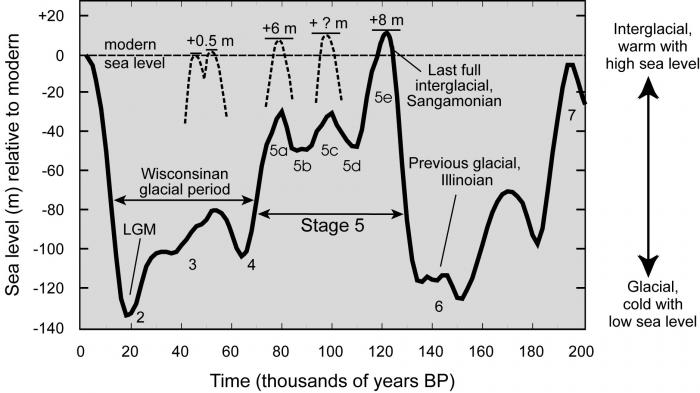
- Glacial-Interglacial Cycles: Fluctuations between ice ages (glacials) and warmer periods (interglacials) caused dramatic sea level variations.
- Example: During the Last Glacial Maximum (LGM), sea levels were about 120 meters lower than today due to massive ice sheets.
5. Holocene Epoch (11,700 years ago - present):
- Post-Glacial Rebound: As ice sheets melted, land rebounded, causing relative sea level changes that vary by location.
- Example: Isostatic rebound in Scandinavia led to ongoing land uplift, affecting coastal regions and relative sea levels.
6. Anthropogenic Impact (Industrial Era - present):
- Accelerated Sea Level Rise: Human activities, particularly the burning of fossil fuels, have increased global temperatures and accelerated ice melt.
- Example: Since the late 19th century, sea levels have risen at an average rate of about 3.3 millimeters per year, threatening coastal communities.
7. Future Projections (ongoing):
- Global Warming Effects: Continued greenhouse gas emissions are expected to lead to further ice melt and thermal expansion of seawater.
- Anticipated Consequences: Rising sea levels could submerge low-lying coastal areas, increase coastal erosion, and impact ecosystems and infrastructure.
Sea level changes throughout Earth's history have been driven by a complex interplay of geological, climatic, and anthropogenic factors. These changes provide critical insights into Earth's dynamic processes and highlight the need for sustainable environmental stewardship in the face of ongoing sea level rise.
Sea Level Changes in India through Geological History
Introduction:
Sea level changes have been a prominent feature of Earth's geological history. India, with its diverse geological formations, has experienced significant fluctuations in sea levels over millions of years.
1. Early Geological Eras:
- Precambrian Era: During this era, sea levels were generally high, covering vast areas of India.
- Example: The Aravalli Range in northwestern India contains marine sedimentary rocks dating back to this era, indicating the presence of ancient seas.
2. Paleozoic Era:
- Cambrian to Permian Periods: Sea levels fluctuated but remained relatively shallow, resulting in sedimentary rock formations.
- Example: The Spiti Valley in northern India preserves marine fossils from the Paleozoic era, indicating periods of shallow seas.
3. Mesozoic Era:
- Triassic to Cretaceous Periods: India was part of the supercontinent Pangaea and experienced changes in sea levels due to tectonic activity.
- Example: The Kutch Basin in western India holds sedimentary layers indicative of alternating marine and terrestrial environments.
4. Cenozoic Era:
- Paleogene Period: India began separating from Madagascar and experienced marine transgressions.
- Example: The Mumbai region has Eocene marine sedimentary rocks, revealing a time when the Arabian Sea flooded parts of western India.
5. Neogene Period:
- Miocene Epoch: India's collision with Eurasia led to the uplift of the Himalayas and changes in sea levels.
- Example: The Siwalik Hills contain marine fossils that show the influence of changing sea levels on terrestrial habitats.
6. Quaternary Period:
- Pleistocene Epoch: Fluctuating ice ages caused significant sea level changes, exposing land bridges between India and neighboring regions.
- Example: The limestone shoals of Adam's Bridge (Rama's Bridge) between India and Sri Lanka are believed to have been partially exposed during lower sea levels.
7. Holocene Epoch:
- Recent Times: Modern sea levels stabilized after the last ice age, but minor fluctuations continue.
- Example: The coastline of Gujarat and the Gulf of Cambay have experienced changes due to rising sea levels, submerging ancient settlements.
Conclusion:
India's geological history showcases a dynamic interplay between tectonic events and climate fluctuations, resulting in significant sea level changes. These changes have played a crucial role in shaping India's diverse geological landscape and its connection to neighboring landmasses over millions of years.
Q. Sea Level Changes in the Late Pleistocene Period and Their Possible Causes.
Introduction
- The Late Pleistocene epoch: approximately 126,000 to 11,700 years ago.
- Characterized by significant fluctuations in global sea levels.
- Drastic shifts between glacial and interglacial periods.
Here are important points:
1. Glacial Maxima and Sea Level Drop
- Glacial periods marked by extensive ice sheets and glaciers.
- Large amounts of water trapped as ice on land.
- Resulted in a lower sea level due to reduced ocean water volume.
- Example: During the Last Glacial Maximum (LGM) around 20,000 years ago, sea levels were about 120 meters lower than today. The exposed Bering Land Bridge connected Asia and North America.
2. Interglacial Periods and Sea Level Rise
- Interglacial periods featured warmer temperatures and ice melting.
- Ice sheets and glaciers retreated, releasing stored water into the oceans.
- Sea level rose as ocean volume increased.
- Example: At the onset of the Holocene epoch around 11,700 years ago, melting ice contributed to a rise in sea levels by about 50 meters.
3. Isostatic Adjustments
- Isostatic rebound: land movements due to changes in ice mass.
- During glaciation, land depressed by the weight of ice; after melting, land slowly rises.
- Can amplify or counteract sea level changes locally.
- Example: Scandinavia continues to rise after the retreat of the Scandinavian Ice Sheet, while areas near the former ice sheet edge, like parts of Scotland, experience subsidence.
4. Climate and Ocean Circulation
- Climate affects ice formation and melting rates.
- Warmer climates lead to increased melting and higher sea levels.
- Changes in ocean circulation impact heat distribution and ice stability.
- Example: Weaker North Atlantic Deep Water formation during certain periods could reduce heat transport and contribute to ice growth, lowering sea levels.
5. Global vs. Local Factors
- Global factors: Earth's orbital variations, solar radiation changes.
- Local factors: Tectonic movements, glacial rebound, sediment deposition.
- Both contribute to sea level changes on different scales.
- Example: The uplift of the Andes mountain range due to tectonic forces has local sea level effects, impacting the adjacent South American coastline.
6. Human Influence in the Late Pleistocene
- Human presence since the Middle Pleistocene (Neanderthals).
- Late Pleistocene saw Homo sapiens' expansion and technological advances.
- Limited direct impact on sea level changes due to smaller populations.
- Indirect impacts through land use changes and carbon emissions would become significant in later epochs.
Conclusion
- The Late Pleistocene experienced significant sea level changes due to glacial-interglacial cycles.
- Factors like ice sheet dynamics, climate variations, and geological processes contributed.
- Understanding these changes provides insights into Earth's complex interplay between climate, geology, and life.
Impacts
- Displacing human populations and other species due to flooding and also erosion.
- Increasing ground water salinity from coastal flooding, which reduces freshwater quality and availability and decreases soil quality.
- This, in turn, affects agricultural crops and livestock.
- Wetland flooding.
- More destructive storms and cyclones
- Loss of habitat for fish, birds, and coastal plants that survive in shallow water.
Management
- Construct New Infrastructure.
- Maintain and Restore Wetlands.
- Maintain Water Quality and Availability.
- Model Climate Risk.
- Modify Land Use.
- Monitor Operational Capabilities.
- Plan for Climate Change.
- Preserve Coastal Land and Development.
- Preserve Habitat.
- Repair and Retrofit Facilities.