
Other Hazards | ENVIRONMENTAL GEOGRAPHY Optional for UPSC
Other Hazards | ENVIRONMENTAL GEOGRAPHY Optional for UPSC

15.1 Heat Wave
Introduction
- A heat wave is a period of excessively hot weather, which may be accompanied by high humidity, especially in oceanic climate countries.
- It is usually measured relative to the usual climate in the area and relative to normal temperatures for the season.
- Temperatures that people from a hotter climate consider normal can be called a heat wave in a cooler area.
- Several countries have adopted their own standards on heatwaves.
- It occurs in both land and ocean.
- A marine heatwave is a period of abnormally high temperatures relative to the average seasonal temperature in a particular region of a sea or ocean.
- Heat waves often have complex effects on human economies and thus is characterized as a hazard.
Definition
- The World Meteorological Organization, defines a heat wave as five or more consecutive days of prolonged heat in which the daily maximum temperature is higher than the average maximum temperature by 5 °C (9 °F) or more.
- In 1900, A. T. Burrows defined a "hot wave" as a spell of three or more days on each of which the maximum shade temperature reaches or exceeds 90 °F (32.2 °C).
- A definition based on Frich et al.'s Heat Wave Duration Index is that a heat wave occurs when the daily maximum temperature of more than five consecutive days exceeds the average maximum temperature by 5 °C (9 °F).
Criteria for Heat Waves in India
The Indian Meteorological Department (IMD) has given the following criteria for Heat Waves :
- Heat Wave need not be considered till maximum temperature of a station reaches atleast 40°C for Plains and atleast 30°C for Hilly regions.
- When normal maximum temperature of a station is less than or equal to 40°C : Heat Wave Departure from normal is 5°C to 6°C Severe Heat Wave Departure from normal is 7°C or more
- When normal maximum temperature of a station is more than 40°C : Heat Wave Departure from normal is 4°C to 5°C,Severe Heat Wave Departure from normal is 6°C or more
- When actual maximum temperature remains 45°C or more irrespective of normal maximum temperature, heat waves should be declared.
Causes
- Transportation/Prevalence of hot air in the region.
- Absence of moisture in upper atmosphere.
- Cloudless sky – to allow maximum insulation.
- Large amplitude anti-cyclonic flow over the area.
- Marine heatwaves are caused by a variety of factors, including shorter term weather phenomena such as fronts, intraseasonal, annual, or decadal modes like El Niño events.
- Intensity of individual heat waves can often be attributed to global warming.
- Heatwaves over land and marine heatwaves have become more frequent and more intense since the 1950s due to climate change.
Formation
- Heat waves form when high pressure aloft (at 10,000-25,000 ft. ) strengthens and remains over a region for several days up to several weeks.
- This causes warm air to sink. The result is a dome of hot air that traps the heat near the ground and prevents cooling convection currents from forming clouds.

Effects
Primary effect:
- Increased mortality.
- The health impacts of Heat Waves typically involve dehydration, heat cramps, heat exhaustion and/or heat stroke.
- Heat Cramps: Ederna (swelling) and Syncope (Fainting) generally accompanied by fever below 39°C i.e.102°F.
- Heat Exhaustion: Fatigue, weakness, dizziness, headache, nausea, vomiting, muscle cramps and sweating.
- Heat Stoke: Body temperatures of 40°C i.e. 104°F or more along with delirium, seizures or coma. This is a potential fatal condition
- Excessive heat causes psychological stress.
- Bushfires and wildfires.
- Infrastructural damage.
- Glacier melt and moisture flow.
- Electricity spikes due to increased air conditioning use.
- Marine Heat Waves threaten marine biodiversity and ecosystems, make extreme weather more likely.
Secondary effect
- Decrease in labour productivity.
- Increased conflict both at the interpersonal level and at the societal level.
- Higher crime rate.
- Ozone pollution in urban areas.
- Severe flooding.
- Power outages.
- Negatively impact on the fisheries, aquaculture and tourism industries.
- Increased cost of living.
Distribution
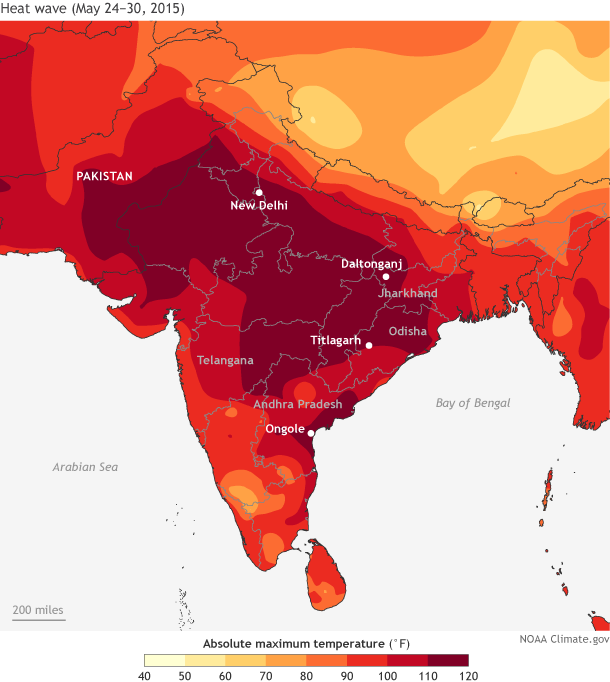
- Heat waves can occur anywhere. China, America, Europe and India have all been stricken recently.
- In India Heat waves typically occur from March to June, and in some rare cases, even extend till July.
- On an average, five-six heat wave events occur every year over the northern parts of the country.
- Heat waves generally occur over plains of northwest India, Central, East and north Peninsular India.
- It covers Punjab, Haryana, Delhi, Uttar Pradesh, Bihar, Jharkhand, West Bengal, Odisha, Madhya Pradesh, Rajasthan, Gujarat, parts of Maharashtra and Karnataka, Andhra Pradesh and Telangana.
- Sometimes it occurs over Tamil Nadu and Kerala also.
Management
- Understanding disaster risk.
- Strengthening disaster risk governance to manage disaster risk.
- Investing in disaster risk reduction for resilience.
- Enhancing disaster preparedness for effective response and to “Build Back Better.”
NDMA Guidelines
- Identification of vulnerable group, heat wave related illnesses.
- Establish Early Warning System and communication system.
- Developing inter-agency response plan and coordination in field.
- Local level preparedness for health eventualities.
- Capacity building / training programme for health care professionals.
- Public Awareness and community outreach.
- Collaboration with non government and civil society.
- Assessing the impact- feedback.
- Cool Roofs to provide affordable thermal comfort.
15.2 Cold Wave
Introduction
- A cold wave, sometimes known as a cold snap or deep freeze, is a weather event involving a cooling of the air, or the invasion of very cold air, over a large area.
- It is a rapid fall in temperature within a 24-hour period requiring substantially increased protection to agriculture, industry, commerce, and social activities.
- The precise criteria for a cold wave are the rate at which the temperature falls, and the minimum to which it falls.
- This minimum temperature is dependent on the geographical region and time of year.
- They can be preceded or accompanied by significant winter weather events, such as blizzards or ice storms.
- They can feel even colder during periods of high winds.
- According to the IMD, a severe cold wave is air temperature that can become "lethal to the human body when exposed.”
Criteria for cold wave in India
As per the India Meteorological Department’s criteria
- Cold Wave is considered when the minimum temperature of a station is 100C or less for plains and 0°C or less for hilly regions.
- Based on Departure
- Cold Wave (CW): Negative Departure from normal is 4.5°C to 6.4°C
- Severe Cold Wave (SCW): Negative Departure from normal is more than 6.4°C
- Based on Actual Minimum Temperature (For plain stations only)
- Cold Wave: When the minimum temperature is ≤ 04°C
- Severe Cold Wave: When the minimum temperature is ≤ 02°C
- Cold Wave conditions for coastal stations - When minimum temperature departure is -4.5°C or less over a station, “Cold Wave” may be described if the minimum temperature is 150C or less.
Cause
- Pressure differences.
- Clear sky.
- La-Nina.
- Non-Seasonal rainfall.
Formation
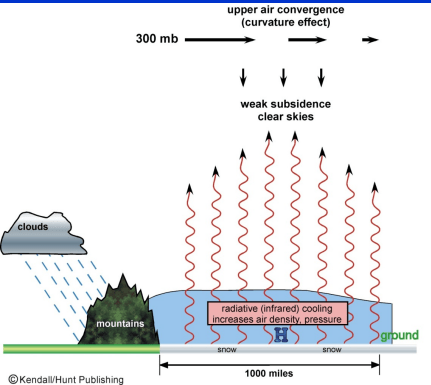
- The cold wave forms when cold air masses near the surface moves out from its source region in northern Canada and northern Asia.
- The core of a cold wave at the surface consists of a strong high-pressure center that forms during winter in the higher latitudes.
- The high pressure is associated with slow-moving winds.
- When these cold air masses get accumulated in any region there is a rapid fall in the temperature within 24 hours and the cold wave is formed.
Effect
- Increased power and fuel demand.
- Increase mortality among human and wildlife.
- Failure of transportation system.
- Risk of Hypothermia and frostbite.
- Crop failure and Famines.
- Water supply issue due to frozen pipelines.
- affects livelihood and economy of small vendor.
- Boost tourism.
Distribution
- Source region of Cold wave in northern hemisphere is in northern Canada and northern Asia.
- Anthropogenic global warming may lead to a decrease in the global occurrence of cold waves.
- During the cold-weather season (November to March), many stations from north, northwest, east and central India together named as Core Cold Wave Zone (CCZ) experienced the highest number of cold wave/severe cold wave with relatively higher frequency during December-January.
- The maximum numbers of cold waves occur in Jammu and Kashmir followed by Himachal Pradesh, Punjab, Bihar, Haryana and Uttar Pradesh.
Management
- Government Engagement.
- Vulnerability Assessment and Mapping.
- Drafting and Developing the Cold Wave Action Plan.
- Team Preparation and Coordination.
- Implementation and Monitoring.
- Strategies for Reducing Cold Wave exposure and adapting to Climate Change.
NDMA Guidelines
- Identification of cold wave risk and vulnerability assessment;
- Establish qualitative early warning, forecasting and alerts dissemination;
- Develop inter-agency coordination at different levels;
- Preparedness at the local level health care ;
- Structural & non-structural measures including cold wave related programmes/schemes;
- Public awareness and community outreach;
- Capacity building and training programmes;
- Collaboration with private, non-government organisations and civil society;
- Research & development; and
- Assessing the impact – feedback for reviewing and updating the plan.
Mitigation Measures
- Agriculture Sector: Thermal insulation, Air mixing by running fans in orchards, creating an air blanket of smoke particularly in orchards, Sprinkler irrigation to release latent heat of fusion, Cultivation of cold/frost resistant plants/crops/ varieties, Mixed cropping etc.
- Health Sector: Develop a standard cold wave Treatment Protocol, awareness campaigns, Ensure adequate arrangements of staff, beds, essential medicines and equipment, All cases of cold-related illnesses (suspected or confirmed) should be reported to IDSP etc.
- Animal Husbandry: Improving livestock feeding practice and dietary additives, Use of high-quality forage or pastures, Covering the animals especially smaller ruminants during cold days, Construction of climate-smart sheds
- Homeless and Urban Poor: put up shelters at a strategic potential location for meeting the requirement of shelter-less, make additional arrangements during the winter season under “Winter Action Plan”, Collaborate with different Departments / Agencies to deal with cold wave.
15.3 Wildfire
Introduction
- Wildfire, also called wildland fire, is uncontrolled fire in a forest, grassland, brushland, or land sown to crops.
- The terms forest fire, brush fire, etc., may be used to describe specific types of wildfires.
- Wildfires are distinct from beneficial human usage of wildland fire, called controlled burning, although controlled burns can turn into wildfires.
Causes
- Irresponsible human activities such as unattended campfires, smoking, fireworks etc
- Climatic conditions such as extreme drought, climate change
- Natural reasons such as lightning, volcanic eruption, sparks from rock falls, spontaneous combustion etc
- Fire danger in a wildland setting varies with weather conditions: drought, heat, and wind participate in drying out the timber or other fuel, making it easier to ignite.
- Once a fire is burning, drought, heat, and wind all increase its intensity.
- Topography also affects wildfire, which spreads quickly uphill and slowly downhill.
- Dried grass, leaves, and light branches are considered flash fuels.
- They ignite readily, and fire spreads quickly in them, often generating enough heat to ignite heavier fuels such as tree stumps, heavy limbs, and the organic matter of the forest floor.
Effect
Primary Impact:
- Disrupt transportation, communications, power and gas services, and water supply.
- Deterioration of the air quality.
- loss of property, crops, resources, animals and people.
- Direct health impacts of smoke and fire,
- Contamination of water and soil.
Secondary Impact:
- Increased demands on utilities to prevent power transmission equipment from becoming ignition sources.
- The cancelation or nonrenewal of homeowners insurance for residents living in wildfire-prone areas.
- Psychological impact.
Management
- Prevention - Increasing resilience.
- Detection - Fire detection and alerts.
- Suppression - Trainings, Forest fire equipment.
- Restoration - Assessment of losses, Post fire management.
NDMA guidelines
Prevention
- Maintenance and creation of new fire lines/ fire breaks.
- Management of weeds.
- Silvicultural practices like Thinning, salvage felling.
- Prescribed/ control burning/ Fire risk zonation and resource allocation.
- Soil and Moisture Conservation.
- Awareness raising , capacity building of local people.
- Conversion of dry biomass into energy like pine needles to briquettes.
Detection
- Fire watch tower.
- Early warning.
- Involvement of local people for ground based detection.
- Regular patrolling.
Suppression
- Fire fighting tools.
- Involvement of JFMCs, EDCs, BMCs, WMCs,
- Best practices on forest fire management.
- Liaison with local people.
- Involvement of Distt. Administration.
- Deployment of NDRF.
Post Fire
- Damage assessment.
- Soil and Moisture conservation.
- Plantation of native fire-hardy species.
- Plantation of broad leaved species, shrub species of NTFP importance.