
PRINCIPLE OF ECOLOGY | ENVIRONMENTAL GEOGRAPHY Optional for UPSC
PRINCIPLE OF ECOLOGY | ENVIRONMENTAL GEOGRAPHY Optional for UPSC

Please refer to GS notes. Here is advanced content:
Introduction
- Ecology is the scientific study of the relationship and interactions between organisms and their environment.
Practice Questions
- “The web of life is seamless and the consequences of disruption to one part of the ecosystem ripple throughout the whole.” Elaborate. (UPSC, 19/15).
- How is 'Deep Ecology' as a concept different from 'Shallow Ecology’? Explain. UPSC 2023, 10 Marks.
- "In nature, nothing exists alone." Discuss the interconnectedness of ecosystems and the significance of biodiversity in maintaining ecological balance.
- "The web of life both cradles us and calls us to weave it further." How does the principle of ecology emphasize the importance of biodiversity and ecosystem sustainability?
- "The Earth does not belong to us: we belong to the Earth." - Marlee Matlin. Analyze this statement in the context of deep ecology principles. How does deep ecology differ from shallow ecology, and what are the key principles guiding deep ecological thinking?
- "We live on a planet earth whose resources are finite." Analyze the significance of this principle in the context of sustainable development and resource management. How can the principles of ecology guide policymakers in addressing issues such as resource depletion, pollution, and habitat destruction?
- "The seamless web of life." Elaborate on this concept and its implications for understanding biodiversity, ecological interactions, and the functioning of ecosystems. How does recognizing the interconnectedness of life forms guide conservation efforts and sustainable use of natural resources?
Thinkers Perspectives and Definitions
- According to Webster’s dictionary, “ecology is the totality or patterns of relations between organisms and their environment”.
- For E. Hackel, “It is the science of relation between organisms and their environment”.
- Taylor defined ecology as “the science of all the relations of all the organisms in relation to all the environments”.
- According to the United States Council on Environmental Quality, “ecology is the science of the intricate web of relationships between living organisms and their non-living surroundings”.
- According to Woodbury (1954), “Ecology is a science which investigates organisms in relation to their environment’.
- E.P. Odum (1969) defined ecology as “the study of structure and function of nature”.
- R Margalef (1968) treated ecology as “study of ecosystems”.
Development of the concept
The development of ecology may be divided into four phases:
- Phase One (period upto First World War): It was dominated by the attempts to define ecology influenced by Darwinian concepts of evolution of species.
- Phase Two (inter-war period): It was characterised by development of scientific methodologies based on laboratory analysis, pollen analysis, application of statistical techniques etc.
- Phase Three (from Second World War to 1960): It was characterised by the introduction of system analysis in ecological studies.
- Phase Four or Modern Phase (since 1960): It is characterised by diversification and specialization of themes of ecology. “Emergence of applied ecology envisaged the role of ecology in nature conservation and environmental management. The concept of niche theory, the ecosystem energy flow, material recycling, tolerance limits and successional change are employed in different planning contexts.” – C.C. Park, 1980.
- The concept of ecology now has been extended from single phenomenon (plant ecology, animal ecology) to set of phenomena occupying a definite space in the biosphere at a definite time interval.
Scope and Objectives
The scope of ecology has been extended from the scientific study of mutual relationships of biotic and abiotic components to the environmental problems in terms of environmental degradation and ecological crises. The present scope and aspects of ecology are very wide:
- The local and geographical distribution and abundance of organisms (habitat niche, community, bio-geography).
- Temporal changes in the occurrence, abundance and activities of organisms (seasonal, annual, successional, geological).
- The inter-relationship between organism in population and communities (population ecology).
- The structural adaptations and functional adjustment of organisms to their physical environment. (adaptation)
- The behaviour of organism under natural conditions (ethology).
- The evolutionary development of all these inter-relations (evolutionary ecology).
- The biological productivity of nature and its relations with mankind.
- The development of mathematical models to relate interaction of parameters and predict effects (systems analysis).
- The conservation and management of natural resources and pollution (applied ecology).
Fundamental Principles of Ecology
Content from GS Environment: Fundamental Principles of Ecology
1. Ecosystem is fundamental unit of study the ecology.
2. Uniformitarianism: The same processes acting today, were active throughout the history.
3. All living organisms and physical environment are mutually reactive.
4. Geochemical cycle circulates matter in biosphere
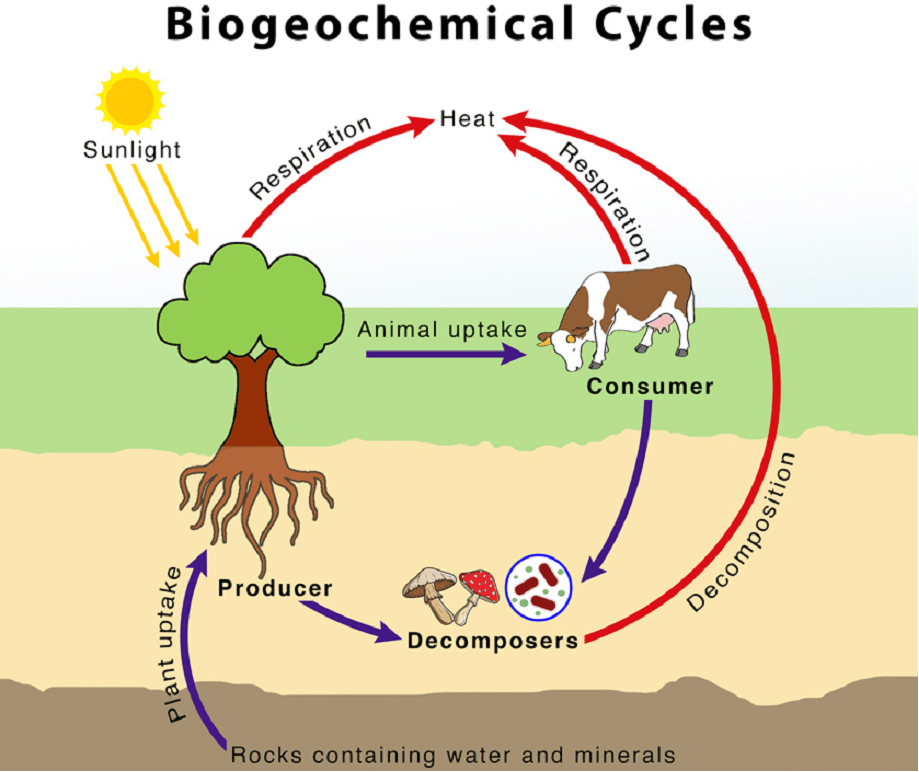
5. There is unidirectional & non-cyclic energy flow via input of solar radiation.
- Law 1: Energy is neither created nor destroyed.
- Law 2: When work is done, energy transfers from one form to another.
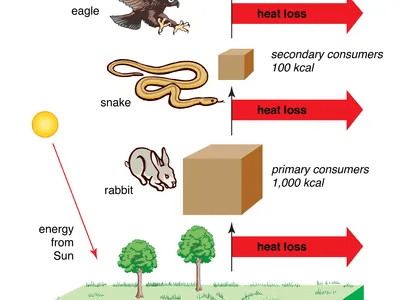
6. Loss of energy at every trophic level.
- Lindemann’s Law of 10 percent, 1942: Only 10% of energy in a food chain out of the total energy is transferred from one trophic level to another. The rest of the energy is utilized for other metabolic processes and some is released as heat.


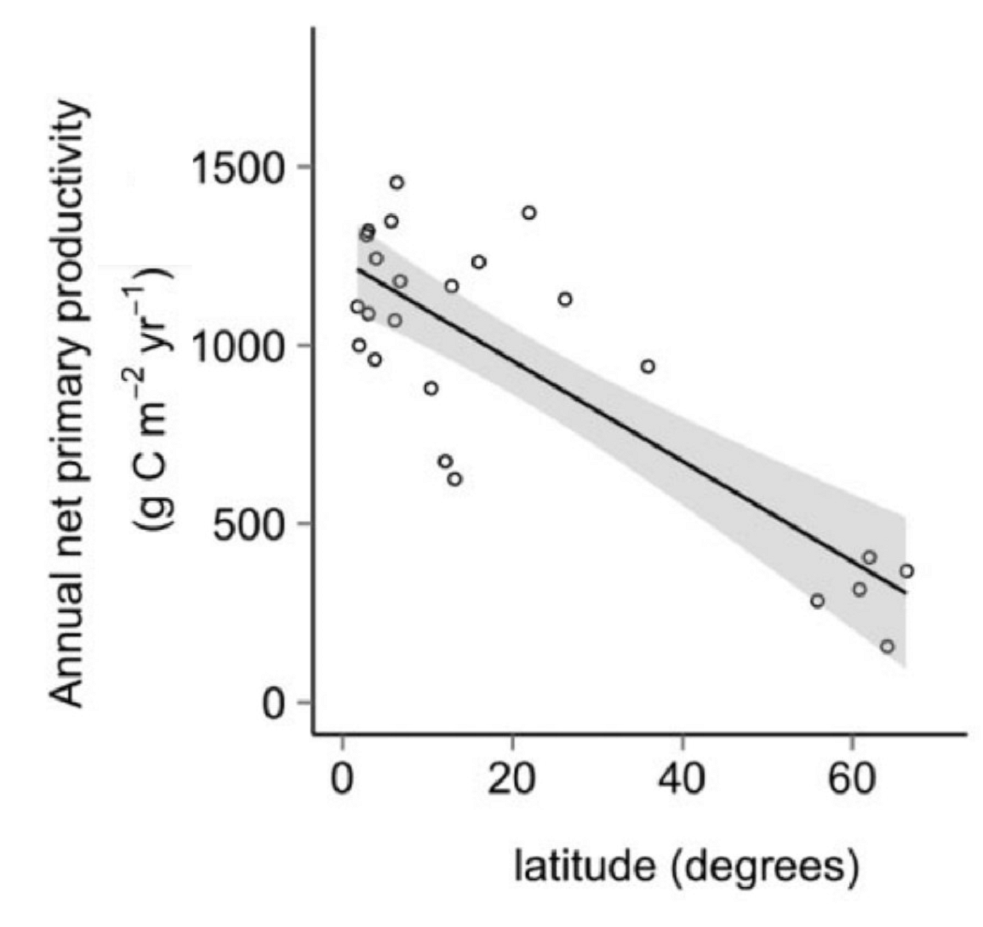
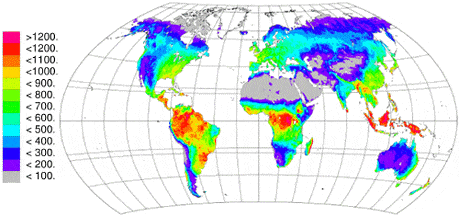
7. Productivity (rate of growth of organic matter by autotrophs) decreases from Equator to poles.
8. Homeostasis mechanism is followed to counterbalance any changes and to bring the equilibrium.


9. Ecological succession: A community develops through a number of stages, from bare area to a stabilized climax. These stages of transition are known as seres.
10. Evolution of species: two theories
- Charles Darwin: Natural selection and adaptation, Survival of the Fittest.
- D. Vries: Theory of spontaneous change.
11. Ecosystem Modifies itself
- It undergoes succession to achieve the climax.
- If unable to adjust with change, ecosystem becomes unstable.
- The Man also alters it.
12. Components of ecosystem
- Biotic: livings e.g., Humans, animals, plants.
- Abiotic: Non- living.
Some More Fundamental Principles of Ecology for Geography Optional
- Ecosystem is a fundamental unit of ecological study, because it comprises both biotic and abiotic components. Ecosystem is a monistic concept, as it brings physical environment, plants and animals together in a single framework.
- At the largest scale, the whole biosphere becomes an ecosystem.
- R.L. Lindeman (1942) has formulated four principles about the relationships between trophic levels within a natural ecosystem.
- Principle I: Organisms at trophic level three and beyond tend to be 'generalists' rather than 'specialists' in terms of their feeding habit.
- Principle II: The relative loss of energy due to respiration is progressively greater to higher trophic levels.
- Principle III: Species at progressively higher trophic levels appear to be more efficient in using their available food supply.
- Principle IV: Higher trophic levels tend to be less discrete than the lower ones.
- Principle V: Food chains tend to be reasonably short.
- M.J. Holliman (1974) has formulated the four ‘environmental principles’
- (a) Nothing actually disappears when we throw it away.
- (b) All systems and problems are ultimately if not intimately inter-related.
- (c) We live on a planet earth whose resources are finite.
- (d) Nature has spent literally millions of years refining a stable ecosystem.
- 'Reproductive isolation' is another aspect of evolution of morphologically differentiated populations of species.
- F.E Clements (1916) has identified two basic forms of succession:
- Primary succession: It refers to developmental sequence of vegetation in those areas, where there was no vegetation earlier.
- Secondary Succession: It is the developmental sequence of vegetation in those areas, which had vegetation cover earlier, but now have been rendered nude due to destruction of vegetation.
Sub-Division of Ecology
Sub-division on the Basis of Levels of Organisation
Two main sub-divisions of ecology are:
- Autecology: It studies an individual organism. It includes its life history and behaviour as a means of adaptation to the environment.
- Synecology: It is concerned with the study of a group of organisms which form a unit.
- Synecology is further sub-divided in the following:
- Population ecology : also known as demonology. It deals with the study of the pattern of growth, structure and regulation of population organism.
- Community ecology : It deals with the study of the local distribution of animals in various habitats.
- Ecosystem ecology: It deals with the ecological study of the process of soil formation, energy flow, productivity etc.

Sub-division Based on Taxonomic Affinities
- Plant ecology: It studies the distribution and abundance of plants, the effects of environmental factors, and the interactions among and between plants and other organisms.
- Animal ecology: It studies the relationships of individuals to their environments. It includes physical factors and other organisms, and the consequences of these relationships for evolution, population growth and regulation, interactions between species, the composition of biological communities, and energy flow and nutrient cycling etc.
Sub-divisions on the Basis of Habitat
- This approach of ecological study led to the development of 'habitat ecology'.
- Examples: Forest ecology, grassland ecology, freshwater ecology, estuarine ecology, island ecology, marine ecology, coral reef ecology etc.
Deep Ecology and Shallow Ecology
Introduction:
- Deep ecology, visualised by thinkers like Arne Naess, emphasizes the interconnectedness and intrinsic value of all living beings, promoting a holistic view that prioritizes the well-being of ecosystems over individual species.
- In contrast, shallow ecology, associated with thinkers like Garrett Hardin, tends to focus on human-centered solutions to environmental issues without addressing deeper ethical and philosophical questions.
Differences between Deep Ecology and Shallow Ecology:
| Aspect | Deep Ecology | Shallow Ecology |
|---|---|---|
| Perspective | Ecocentric | Anthropocentric |
| Approach | Holistic: recognizes the complex and interdependent nature of ecosystems, considering the entire ecological system as a whole. | Reductionist: focusing on individual components or issues within the ecosystem. |
| Core Principle | Focuses on intrinsic value of nature | Emphasizes human-centered environmentalism |
| Relationship with Nature | Views humans as one part of a larger ecosystem | Views humans as separate from nature, superior |
| Ethical Stance | Advocates for non-interference in ecosystems | Supports conservation for human benefit |
| Interconnectedness | Considers interconnectedness of all life forms | Focuses on specific environmental issues |
| Environmental Goals | Seeks to promote biodiversity and ecosystem health | Aims for resource conservation and sustainable use |
| Philosophical Basis | Rooted in spiritual and philosophical ideologies | Grounded in scientific and pragmatic approaches |
| Goal | Calls for a paradigm shift in human thinking | Seeks incremental changes within the system |
| Time Horizon | Long-term perspective | Short-term focus |
Case Studies:
- Chipko Movement: A grassroots environmental movement in Uttarakhand, India, where local communities protested against deforestation and commercial logging.
- Great Barrier Reef: The conservation of the Great Barrier Reef in Australia, a UNESCO World Heritage site, threatened by climate change, pollution, and coral bleaching.
- Serengeti National Park: The management and protection of the Serengeti ecosystem in Tanzania, known for its annual wildebeest migration, facing challenges from poaching and habitat loss.
Conclusion:
- The contrast between deep ecology and shallow ecology reflects broader debates within environmentalism about the nature of human-nature relationships and the appropriate strategies for addressing environmental challenges.
- Ultimately, the choice between these approaches shapes not only environmental policies but also the fundamental ethos guiding our interactions with the natural world.
Associated terms
Niche
Please refer to the GS content for Niche. Here is some content for advanced level for optional:
- Niche is defined as ‘the functional role and position (micro-habitat) of species in its ecosystem. – W.P. and M.A. Cunnigham, 2003
Types:
- Ecological niche is a central concept in the ecology of organisms. It is sub-divided into the fundamental and the realized niche.
- The fundamental niche is the set of environmental conditions under which a species is able to persist.
- The realized niche is the set of environmental plus ecological conditions under which a species persists.
Factors Affecting Niche:
- According to S.A. Whittaker, and R.B. Root (1973) ecological niche are affected by 3 types of variables.
- Habitat variables: These include physical factors such as relief, slope, soil moisture, soil fertility etc.
- Niche variables: These include height of the location above ground surface, relationship to intracommunity pattern, seasonal and diurnal time, number and size of prey, and ratio between number of animals and plant food etc.
- Population response variables: These include population density, coverage of species, frequency of feeding, success of reproduction, fitness of animals etc.
Habitat
Please refer to GS notes. Here is advanced content:
- Competitive Exclusion Principle: “No two species will occupy the same niche and compete for exactly the same resources in the same habitat for very long.” – Cunnigham and Cunnigham, 2003.
- The habitat plus the niche is called the Ecotope. It is defined as the full range of environmental and biological variables affecting an entire species.
Niche construction (Ecosystem Engineering)
- Niche construction is the process by which an organism alters the local environment.
- Its examples include the building of nests and burrows by animals, and the creation of shade, influencing of wind speed, and alternation of nutrient cycling by plants.
- The term "niche construction" is more often used as feedback mechanisms of natural selection.
- There is an emergent homeostasis or homeorhesis in the structure of the nest that regulates, maintains and defends the physiology of the entire colony.
- Termite mounds maintain a constant internal temperature through the design of air-conditioning chimneys.
- The concept of ecosystem engineering is related to niche construction, but the former relates only to the physical modifications of the habitat, whereas the latter also considers the evolutionary aspects and the process of natural selection.
Examples
- Earthworms physically and chemically modify the soil in which they live.
- Lemon ants employ a specialized method of suppression that regulates the growth of certain trees.
- Beavers build dams and thereby create lakes that drastically shape and alter riparian ecosystems.
- Benthic diatoms living in estuarine sediments in the Bay of Fundy secrete carbohydrate exudates. It binds the sand and stabilize the environment. It allows other organisms to colonize the area.
- Chaparrals and pines increase the frequency of forest fire through the dispersal of needles, seeds and oils. The benefit of this activity is facilitated by an adaptation for fire resistance.
- Saccharomyces cerevisiae yeast creates a novel environment out of fermenting fruit. This fermentation process attracts fruit flies that is closely associated with it, and utilizes for transportation.
- Cyanobacteria provide an example on a planetary scale through the production of oxygen as a waste product of photosynthesis. This dramatically changed the composition of the Earth’s atmosphere and oceans.
- Microbialites represent ancient niches constructed by bacterial communities which give evidence that niche construction was present on early life forms.